
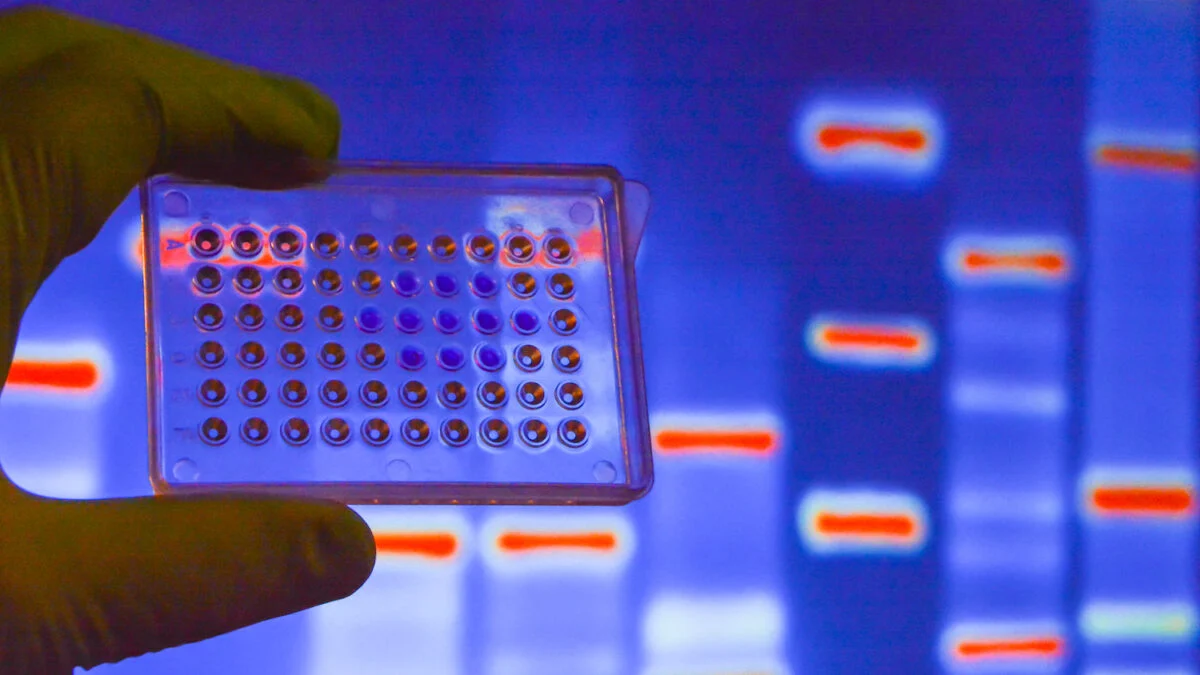
The particularity of this method? It does not require DNA sequencing. In a few days, a chip analyzes the chemical modifications present on small fragments of tumor DNA circulating in the blood. The first results are promising.
When a scanner leaves a question unanswered
Sometimes it all starts with an image. A chest CT scan reveals a nodule on a lung. It is small, perhaps difficult to interpret. Is it benign? Is it cancer? For the patient, waiting for the answer can be particularly trying.
Today, the scanner constitutes an essential tool for early detection of lung cancer. But it has an important limitation: many suspicious nodules ultimately turn out to be non-cancerous. To remove doubt, doctors can then resort to a biopsy, or even surgery.
It is precisely in this space of uncertainty that researchers at Tel Aviv University are looking for another path: using blood as a sort of biological “mirror” of the tumor.
Their method relies on circulating free DNA, small fragments of DNA that circulate naturally in the blood. Among them may be fragments from tumor cells.
A chip to identify the chemical “signature” of cancer
The technology developed by Professor Yuval Ebenstein’s team does not seek to read the patient’s entire genetic heritage. She is interested in a particular chemical modification of DNA: methylation.
This modification plays a role in regulating gene activity. However, in cancer cells, certain methylation profiles are profoundly modified. They can thus constitute a true biological fingerprint of the tumor.
Concretely, researchers extract circulating free DNA from a blood sample, then use a fluorescent marker to identify the methylated regions. The fragments are then deposited on a DNA chip designed to analyze 170 genomic regions particularly interesting in lung cancer. An optical scanner then reads the light patterns obtained. The computer model can thus recognize the characteristic signature associated with cancer.
The interest is major: unlike liquid biopsies based on sequencing, this approach does not require decoding all of the DNA. According to the researchers, the test can currently be carried out in two to three daysfor approximately 60 dollars per sampleor around 55 euros.
“Our goal is to make blood tests for cancer diagnosis more accessible, simpler and less expensive without sacrificing accuracy. We have developed a new approach that does not require genetic sequencing but identifies the chemical fingerprint of the tumor using light, with technology that can be implemented in standard clinical laboratories“, explains Professor Yuval Ebenstein, from Tel Aviv University.
More than 90% accuracy: encouraging figures, but to be confirmed
To test their method, the researchers worked with
103 participants: 51 people with lung cancer and 52 healthy controls.
After a first phase intended to train their model, it was evaluated on a separate group, as part of a blind analysis. For stage 2 to 4 lung cancers, the test achieved sensitivity of 93.1% and one
specificity of 90.3%.
In short, sensitivity indicates that the test correctly identified the vast majority of people with cancer in the sample studied. Specificity measures one’s ability to recognize people who do not have it.
The researchers also observed that their molecular signature made it possible to distinguish two main types of lung cancer: adenocarcinoma and squamous cell carcinomaeach exhibiting different DNA signatures.
These results should, however, be interpreted with caution. The study is a proof of conceptcarried out on a limited staff. Above all, the controls were in good health. However, in real life, the difficulty is precisely to distinguish cancer from a benign nodule or another lung disease.
In other words, this test is not yet able to replace the scanner, nor to constitute generalized screening for lung cancer.
What if the blood test also made it possible to follow the treatment?
The Israeli team, however, sees another possibility, particularly interesting for patients already diagnosed.
In the people followed in the study, the researchers found that the chemical signature of circulating DNA changed in parallel with the response to treatment. In patients whose disease responded to treatments, this imprint gradually approached that observed in healthy people. In patients not responding to treatment, no significant changes were observed.
A still preliminary observation, which will need to be confirmed by much larger studies. But it draws a perspective: that of a blood test capable, in the long term, of complementing imaging to more easily follow the evolution of a disease and the effectiveness of a treatment.
For Professor Ebenstein, this perspective already constitutes an important step: “This is an important step toward a tool that can complement imaging tests and help doctors diagnose lung cancer and monitor the effectiveness of treatments.”.
For patients, the issue therefore goes beyond just the performance of a new technology. It is also, potentially, a matter of reducing the uncertainty that accompanies a suspicious image, of avoiding certain invasive procedures and, perhaps tomorrow, of following the evolution of a cancer using a sample as simple as a blood test.