
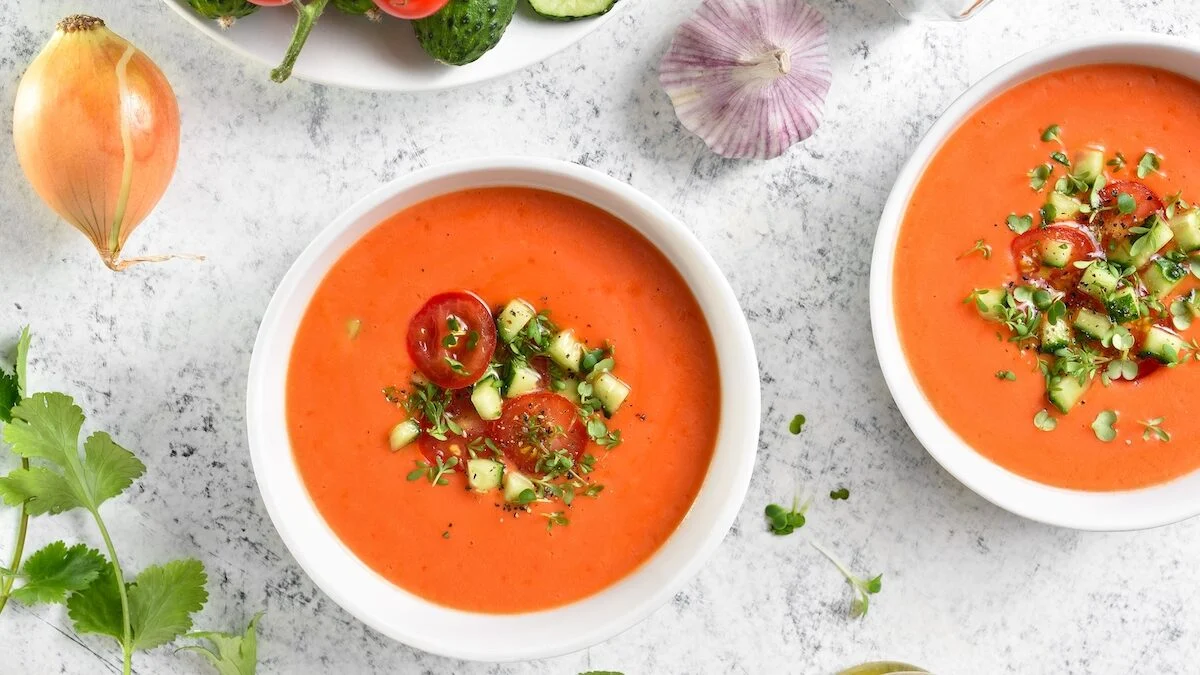
When it’s hot, no one necessarily wants to turn on the oven or spend an hour behind the stove. Between picnics, quick lunches and heatwave days, cold soups like gazpacho can be a practical solution for eating while cooling off at the end of summer.
And in the fresh sections of supermarkets, one gazpacho particularly stands out: Alvalle Original gazpacho, which displays both a Nutri-Score A and a rating of 100/100 on Yuka.
So what’s special about it? And above all, is it really a good option when temperatures rise?
Why gazpacho is interesting when it’s hot
Before even talking about its composition, gazpacho has an obvious advantage during periods of high heat: it contains a lot of water.
“Cold soups are a great option when it’s very hot”explains dietician-nutritionist Alexandra Murcier. “They are rich in water and therefore contribute to hydration. The vegetables they contain are themselves very rich in water, but also in vitamins and minerals.”
A significant benefit during a heatwave, since perspiration leads to water but also mineral losses.
Gazpacho therefore allows you to contribute to the day’s water intake while consuming vegetables.
Alvalle Original gazpacho: what does it contain?
The product concerned is Alvalle Original gazpacho, sold in the fresh section.
According to information provided by the brand, its recipe contains 94% vegetables, mainly tomatoes, red pepper, cucumber and onion. There is also extra virgin olive oil, vinegar, salt, garlic and lemon juice.
For 100 ml, the product provides approximately 42 kcal and 0.62 g of salt.
Its composition partly explains its Nutri-Score A, which evaluates the overall nutritional quality of a food according to an official algorithm.
Why does Yuka give it 100/100?
The Nutri-Score and the Yuka score do not measure exactly the same thing.
Yuka assigns its score taking into account several criteria: 60% for nutritional quality, 30% for additives and 10% for the biological dimension.
In the case of Alvalle Original gazpacho, the application therefore gives it the maximum score. Its relatively short recipe and the absence of additives considered to present a significant risk according to Yuka criteria contribute in particular to this evaluation.
But be careful: 100/100 on Yuka does not mean that the product is “perfect” or that it is better than all homemade gazpachos. This is a mark awarded according to the method specific to the application.
Likewise, Nutri-Score A does not mean that you should consume this product as much as you want. Above all, it makes it easier to compare the nutritional quality of products belonging to the same category.
Gazpacho and heatwave: another advantage thanks to vegetables
Gazpacho doesn’t just provide water. The vegetables it contains also provide different micronutrients and antioxidant compounds.
“Cold soups also provide valuable antioxidants, capable of helping the body fight against oxidative stress accentuated by high temperatures.
underlines Alexandra Murcier.
The composition of the gazpacho plays an important role here. “Depending on the ingredients chosen, we benefit, for example, from the lycopene of tomatoes or the vitamin C contained in peppers,” specifies the nutritionist.
Another good argument for varying the vegetables consumed during the summer.
How to choose a good gazpacho at the supermarket?
You do not necessarily need to purchase this specific reference. To choose an interesting gazpacho in the fresh section, a few reflexes can help you.
First look at the ingredient list. The simpler and more heavily composed of vegetables, the better. Also check the amount of salt, which can quickly increase in some prepared soups.
The Nutri-Score can then be used as a benchmark to compare several similar products.
Finally, if you use Yuka, remember to scan directly the product you plan to purchase: recipes may change and two gazpachos with similar names may have different compositions.
What to accompany a gazpacho to make it a real meal?
A bowl of gazpacho can be a very refreshing starter, but on its own it doesn’t necessarily constitute a complete meal.
For lunch or dinner, you can accompany it with a source of protein, for example eggs, fish, chicken or legumes, as well as a starch depending on your hunger: wholemeal bread, potatoes, cereals, etc.
Some raw vegetables or a salad can also complete the meal.
And during heatwaves, remember to drink water regularly: a gazpacho can contribute to fluid intake, but it does not replace water as your main drink.