
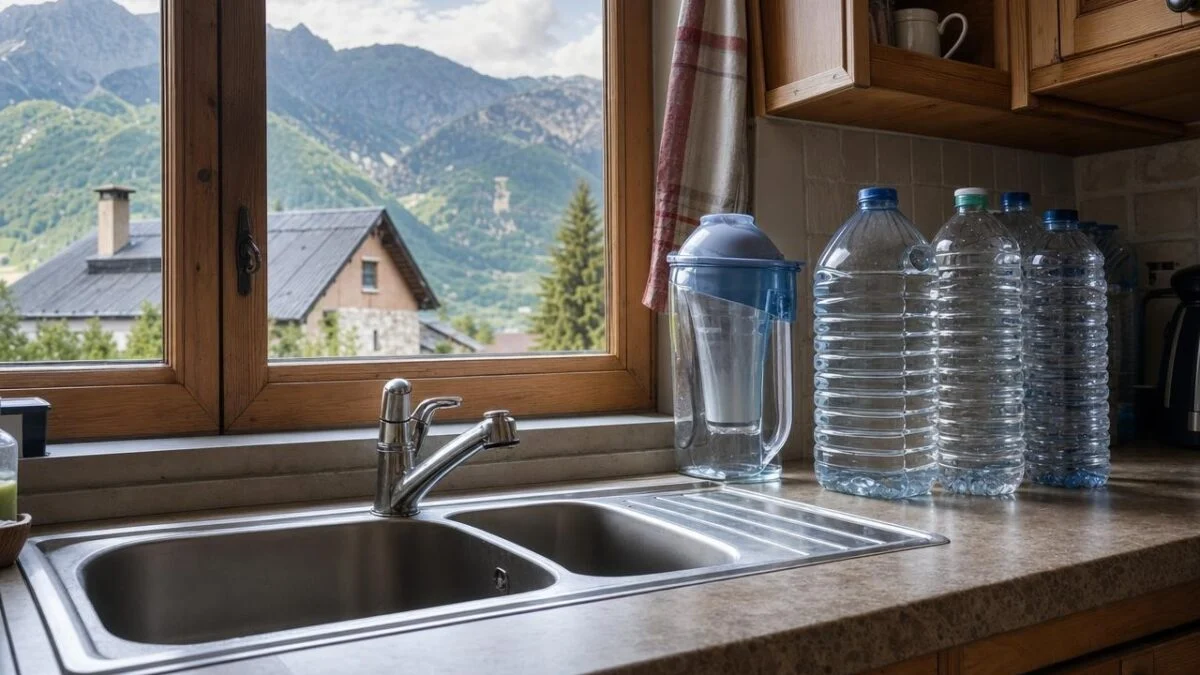
Since the start of summer 2026, nearly 1,760 inhabitants of a valley of Savoy had to change a simple everyday gesture: turning on the tap to drink or cook. In question, analyzes made obligatory by a new European standard which reveal an exceeding of the threshold ofnatural uranium
in drinking water, noted by the Auvergne-Rhône-Alpes Regional Health Agency.
The municipalities of The Chapel, Les Chavannes-en-Maurienne And The Roomin the valley of Maurienneare directly concerned. According to the Auvergne-Rhône-Alpes Regional Health Agency (ARS), exceedances of the regulatory threshold of 30 micrograms per liter of uranium have been reported since the end of June 2026, with a record in La Chapelle at 72.80 micrograms per liter, more than twice the limit. The Chamber has already found a solution, but La Chapelle and Les Chavannes remain subject to a strict ban on the consumption oftap water.
What does the ban on tap water change in La Chapelle, Les Chavannes and La Chambre?
For La Chambre, the water union disconnected the contaminated catchment on July 21 and interconnected it to another resource. The 1,200 residents are once again supplied with compliant water, specifies the ARS. In Chavannes and La Chapelle, each mayor has issued a municipal decree: water must no longer be used for drinking, preparing or cooking food, even for coffee or baby bottles.
However, water remains authorized for washing, showering, washing dishes and laundry. In La Chapelle, the town hall distributes bottles three evenings a week, Monday to Friday from 6:30 p.m. to 8 p.m. “It’s quite a logistics for our town hall. We are a small town of 367 people“, explains Mayor Isabelle Quillet to ici.fr. “This represents a significant cost for our municipality, around 5000 euros for three weeks, we will have to find other solutions“.
Natural uranium and the 2026 European standard: why water is considered undrinkable
According to the ARS Auvergne-Rhône-Alpes, these exceedances do not reflect an industrial accident but the local geology. The Regional Health Agency emphasizes “that we are not faced with the sudden appearance of new pollution, nor a situation of acute intoxication. Uranium is naturally present in the subsoil of this sector. What is new is that its concentration as a chemical element is now one of the parameters sought in health control.“.
Since January 1, 2026, a European directive has required the dosage of chemical uranium in drinking water, with a limit set at 30 micrograms per liter. The World Health Organization has defined a lower reference value, at 15 micrograms per liter. The ARS now takes monthly samples from the catchments concerned in order to monitor the evolution of concentrations and their possible variation according to the seasons.
Risks for the kidneys and sustainable solutions under study in Maurienne
The ARS indicates that repeated and prolonged consumption of water too laden with uranium can disrupt kidney function, especially in infants, young children, pregnant or breastfeeding women, the elderly and those who already have kidney disease. The European Food Safety Authority considers the risk to be greatest to the kidneys and digestive tract for significant exposures. If you stop consuming non-compliant water, the impacts on health decrease.
 © ASNR
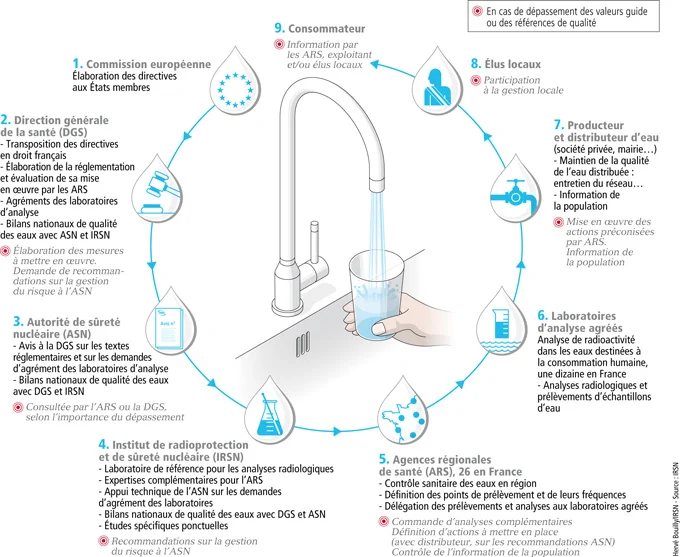
Radiological quality of drinking water: who does what?
To get out of this situation in the long term, the municipalities, the ARS, the State services and the network manager are studying several avenues: specific filtration of uranium, installation of a depollution unit or new connections between networks. The ARS also informed doctors at the La Chambre health center and the Vallée de Maurienne hospital center so that they could answer patients’ questions, while waiting for these technical solutions to be successful.