
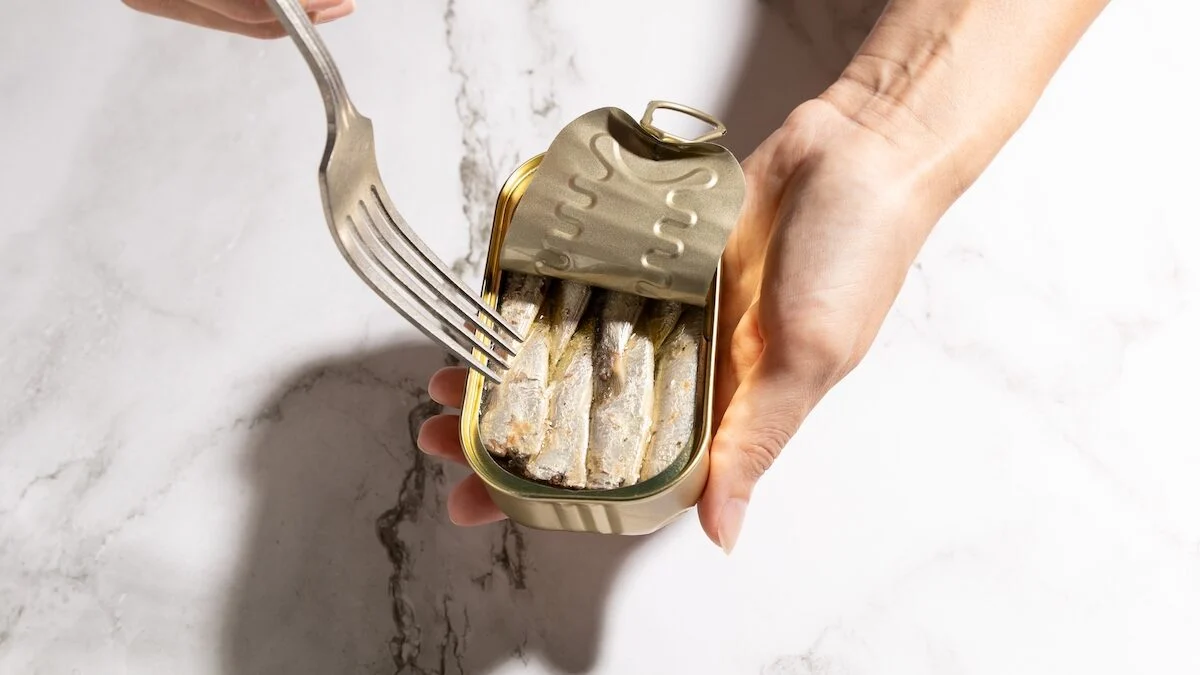
A hastily opened can of sardines, some toast, a salad… and suddenly, a doubt: should we remove the bones or can we eat them? These small, hard elements can seem unappetizing, or even dangerous for the throat. However, in canned foods, they no longer have much in common with the bones of a fresh fish.
And it’s not the only item that we tend to throw away: the oil that comes with sardines also often ends up in the sink. Wrong? Not necessarily. It all depends on its quality and how it was used.
Yes, the bones of canned sardines can be eaten
Unlike those of a fresh sardine, the bones of canned sardines are usually softened enough to eat.
Before arriving on your plate, the sardines are subjected to a heat treatment, called canning. This high temperature cooking, combined with the time spent in the can, gradually makes the edges much more crumbly. They can thus break easily under the fork and mix with the flesh.
For an adult who does not have any particular difficulty swallowing, it is therefore entirely possible to eat them. Their texture may be surprising, but they are not comparable to the rigid bones of fresh fish.
If their presence bothers you, there is no obligation to keep them. The central bone can be removed very easily before eating the sardine.
And these edges are particularly interesting for calcium
Eating them above all allows you to benefit from some of the minerals present in fish. The bones are in particular an interesting source of calcium and phosphorus, two important minerals for bones and teeth.
Quantities vary depending on the products and their method of preparation. The Anses Ciqual table indicates approximately 333 mg of calcium and 306 mg of phosphorus per 100 g of canned and drained sardines in oil.
However, bones should not be considered as a miraculous source of calcium: the diet as a whole remains decisive. But systematically removing them also means depriving yourself of an interesting part of the sardine’s minerals.
Not everyone should eat them
Although the edges are softened, they still remain small solid fragments. For some people, they can therefore pose a problem.
This is particularly the case for people who have swallowing problems, or dysphagia. This difficulty in swallowing can encourage faltering and requires adapting the texture of food.
The High Authority for Health estimates in particular that dysphagia affects 8 to 15% of elderly people living at home and 30 to 62% of those living in institutions.
In frail elderly people, young children or people being treated for a swallowing disorder, it is therefore better to err on the side of caution. The sardines can be crushed very finely with a fork or mixed to obtain a homogeneous preparation. There are also references sold without edges.
The principle is simple: a food can be perfectly edible without being adapted to all swallowing abilities.
Should you keep the oil from sardines?
But this dilemma brings to mind another when opening the box: the oil. By reflex, many drain it completely, or even throw it directly into the sink. However, it is not necessarily necessary to get rid of them completely.
“When it is a quality oil, especially olive oil, it helps preserve the nutrients of the fish and also provides good fatty acids”explains dietitian Julie Boët in a previous article.
The oil can therefore be reused in the meal, for example to season a salad, vegetables or accompany sardines. This also helps avoid wasting a food product unnecessarily.
But you have to look at what oil is actually in the box.
Olive oil, rapeseed… look what it says on the label
Not all canned sardines are equal on this point. Before choosing a reference, it is better to look at the list of ingredients and the type of oil used.
According to Julie Boët, the ideal is to favor a simple composition, a quality oil and a reasonable salt content.
The expert also recommends paying attention to the method of preparing sardines. “It is better to favor sardines prepared with gentle, slow or steam cooking, because too high temperatures can alter some of the omega-3 and vitamins.she specifies.
Be careful, however, not to conclude from this that the oil in the can is systematically more interesting than that of a bottle of oil used in cooking: it all depends on the product chosen and the quantity consumed.
Can you use all the oil in the can?
Yes, but it’s not necessarily necessary. If you like its taste and it is of good quality, you can keep some of it and add it directly to your recipe.
On the other hand, there is no need to combine the oil from the preserve with a generous quantity of additional oil in the same preparation.
“If you are already using the oil from the can in your dish, do not add more. This risks making the meal too rich and nutritionally unbalanced,”
reminds the dietician.
And if you simply don’t like this oil or if its quality doesn’t convince you, you can obviously drain the sardines. It is not necessary to consume it to benefit from the nutritional qualities of fish.
Canned sardines: the right reflex
In the end, bones and oil are not necessarily waste. The former provide calcium and phosphorus in particular when they are sufficiently softened by canning. The second can be used in the recipe when it is of good quality.
But the priority remains adaptation to the consumer: for a person having difficulty swallowing, the bones must be removed or the fish reduced to a suitable texture.
As for sardines themselves, they are one of the fatty fish recommended in a varied diet. ANSES recommends eating fish twice a week, including fatty fish.
So, the next time you open a can of sardines, there’s no need to systematically throw away everything that doesn’t look like flesh: instead look at what the can actually contains… and adapt its consumption to your needs.
Sources
- Marmiton
“Eating the bones of canned sardines is a good or bad idea”