
Published in Human Reproductionthis American study does not allow us to conclude that vanillin causes miscarriages or fertility problems. However, it reveals a precise biological mechanism which deserves to be studied, while the effects of many aromas inhaled during pregnancy remain poorly understood.
When pregnancy is just beginning, the cells are already at work
It’s an almost invisible period. Sometimes the pregnancy has just started and the future mother does not even know yet that she is expecting a child. However, in his body, the first embryonic cells already have a considerable mission: to multiply and gradually determine the tissues which will form the future baby.
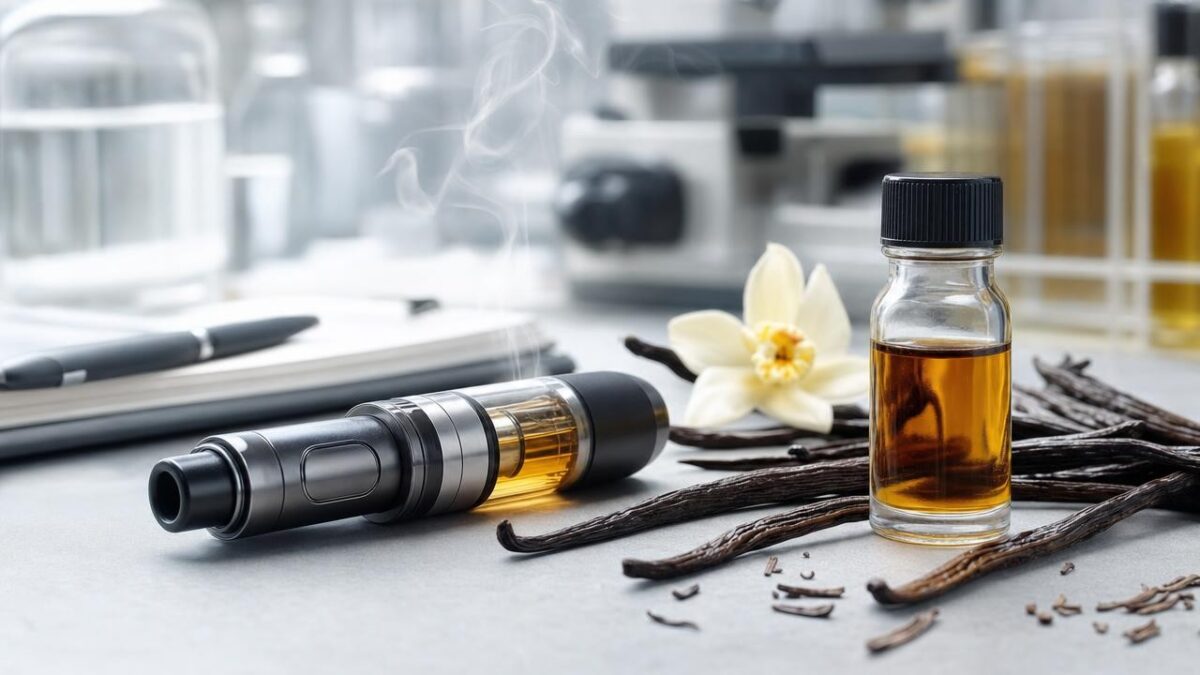
It is on these particularly early cells that researchers from the University of California at Riverside (UCR) decided to test the vanillinthe main compound giving vanilla its taste and smell. Widely used in electronic cigarette liquids, it can be present in significant concentrations.
““We focused on vanillin because it is frequently used in e-cigarette liquids, is often used in high concentrations, and because we knew that embryonic cells have a channel on their surface called TRPV4 that is likely to bind vanillin.”explains Professor Prue Talbot of the Department of Molecular, Cellular and Systems Biology at UCR, who led the study.
The hypothesis was therefore precise: what happens when a substance inhaled with an electronic cigarette meets the cells of an embryo at such an early stage?
The most surprising result appears at low concentration
The researchers exposed human embryonic stem cells to different concentrations of vanillin.
At high concentrations, in the micromolar range, the substance tended to kill cells. But at much lower nanomolar concentrations, the cells did not necessarily die. They changed trajectory.
In particular, they lost their pluripotency, that is to say their ability to give birth to different types of cells. More precisely, vanillin promoted their transformation into endodermis cells.
However, during normal development, embryonic cells must be able to form three large families of tissues: endoderm, ectoderm and mesoderm. The latter will notably participate in the formation of the digestive tract and the respiratory tract, but also of the nervous system and the muscles.
“Nanomolar concentrations caused a loss of pluripotency, that is to say the ability to develop into all cell types. Vanillin also caused stem cells to differentiate into endoderm, rather than ectoderm or mesoderm.”explains Professor Prue Talbot.
The researchers also identified the mechanism: vanillin binds to the TRPV4 channel present on the surface of cells. This interaction results in a rapid entry of calcium, which acts as a messenger and triggers a cascade of reactions modifying the behavior of the cells.
When scientists blocked TRPV4, the effect of vanillin disappeared. A result which reinforces the hypothesis of a specific biological mechanism.
But can we really transpose these results to a pregnant woman?
This is where caution is required. The researchers attempted to estimate the concentrations of vanillin likely to be reached in the body of a woman who vapes, taking into account in particular the quantity present in liquids and the number of puffs. Some theoretical concentrations were close to those used in the experiments.
But a cell immersed in a vanillin solution is not an embryo in the uterus.
“These results do not allow us to state with certainty that the same effects would be observed in women and their embryos.recognizes Professor Prue Talbot.
Several independent experts insist on this limit. Winston Morgan, toxicologist at the University of East London, believes that the researchers highlight “a potential danger rather than a quantifiable risk”. He emphasizes in particular that the embryo benefits from several biological barriers and mechanisms capable of reducing its actual exposure to the substance.
Same observation for Oliver Jones, professor of chemistry at RMIT University: “a group of cells in a Petri dish is not the same as a human embryo“.
What this study doesn’t say about miscarriages
The information may naturally worry a pregnant woman who vapes, or a woman who is trying to have a child. But a distinction is essential: this study demonstrates neither an increase in miscarriages nor a decrease in fertility in women.
Marian Knight, professor of maternal and child health at the University of Oxford, points out that it is ““It is not possible to generalize the results of this type of study to absolute risks of pregnancy, such as the risk of miscarriage.”
Benedikt Berninger, specialist in developmental neurobiology at King’s College London, also judges that the link with miscarriages remains very speculative. The model used is much simpler than a real embryo, whose cells evolve in a complex environment and subject to numerous control mechanisms.
So why take these results seriously? Because they provide new information on how an inhaled aroma could act on human embryonic cells. And because the prenatal period is one of the times when the body is particularly vulnerable to chemical substances.
Researchers are also calling for better information on the composition of vaping liquids.
“Women don’t necessarily know the chemicals in vaping products”estimates Professor Prue Talbot.
For Oliver Jones, the practical conclusion can remain simple despite the uncertainties: “Avoiding e-cigarettes and vaping while pregnant or trying to get pregnant is reasonable general advice.”
And for women who vaped before discovering their pregnancy, this study should definitely not become a new reason to feel guilty. It does not allow us to say that past exposure caused damage to their embryo.
Rather, it recalls a reality that is still too little known: behind a familiar scent, even that of vanilla, substances can be hidden whose effects on the first weeks of development remain to be understood. For scientists, the real challenge begins now: determining whether or not this signal observed in the laboratory corresponds to a real effect in pregnant women.