
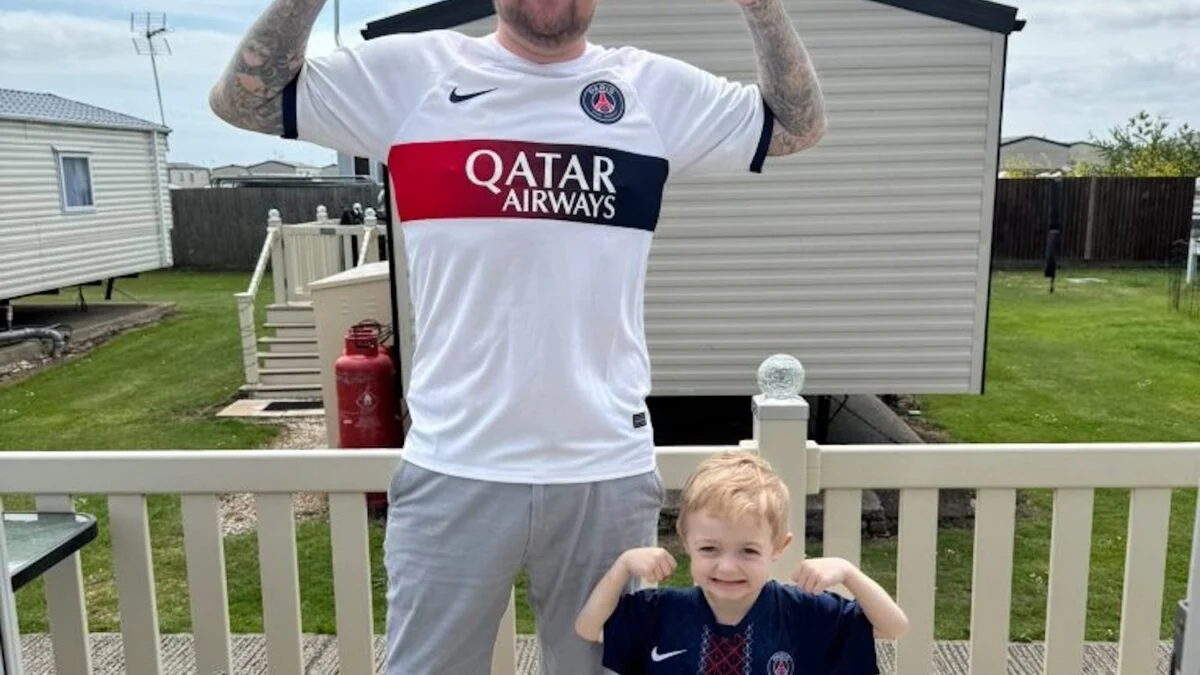
It took 17 hours on the operating table. For a father, a few months of preparation. And for a little 6 year old boy, a new chance.
On January 29, 2025, at King’s College Hospital in London, Gary Jackson donated part of his liver and small intestine to his son Harry. A gesture of exceptional magnitude: combined liver-intestine transplants carried out from a living donor are so rare in children that only around ten cases are recorded in the world.
But behind this medical feat, there is above all the story of a father who changed everything to be able to save his child, and that of a boy who had been waiting for years for a solution to an illness which had gradually put his liver in danger.
For Harry, waiting could become a matter of life and death
Her son, Harry Jackson, from Cambridge, was born with intestinal malrotation, an abnormality that can cut off blood supply and cause potentially fatal volvulus (a twisting of a segment of the intestine on itself, which blocks transit and compresses blood vessels). Years of intravenous nutrition to keep him alive also damaged his liver, causing intestinal failure-associated liver disease (IFALD).
In December 2023, the family met with the transplant team at King’s College Hospital to discuss a heart transplant. liver and thesmall intestine. After weeks of testing, doctors showed that Gary Jackson was a 98% HLA match with his son, meaning their immune systems are identical and the risk of rejection is reduced. The HLA (Human Leukocyte Antigen) system is the tissue compatibility system essential to determine whether the donor and recipient can perform a transplant without major risk of rejection.
His father discovers he can be the one to save his son
“When you are a parent, you would give everything to your child without hesitation. So when I was told that I could donate part of my liver and intestine to Harry, I didn’t hesitate for a second. I was just incredibly grateful for the opportunity to do something that could save his life and give our little boy a second chance.” Gary then declares.
The parents knew that an intestinal transplant would undoubtedly be necessary one day, but the rapid damage to the liver meant that a double transplant had to be considered sooner than expected. For surgeon Miriam Cortes-Cerisuelo, organ donations from living donors make it possible to use “a very good quality organ, from a healthy donor, and to better prepare for the operation“, which offers “much better chances of success for the transplant“.
To be a donor, Gary had to transform his own life
To be allowed to donate, Gary Jackson went on a drastic diet and gave up alcohol completely for months. “The journey to surgery was not easy. I had to lose almost 80 pounds, follow a strict diet, give up alcohol completely, and stay determined for months to ensure I was healthy enough to make this donation.“, he says.
5 p.m. in the OR to give Harry a second chance
The operation led by Professor Nigel Heaton and his team lasted 17 hours. Surgeons removed about 20 percent of Gary Jackson’s liver and a meter and a half of small intestine from the usual six meters. Gary Jackson took about six weeks to recover and confides: “It was trying, but nothing beats the joy of seeing Harry healthier and stronger afterwards. It remains the greatest privilege of my life, and I would do it all again without the slightest hesitation“.
A transplant so rare that only a few cases are recorded in the world
For Miriam Cortes-Cerisuelo, transplants combining liver and small intestine from a living donor, like that of Harry Jackson, are extremely rare: doctors are only aware of around ten cases in the world, including two at King’s College Hospital. She recalls that with “hundreds of patients on the active waiting list“, the service depends on the generosity of organ donors and their families.
His mother Annie says: “There are hundreds of children like Harry waiting for the phone call that could save their lives. As parents, we feel completely helpless watching our child wait for something so uncertain.“.