
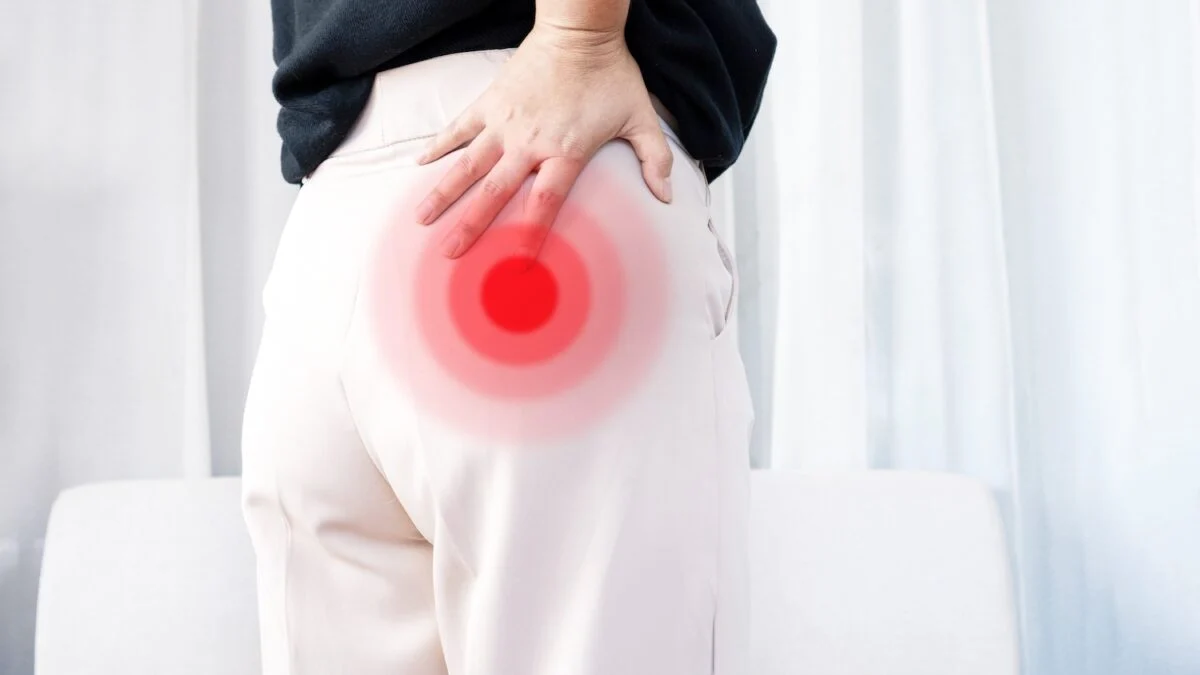
On social networks and in health media, a mysterious term often comes up: “dead buttock syndrome”. If it makes you smile at first glance and evokes an osteopath’s joke, this phenomenon nevertheless reflects a frequent anatomical reality, directly linked to our increasingly sedentary modern lifestyles.
A popular expression for a sedentary reality
Behind this evocative and somewhat provocative name lies in reality a purely functional and non-medical concept.
“The term is mainly media rather than medical. It refers to a feeling of numbness or pain in the buttocks after prolonged sitting, or weakness of the gluteal muscles linked to a sedentary lifestyle.“, first defines Dr. Gerald Kierzek, emergency physician and medical director of True Medical.
Contrary to what the formula suggests, it is neither an irreversible paralysis nor an official clinical diagnosis codified by medicine. “The glutes are not actually ‘asleep’ and this is not a medical diagnosis.”specifies the doctor.
However, the phenomenon is based on a very concrete anatomical mechanism known as gluteal amnesia. Spending hours motionless in a chair puts the gluteus maximus, medius and minimus muscles into forced rest, compressing blood vessels and inhibiting nerve control.
“However, the problem is real: sitting for a long time reduces muscle activity and can promote poor coordination between the glutes, hips and lower back.warns the doctor.
In the long run, the brain struggles to send the appropriate nerve signal: the glutes forget how to contract effectively when requested, forcing other anatomical structures to work in overdrive to compensate for this deficiency.
Recognize the signs of gluteal amnesia
This lack of daily muscular stimulation can manifest itself in a range of insidious symptoms, which often appear from the first steps after prolonged sitting or during everyday movements:
-
Numbness and tingling:
a feeling of temporary anesthesia in the area or unpleasant tingling immediately after getting up; - Targeted muscle weakness: a feeling of lack of strength and instability during simple efforts, such as climbing stairs, running or getting up from a deep seat;
- Local and distant discomfort: a dull, stabbing pain localized in the buttock, which sometimes extends towards the hip or radiates unpleasantly towards the lower back;
- Lack of stability of the pelvis: difficulty keeping the pelvis horizontal when walking or in unipodal support (on one leg);
- Deleterious compensation mechanisms: to compensate for this lack of tone, the lower back (the lumbar region) or the back of the thighs (the hamstring muscles) take over. Result: these overworked areas end up stiffening and becoming painful in turn.
Be careful, however, not to make a hasty self-diagnosis.
“Deep pain in the buttock is not necessarily a ‘dead buttock’: it can also be linked to sciatica, disco-radicular pain, tendinopathy of the gluteus medius or a mechanical problem of the hip joint”Dr. Kierzek cautiously emphasizes.
Good daily reflexes to wake up your muscles
To effectively counter the ravages of a sedentary lifestyle on the pelvic girdle, the key does not lie only in the intensity of a weekly sports session, but in the regularity of the micro-movements injected into the heart of your day.
“The most effective way is to split up your sitting time.advises Dr. Gerald Kierzek. The doctor therefore recommends adopting simple and preventive actions throughout your work routine:
- Get up, stretch and walk for at least two to three minutes every 30 to 60 minutes;
- Get into the habit of making phone calls while standing or pacing around the office;
- Systematically favor stairs over elevators and treadmills;
- Avoid crossing your legs and not remaining frozen in the same posture for several hours in a row;
- Alternate working positions by adopting a sit-stand desk if your professional environment allows it.
“A regular active break during the day is infinitely preferable to a single big sports session in the evening to compensate for eight hours of total immobility“, insists the practitioner.
Three quick exercises to reactivate your lower body
To quickly restore tone and re-educate your gluteal muscles, it is very useful to perform targeted strengthening movements directly at home or in the office. To practice without looking for pain, 2 to 3 times a week to start:
- Isometric contraction (at the office): Sitting upright or standing, firmly and voluntarily contract both glutes, maintaining pressure for 5 seconds, then release completely. Repeat this exercise 8 to 10 times in a row;
- The gluteal bridge or Glute bridge (on the ground):
Lying on your back, knees bent and feet flat on the floor hip-width apart, push hard into your heels to gently lift the pelvis until the thighs, pelvis and torso are perfectly aligned. Contract at the top for a second then slowly lower back down. Perform 2 to 3 sets of 8 to 12 repetitions; - Sit-to-stand or Chair squat (daily):
Get up from your chair without using your arms, then sit back down in a controlled manner, braking your descent, without letting yourself fall. Start with 5 to 10 very clean repetitions, using your hands on the armrests only if necessary.
Once these basics are well understood and your muscles are awakened, you can gradually enrich your routine by adding strong stair climbs, lateral leg raises (for the gluteus medius) or partial squats with an elastic band.
When should you consult a professional?
If resuming regular movement and breaking up sitting time is generally enough to restore good muscle function in a few weeks, certain warning signals should lead you to consult a doctor or physiotherapist:
- The numbness persists for a long time after standing and walking;
- The sharp pain goes down the leg or behind the knee;
- You notice a clear loss of strength, the appearance of a limp or if you have unexplained falls;
- The pain wakes you up at night or tends to get worse as the days go by;
- The symptoms persist without improvement despite several weeks of adapted activity.
“Sudden muscle weakness, significant loss of sensitivity, difficulty urinating or loss of control of stools constitute neurological emergencies which require immediate medical consultation.concludes Dr. Kierzek.
Apart from these emergency situations, keep in mind the fundamental precept: the best remedy to preserve your glutes remains repeated and varied movement throughout the day!