
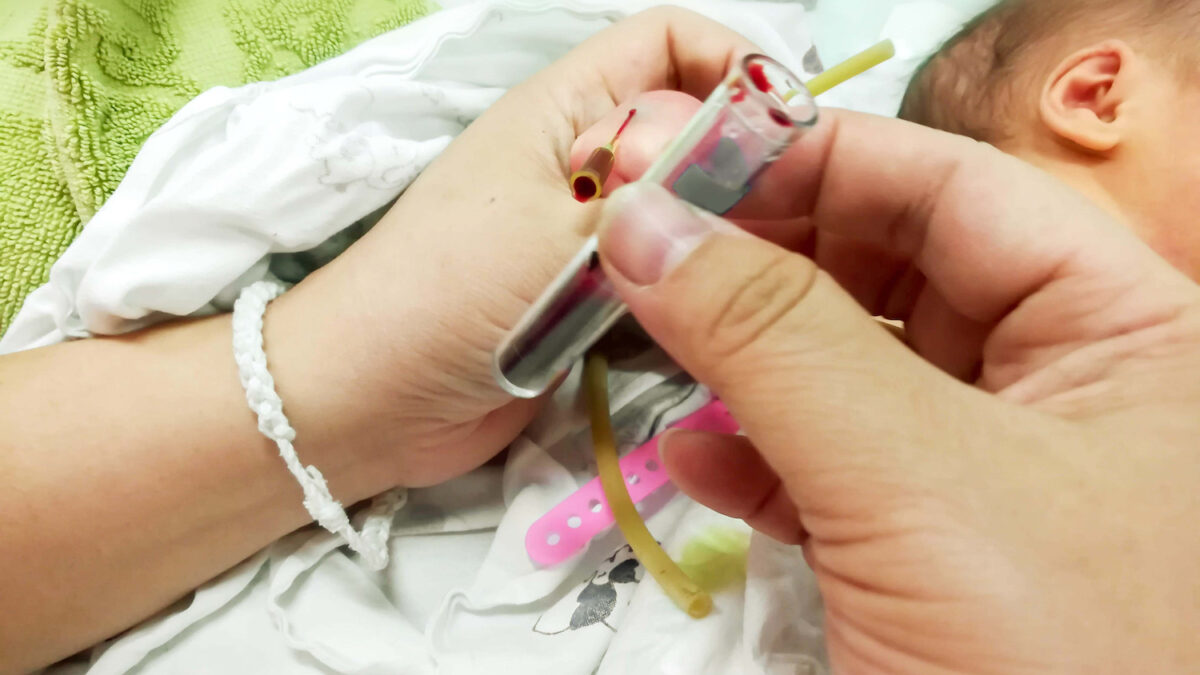
A blood test for a baby is not necessarily carried out like for an adult: the technique depends on the baby’s age, the volume to be taken and the examination. In a video published on Instagram, Dr Jules Fougère, aka @ped.urg, above all shows the precautions taken to limit discomfort and reassure parents.
A technique chosen according to age and examination
The first thing to remember is simple: There is no one way to take a baby’s blood test. The recommendations of the World Health Organization point out that the choice depends in particular on the age of the child, the quantity of blood necessary and the type of analysis to be carried out.
In his video, Dr Jules Fougère emphasizes that the procedure may differ from an adult blood test. This is true in principle: in a newborn or infant, caregivers can choose a peripheral vein, a heel or finger capillary sample, depending on the situation. For certain examinations, particularly in newborns, it may be necessary to collect very small quantities of blood.
The video also discusses a “drop by drop” collection technique in small quantities. This idea corresponds to certain hair samples, but it should not be understood as a universal rule. The elbow crease is not always the chosen site in babieswithout this meaning that one end is systematically used.
Another important nuance: the video explains that the caregiver’s hand can be sufficient instead of a tourniquet. In practice,
the teams use adapted methods, sometimes without a traditional tourniquetfor example by holding the wrist or the area to be sampled. But whether or not to use a tourniquet depends on the site, technique and local protocol.
“Obviously, this gesture may seem impressive to parents” admits the expert. Sampling is often more stressful to watch than to understand. Knowing that caregivers are adapting their actions helps put the scene in context.
What can help the baby during the collection
The video emphasizes settling the baby before the procedure, excluding emergencies, and mentions breastfeeding or a sugary solution. This is a useful point, as long as you phrase it carefully: feeding, sucking, and sometimes a sucrose solution can reduce pain or discomfort during brief needle procedures in newborns. This does not necessarily make the sampling painless.
Available Cochrane evidence indicates that small amounts of sugar solution, such as sucrose, likely reduce pain during and immediately after venipuncture in newborns, compared with no intervention, water, or usual comfort care.
This sucrose falls under the protocols of the healthcare team : this is not a product to give yourself before taking a sample.
For parents, the objective is therefore not to “make” all pain disappear, but to best support a short medical procedure. A few reflexes can help, always in agreement with the team:
- Ask what type of withdrawal is planned : venipuncture, heel, finger or other method;
- Let caregivers settle and hold the baby as neededeven if it seems impressive;
- If the team suggests it, allow feedingsucking or using a sugar solution according to the protocol;
- Ask questions before the actionwhen possible, to avoid discovering each step at the time of the injection.
These measures are consistent with what we know more widely about the pain of newborns during care and the means used in service to limit discomfort. They do not guarantee the absence of crying, but they can make the care more bearable.
A common case deserves to be distinguished: neonatal screening organized in France. It is based on a few drops of blood placed on a blotting paper, most often after a small prick on the heel, in the first days of life and after parental consent. Here again, the team explains the gesture and chooses the appropriate method.
If the sample is approaching, the most useful thing is to ask the team what you can actually do during the treatment. To accompany moments of crying around a medical procedure, simple cues can also help your baby to calm down, without trying to control everything.