
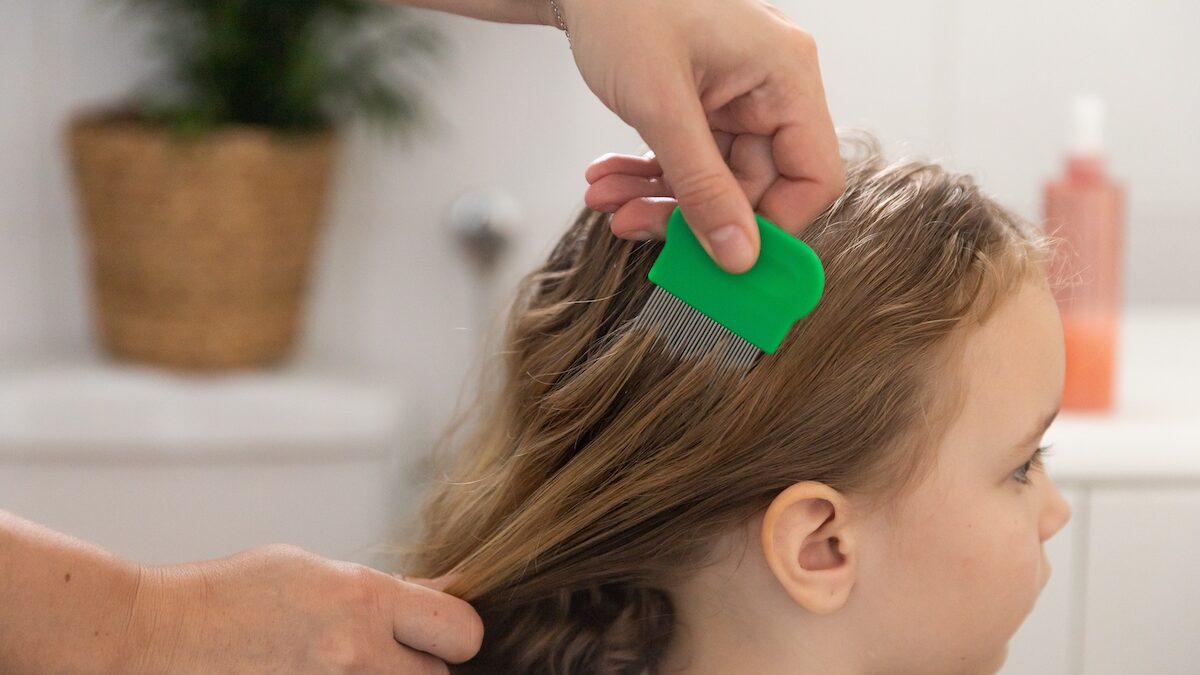
Does your child come home from school with lice? The answer is clear: no, you should neither wash the whole house nor treat the whole family systematically. We must act quickly, but in a targeted manner. Health Insurance points out that head lice are common among children in communities and that they are not linked to a lack of hygiene.
Treat only people in whom live lice are found
The first instinct is not to take out all the anti-lice shampoos, but to inspect each person’s hair. Head lice are mainly transmitted by direct hair-to-hair contact: they do not jump, do not fly and do not come from domestic animals.
In practice, we check children and adults living under the same roof, especially looking for live lice and nits near the scalp. Itching can be a warning, but it is not always present. To better identify useful signs, our guide to recognizing and treating lice bites can help sort them out.
The rule is simple: we treat all people who are actually infested on the same day, but not those in whom we find nothing. “Safety” treatment is unnecessary and can irritate the scalp or contribute to resistance. This is also why preventive treatments against lice are useless.
What treatments should I use?
When treatment is necessary, French recommendations favor products with physical action available in pharmacies, in particular based on dimethicone. You must strictly follow the instructions: quantity, application time, rinsing, passing with a fine comb. Depending on the product, a second application is often planned between D+7 and D+10, in order to eliminate lice from still viable nits.
The right actions can be summarized as follows:
- Inspect the hair of everyone close to you;
- Treat only infested people, ideally on the same day;
- Follow the instructions for the chosen product, without shortening the application time;
- Use a fine comb to remove lice and nits;
- Monitor the hair in the following days.
If the diagnosis is uncertain, if the scalp presents significant lesions or if live lice persist despite two well-conducted treatments, medical advice is preferable.
Clean what touches the head, not disinfect the home
The other common misconception is to wash sheets, sofas, carpets, curtains, floors and soft toys throughout the house. It’s disproportionate. Outside the scalp, lice survive for a short time and transmission through objects is less frequent than head-to-head contact.
The right strategy is therefore targeted cleaning of textiles and accessories in contact with the head or neck. The French authorities recommend in particular taking care of what was recently used by the infested person.
What objects should be cleaned first?
To be treated as a priority:
- Wash pillowcases, sheets, hats, scarves and clothing in contact with the neck or hair at more than 50°C when possible;
- Clean combs and brushes that have touched the hair;
- Isolate non-machine washable items in a closed bag;
- Avoid sharing hats, barrettes, brushes, helmets or stuffed animals during the episode.
There is no need, however, to disinfect the walls, floors or furniture. Head lice are unpleasant, but they do not transmit disease; the main problem is pruritus, sometimes absent. To go further on the basic actions, you can consult our article on how to get rid of lice and nits.
Finally, a treated child generally does not have to be excluded from school or daycare, except in special situations such as infected lesions. Preventing the establishment remains useful: it allows other families to monitor their children’s hair without launching a lice hunt throughout the house.