
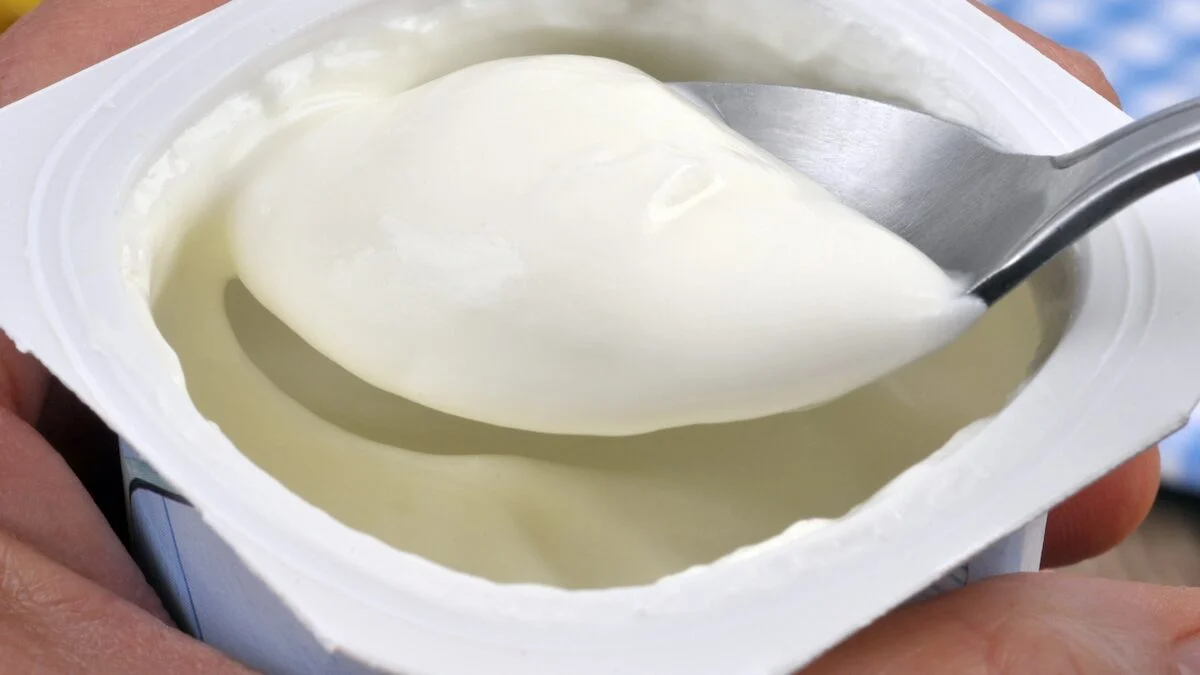
Faced with this little yellowish film of water placed on their natural yogurt, many consumers have the same reflex: they empty it into the sink before eating their yogurt. Others prefer to mix it, without really knowing what it contains. And when the deadline approaches, the suspicion is even greater: is this liquid a sign that the yogurt is starting to sour?
Rest assured: this little liquid on the surface is generally completely normal. It is neither an industrial additive nor, on its own, a sign that your yogurt is expired. And above all, it would be a shame to throw it away.
This yellowish liquid is whey
This liquid film has a name: whey, also called “whey”.
It appears naturally during the production of yogurt. During fermentation, the lactic ferments coagulate the milk and provide the firm texture of the yogurt. Part of the liquid can then separate from the solid material and gradually rise to the surface.
This phenomenon is all the more visible when the yogurt has been shaken during transport or has remained in the refrigerator for a long time.
It also contains nutrients
Contrary to what one might think, this small amount of liquid is not simply water.
Whey contains lactose, proteins, minerals and certain vitamins. It includes calcium, magnesium, potassium and B group vitamins.
The proteins it contains also belong to the same family as those used to make whey, very popular among athletes.
So, rather than throwing it away, just mix it into the yogurt with a spoon. It is easily reincorporated into the preparation and allows you to benefit from the entire product.
Why do some yogurts have more?
The amount of visible liquid varies greatly from one yogurt to another.
Certain products, such as Greek yogurt or skyr, are particularly drained during their manufacture. Part of the whey is thus removed, which explains their particularly thick texture.
Conversely, in a classic natural yogurt, the separation may be more visible.
A pot with a little liquid on the surface is therefore not necessarily less good or less fresh than another.
Can we use this liquid in cooking?
If the yogurt is still suitable for consumption, nothing prevents you from recovering this liquid in certain preparations.
In particular, it can replace part of the milk or water in pancake batter, brioche or certain pastry recipes. It can also be added to a smoothie.
A simple way to limit food waste.
When, however, should you throw away your yogurt?
The whey on the surface is therefore not, in itself, a reason to throw away yogurt.
On the other hand, certain changes should encourage caution. A swollen lid, a frankly unusual odor, the presence of mold or a clearly abnormal appearance are all reasons not to consume the product.
You must also respect the storage conditions and the date indicated on the packaging.
The next time you open a pot of plain yogurt and discover that little yellowish liquid, there’s no need to immediately head for the sink.
If there are no other abnormal signs, just mix it into the yogurt. This small gesture helps preserve the nutrients present in the entire product and avoids unnecessarily throwing away part of what you have just purchased.
This liquid which so intrigues consumers is therefore generally a natural consequence of the manufacture of yogurt, and not a signal indicating that it must be thrown away.
Sources
- Marmiton