
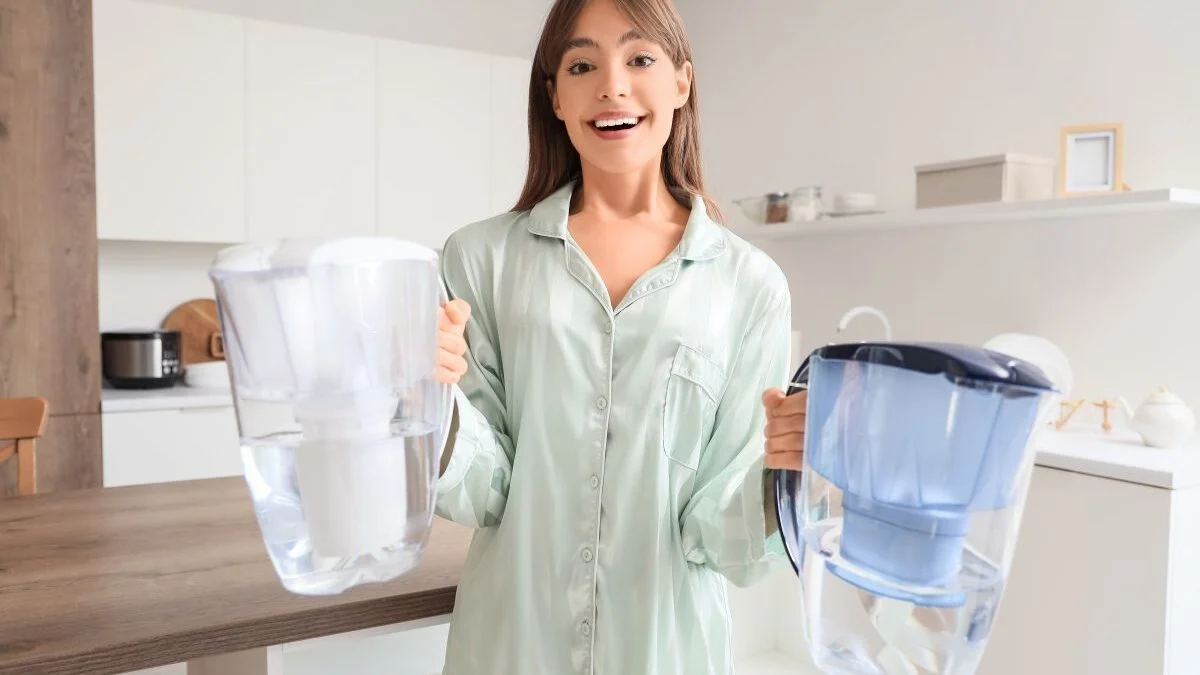
More and more households are returning to tap water but seeking to filter it. According to a survey of 60 million consumers, around one in five households today uses a filter jug, a tap filter or a reverse osmosis unit.
The association tested these devices in the laboratory over 21 to 29 days, with water “doped” with nitrates, pesticides, heavy metals and PFAS.
The verdict of 60 Million consumers is nuanced. Filter jugs from brands like Brita or Hydropure are useful for taste, because they remove chlorine well. But their action on the rest remains partial. In fact, pesticides are only partially retained, nitrates and nitrites decrease variably. And PFAS, these “eternal pollutants” designated by ANSES, largely pass through filters.
What a jug of tap water really filters
The filter jugs are based on activated carbon cartridges combined with resins. This allows some of the dissolved compounds to be retained. In tests with 60 million consumers, the pitchers subjected to highly chlorinated water, at 3 mg/L, were then tasted blind: the taste and odor of chlorine almost completely disappeared, which explains the popularity of these carafes in kitchens.
Limits on pesticides, nitrates, heavy metals and PFAS
As soon as we look at pollutants, the numbers vary. According to the results of 60 Million consumers, a Hydropure carafe reduces nitrates by 94.6% and nitrites by 97.4%, while a Brita model only reduces nitrites by 14.1%. For the pesticide S-metolachlor, some jugs reach 96.5% elimination while others remain at 62%.
Regarding PFAS, 60 million consumers targeted PFOA in particular, a very persistent molecule. Classic carafes only retain a limited portion.
The association recalls that “the reverse osmosis system is the only device for households capable of filtering pollutants, heavy metals and other chemicals contained in running water“.
But a reverse osmosis unit costs up to €500 for a family model and rejects several liters of water for each liter filtered.
Good use of filter jugs and false good deals
The National Agency for Food, Environmental and Occupational Health Safety recalls that tap water remains generally of good quality in France. Domestic devices do not exempt you from following their instructions for use. The 60 Million Consumers association warns: “If your carafe filters chlorine, you absolutely must keep the water in the fridge, otherwise you will quickly have a bacteria culture broth”.
For a simple chlorine taste, a well-maintained filter jug may be sufficient. In rural agricultural areas, where pesticides circulate more, an efficient tap filter or reverse osmosis unit will be more suitable, despite its cost.
Patricia Chairopoulos, who led the 60 Million Consumers survey, warns: “All the so-called natural filters, like charcoal sticks or ceramic beads, are almost useless.” Binchotan charcoal sticks or ceramic beads are therefore no substitute for a well-designed filter cartridge.