
Published on September 9, 2026 in Translational Neurodegenerationthis result remains preclinical. But it opens up an original avenue: protecting neurons by also acting on their environment.
A simple spray to reach a key area of memory
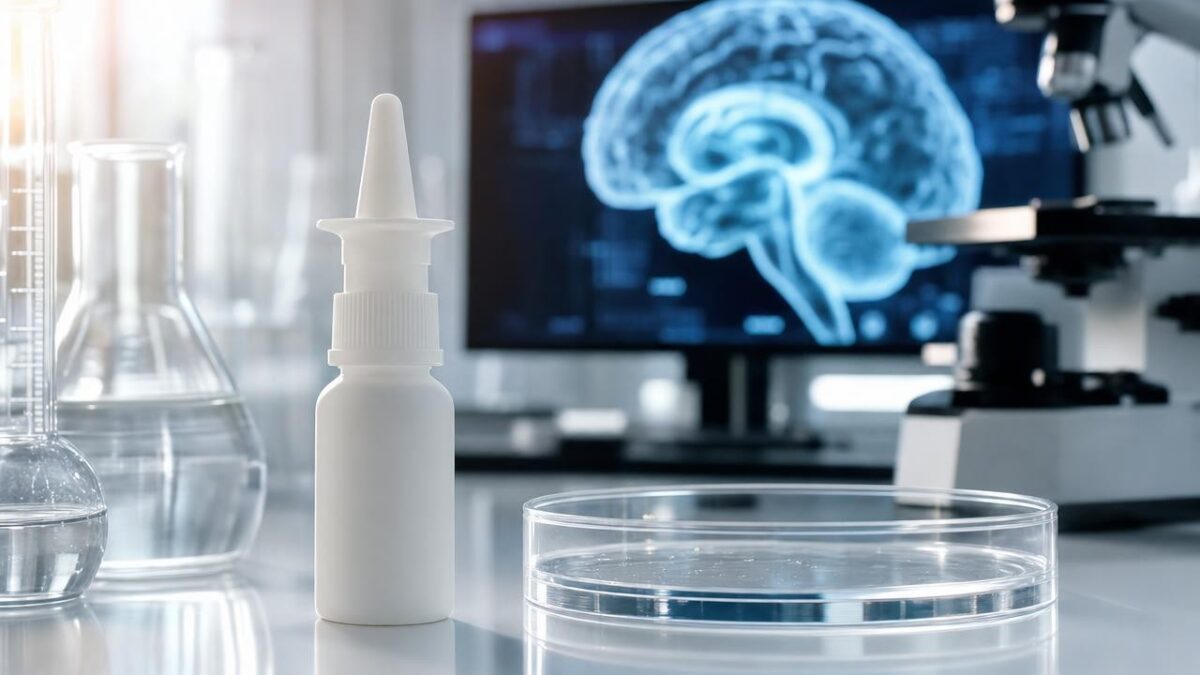
The principle is surprising in its simplicity. Researchers from the Università Cattolica del Sacro Cuore, the Fondazione Policlinico Universitario A. Gemelli IRCCS and the E. Menni Research Center used extracellular vesicles produced by human amniotic membrane cells.
Administered nasally, these tiny “messengers” can reach the brain via pathways connecting the nose to brain tissue. In the mice studied, they reached
the seahorsea region essential to memory, and were integrated by neurons but also by microglia, the immune cells of the brain.
It is precisely this microglia that researchers seek to modify.
The brain is not only attacked by Alzheimer’s proteins
In Alzheimer’s disease, the accumulation of beta-amyloid and tau protein abnormalities take center stage. But the environment of neurons also matters, particularly brain inflammation.
The vesicles tested do not seem to simply “turn off” this inflammation. They reshape the inflammatory environment and modify the state of microglia, creating more favorable conditions for neurons.
In the hippocampus of treated mice, researchers observed an increase in proteins involved in brain plasticity and synapse function, including BDNF, GluA1 and ARC. The animals also performed better on several memory tests.
The amount of hippocampal beta-amyloid decreases, but tau phosphorylation does not change.
Encouraging results, but no treatment yet
The team also tested the vesicles on human neurons produced in the laboratory from cells from Alzheimer’s patients. Here again, researchers observe better preservation of neuronal extensions and more synaptic proteins. However, these results remain very far from application in patients.
“These preclinical results require further validation in humans and do not yet constitute an available treatment for Alzheimer’s disease, but they open a very promising avenue: understanding whether some of the mechanisms by which the placenta naturally regulates inflammation and protects tissues could offer new tools for the treatment of neurodegenerative diseases and, more generally, whether the use of extracellular vesicles represents a new frontier for the treatment of neurological diseases.underlines Claudio Grassi, director of the neuroscience department at the Università Cattolica.
The interest of this research is perhaps precisely there: rather than seeking solely to eliminate the proteins characteristic of Alzheimer’s, it explores another question.
How can we provide the diseased brain with an environment in which neurons can continue to function and communicate?
In humans, it will still be necessary to demonstrate that this strategy is effective, safe and capable of sustainably preserving cognitive functions. But for researchers, the placenta could well contain natural mechanisms for protecting nervous tissue that are still largely unexploited.