
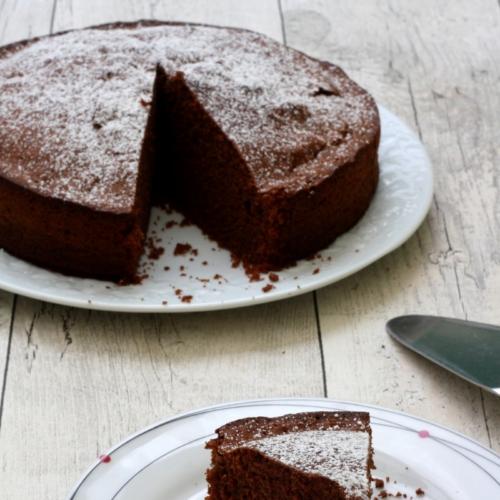
An ultra-delicious chocolate cake, imagined by pastry chef Yann Couvreur and put forward by Dr Jimmy Mohamed, is making many Internet users salivate. And for good reason: this semi-cooked recipe, prepared with dark chocolate and milk chocolate, is as melt-in-your-mouth as possible.
Why is Yann Couvreur’s chocolate cake so popular?
The recipe uses simple ingredients that you can easily have in your cupboard: six eggs, 190 g of sugar, 100 g of flour, 200 g of dark chocolate, 200 g of milk chocolate, 200 g of butter and 6 g of fleur de sel.
Its little secret lies in the combination of the two chocolates. This combination, also present in other Yann Couvreur recipes, provides a particularly tender texture and a richer taste. Fleur de sel enhances the flavors.
Another particularity: cooking. The cake is baked at 145°C for 40 minutes, in a 20 cm circle. The desired result is very precise: well-cooked edges and a still-soft center.
But be careful not to turn this cake into a so-called “slimming dessert”. The objective of the recipe is rather to remind you that a dessert can have its place in a balanced diet, provided you remain occasional and control the quantities. An approach that meets the recommendations for homemade desserts.
Yann Couvreur’s chocolate cake recipe: the steps
Start by melting the 400 g of chocolate with the 200 g of butter and the fleur de sel in a bain-marie. Mix until you obtain a perfectly smooth mixture.
In another container, whisk the six eggs with the sugar. The mixture should become clear and slightly foamy. Then add the sifted flour, then gradually incorporate the melted chocolate.
Butter a 20 cm diameter circle and cover the base with cling film. Pour the mixture into it, then lightly smooth the surface.
Bake for 40 minutes at 145°C. When it comes out of the oven, the edges should be set while the center remains soft.
Then let the cake cool completely before unmolding it. Sprinkle it with a little cocoa and cut it into eight pieces.
How to obtain a perfectly melting texture?
It’s when it comes out of the oven that everything happens. The center of the cake should still move slightly when you handle the pan, while the edges should be firm enough.
This contrast between a set exterior and a soft center is precisely what gives the cake its semi-cooked texture. There is therefore no point in prolonging the cooking to obtain a completely firm cake: you risk losing all its interest.
Last step, often neglected: cooling. Let the cake cool completely before unmolding. It will thus stabilize while retaining its melting core.
And to fully enjoy this dessert, the easiest way is to share it. A portion, enjoyed occasionally, can easily find its place in a varied diet.