
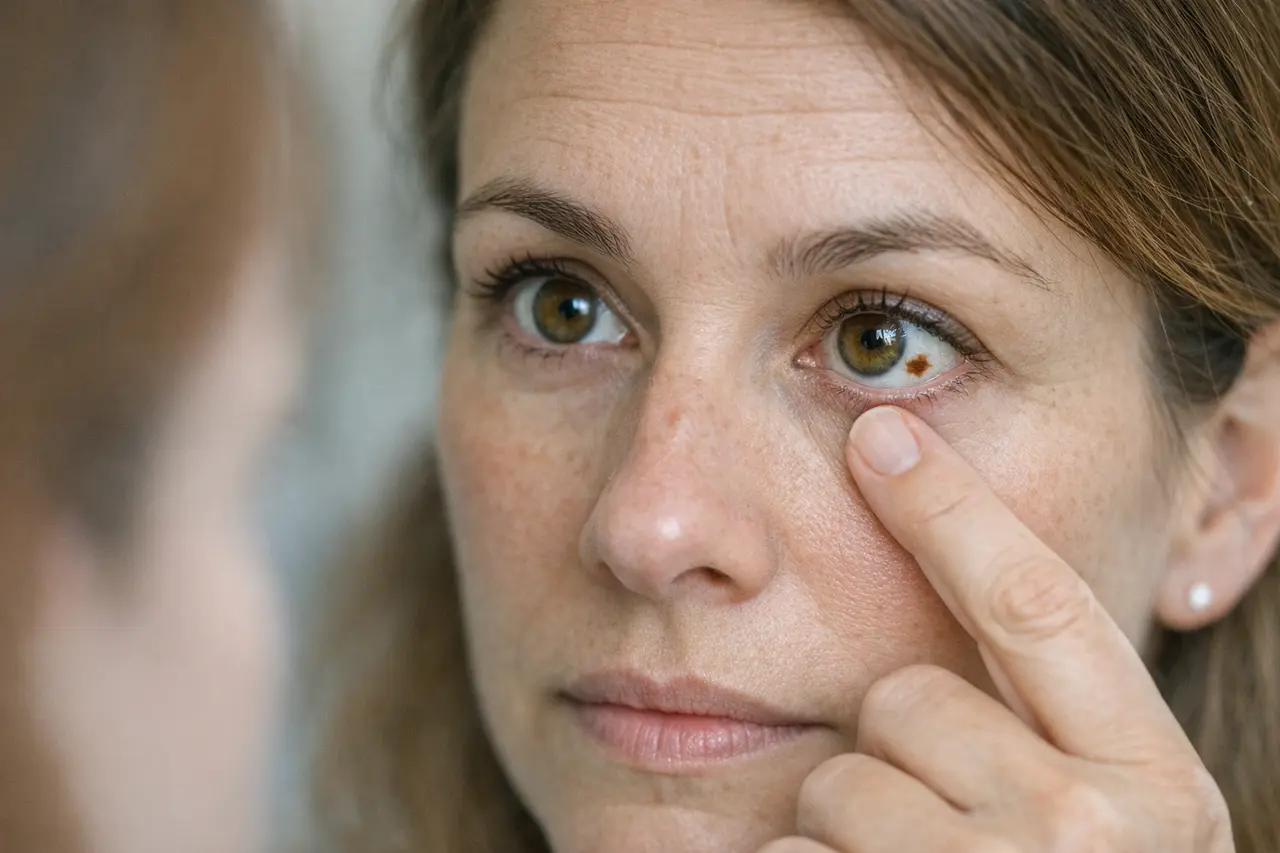
In a video posted on Instagram, Dr Marie Jourdan answers a simple question: can a brown spot in the white of the eye be removed with a laser, like on the skin? The useful answer is in one sentence: no, this stain should not be treated like a common skin stain.
Why “anti-stain laser” reasoning doesn’t work for the eye
Dr Marie Jourdan starts from a very concrete case: a person asks her by email if a brown spot located in the white of the eye could be removed with a laser. The question seems logical, she explains, because in dermatology certain lasers target pigments: they fragment melanin and can reduce various pigment spots, including on certain mucous membranes.
But the eye is not an area of skin. When a laser is used around the eye, for example near the eyelids, a shield can be placed over the eyeball, much like an opaque lens, to prevent the beam from reaching internal structures. The dermatologist specifies: “LThe problem is not the stain. The problem is what’s behind it.” This “behind” is notably the retina, essential for vision. Available data confirm that dermatological lasers used around the eye require strict protections: poorly controlled exposure can cause eye damage, depending on the type of laser and wavelength.
However, we must avoid a formula that is too absolute. Some lasers are well used in ophthalmology, with precise indications, appropriate settings and by specialists. Publications also report laser treatments of very selected conjunctival lesions. But this does not mean that a brown spot from the white of the eye recedes like a sunspot on the cheek. The starting point is not the aesthetic gesture, but the ophthalmological diagnosis.
What a brown spot in the white of the eye can be
The video mentions a common possibility: a “conjunctival mole”, that is to say a nevus of the conjunctiva. The conjunctiva is the thin membrane that covers the white of the eye. A mole corresponds to a pigmented lesion; in the eye, a conjunctival nevus is often benign.
But the nuance is important: a video or a photo does not allow this diagnosis to be made. A brown spot on the conjunctiva may correspond to other lesions, benign or more worrying. Ocular melanoma, particularly conjunctival melanoma, remains rare, but it is one of the diagnoses not to be missed.
A conjunctival nevus is not the exact equivalent of a skin sunspot. It may be present early in life or become visible later. This is why history matters: how long has the stain been there? Has she changed? Has it become darker or more visible?
In practice, the ophthalmologist can examine the lesion using a slit lamp. When the appearance is typical and reassuring, monitoring with comparative photographs may be sufficient. If the lesion appears atypical, evolves or causes concern, it can be removed for histological analysis. Here again, the objective is not just cosmetic: it is about knowing the exact nature of the stain.
It is particularly important to seek ophthalmological advice if the stain:
- East new or recently noticed;
- Gets bigger or changes color;
- Becomes red, inflamed, bleeds or is accompanied by visible new vessels;
- Accompanied by unusual eye symptoms.
Ophthalmological lasers do exist, for example for certain retinal disorders or certain vision surgeries, but they are not interchangeable with cutaneous aesthetic lasers. If we talk about an ophthalmological laser, we are talking about a medical indication, a prior examination and specific ocular safety.
For a brown spot in the white of the eye, the right question is therefore not “Which laser to use?“, but “What is the correct diagnosis“.