
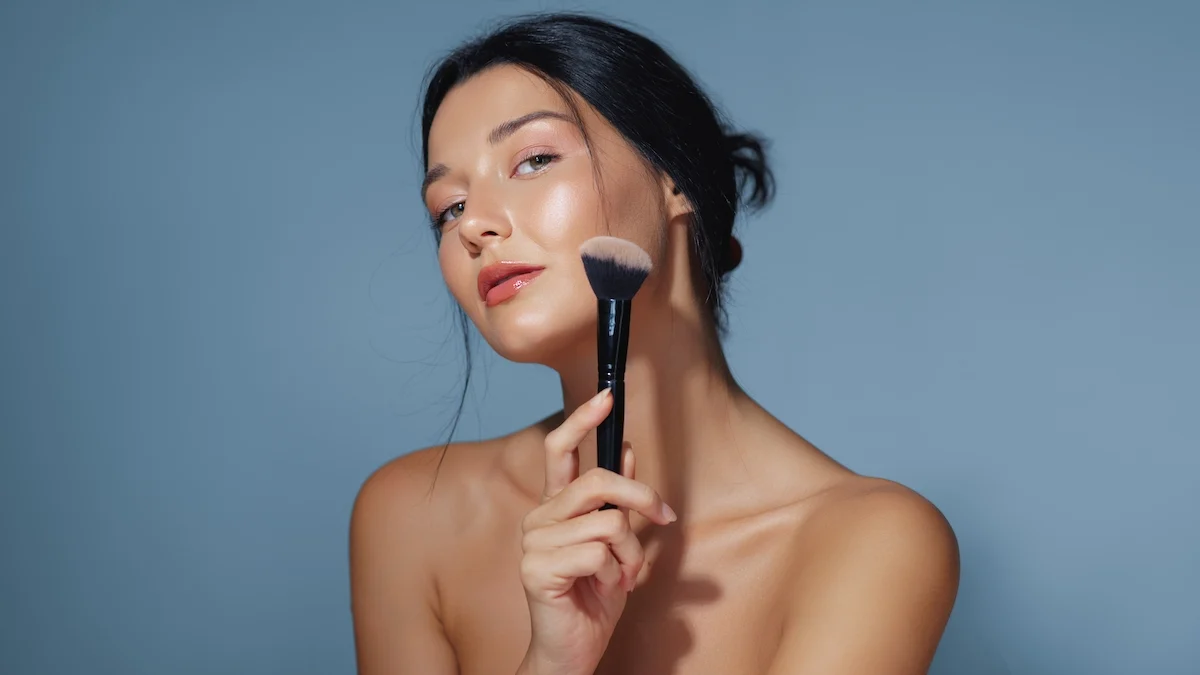
A complexion that turns cakey, a concealer that accumulates in fine lines, a blush that refuses to blend properly… What if the problem did not come from the makeup itself, but quite simply from the brush used to apply it? According to Cosmopolitanthe choice of tool can really modify the final result, especially when it comes to working with foundation, concealer or cream products.
No need to transform your bathroom into a professional makeup artist’s storage room. According to a Macy’s guide published in 2026, three to seven well-chosen brushes can already cover the essentials of a makeup routine: complexion, powder, blush and eyes.
And contrary to popular belief, a good brush is not necessarily overpriced. Dominic Skinner, senior make-up artist at MAC, interviewed by French Vogueinsists on this point: the quality of a brush depends in particular on its shape, its density and its balance, more than on its price.
For foundation, use a synthetic brush
To apply a liquid or cream foundation, Dani Parkes recommends at
Cosmopolitan a brush with synthetic bristles, light enough to allow the material to be deposited and then gradually diffused. The idea is to work in thin layers rather than wanting to immediately obtain maximum coverage.
This method makes it possible to avoid the thick and irregular effect sometimes called “cakey”. The brush should make it possible to distribute the product evenly, then work it in circular movements or in small touches depending on the texture.
The choice of fibers is also important. Synthetic brushes are particularly suitable for liquid and creamy products, as they absorb less material.
French Vogue also recommends this type of fiber for foundation, while natural fibers are traditionally used more with powders.
Concealer: precision above all
Concealer requires a different tool. A small, dense or slightly beveled brush makes it easier to work hard-to-reach areas, notably the inner corner of the eye, the underside of the eye or even the sides of the nose.
For Dominic Skinner, the density of the brush must above all be adapted to the desired effect: a less dense brush allows for a lighter, more blended result, while a denser brush deposits more material and therefore offers greater coverage.
The gesture counts just as much as the tool: it is better to apply a little product then add material gradually than to start with a thick layer that is difficult to blend.
Blush and bronzer: a light hand is your best ally
For blushes, bronzers and other cream or liquid products, makeup artists surveyed by Cosmopolitan recommend synthetic brushes dense enough to deposit the pigment while allowing it to be worked on gradually.
A particularly interesting tip is to place a small amount of product on the back of the hand before passing the brush over the face. This avoids ending up with too large a quantity of material in the same place.
The principle is simple: it is better to gradually build up the intensity. A light first coat can then be built up until the desired color level is achieved.
This technique works particularly well with cream blush and cream bronzer, whose pigments can be easily modulated. French Vogue also recommends using a brush or sponge for these textures, working in small strokes to obtain a uniform result.
For powder, change brushes completely
With powders, the logic is reversed. Soft, airy brushes allow you to deposit less material and diffuse it more easily.
A brush that is too dense or too busy can quickly give a thick result, particularly on dry areas or under the eyes. Macy’s recommends large, fluffy brushes to diffuse the powder and avoid the “cakey” effect.
Dominic Skinner recommends not necessarily choosing the largest brush available. A tool that is too wide can deposit powder where it is not needed and cause the skin to lose its natural glow. Better to target the areas that really need to be mattified: contour of the nose, under the eye, chin or jawline.
Brush or sponge: do you really have to choose?
Not necessarily. The two tools can be complementary.
According to Cosmopolitanthe brush allows you to better control the quantity of product and obtain more coverage. The sponge then intervenes to melt the material and give a more natural finish, close to the skin.
One method therefore consists of first applying the foundation with a brush, then delicately pressing a slightly damp sponge on the face in order to remove the excess and blend any possible demarcations.
This brush-sponge combination makes it possible to obtain adjustable coverage without accumulating too much material.
How many brushes should you really have?
No need to buy a box containing several dozen brushes. For a daily routine, a few well-chosen models are enough.
The minimum can be as simple as a foundation brush, a powder brush, a blush brush and a few eye brushes.
Macy’s estimates that a kit of three to seven brushes already allows you to achieve most of a complete makeup look.
The important thing is above all to choose shapes adapted to its use. A very versatile brush can perfectly replace several specialized models.
And above all, clean your brushes regularly
Even the best brush in the world won’t give a pretty result if it accumulates makeup residue. Cleaning is therefore an essential step, both to preserve the performance of the tool and to limit the accumulation of residue.
Dani Parkes recommends, in Cosmopolitanwash brushes regularly, particularly those used with cream or liquid products, as well as sponges. The guide particularly recommends weekly cleaning.
French Vogue also recommends regular cleaning and explains that brushes used with liquid products require special attention, as foundation or concealer residue can be more difficult to remove.
After washing, it is better to let the brushes dry flat rather than upright, to prevent water from seeping into the handle and weakening the fibers.
In the end, obtaining a perfectly blended complexion does not necessarily require more makeup. The secret might just lie in a few good tools, gradual application and… clean brushes.