
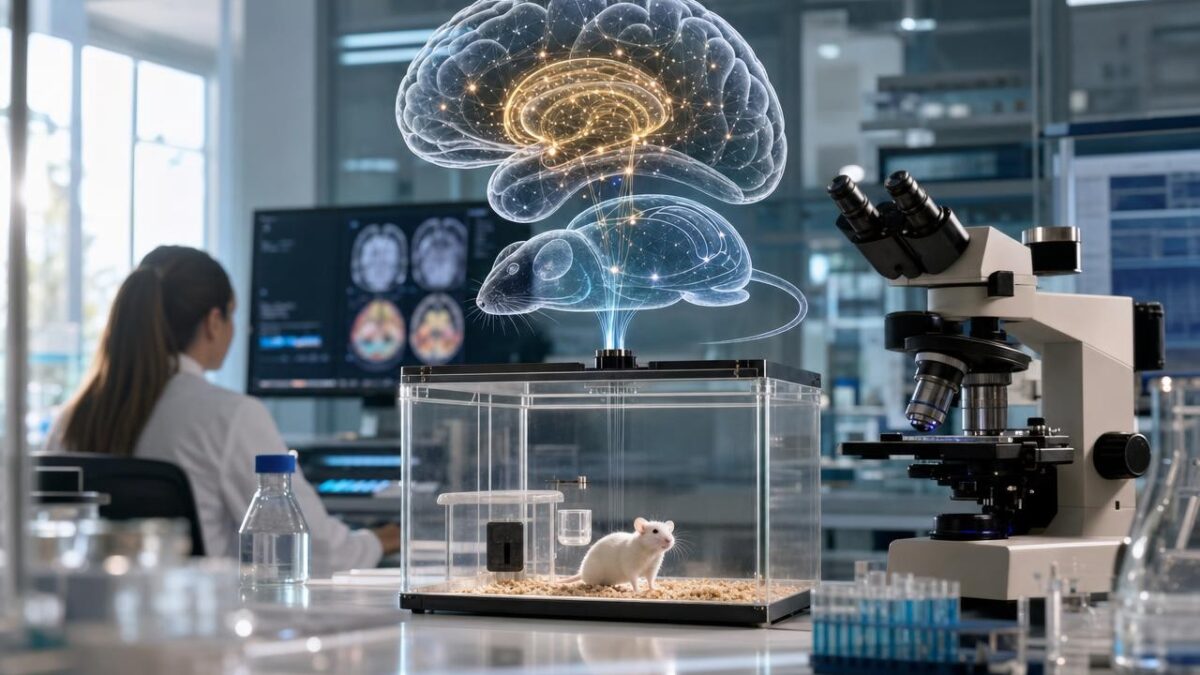
For the first time, human neurons have colonized almost the entire cortex of a small mammal, to the point of almost completely replacing its own gray matter. Behind this feat, which opens up new research perspectives for neurological diseases, one question dominates: to what extent can we humanize the brain of an animal?
To grow human neurons, researchers first made room
How can we study a living human brain without being able to directly access that of a patient? For several years, researchers have been using cerebral organoids: three-dimensional tissues made from reprogrammed human cells.
These models make it possible to observe human neurons in the laboratory, but they have a major weakness: they do not live in a complete organism. No real blood flow, functioning immune system or long distance nerve networks.
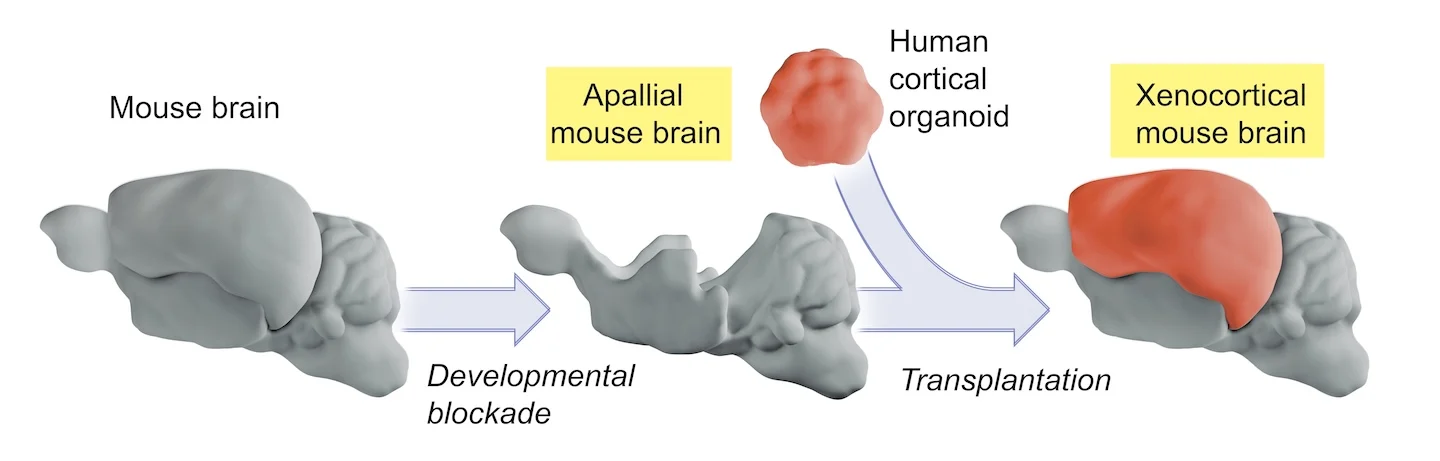
Sergiu Pașca’s team at Stanford therefore imagined an additional step. The researchers genetically created so-called “apallial” mice, in which a large part of the neocortex and hippocampus are not formed.
 © Stanford Medicine
At just two days old, the mouse pups received several human cortical organoid grafts, each containing about 100,000 cells.
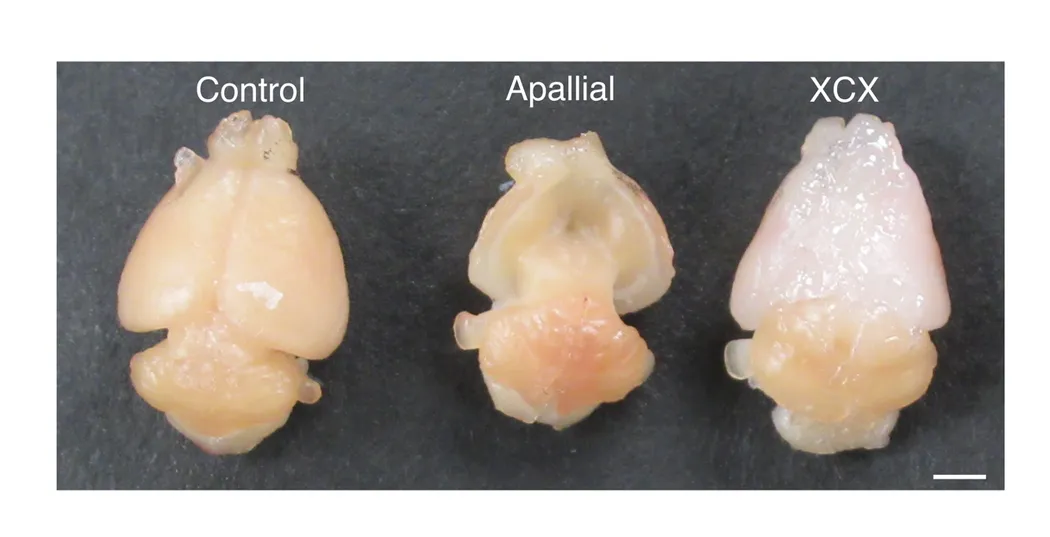
The result is spectacular. Of 29 transplanted mice,
86.2% demonstrate successful integration. Between two and three months, the volume of the graft is multiplied by 4.7. After three months, human tissue represents 91.9% of measured cortical volume.
 © Kaganovsky, K., Kelley, K.W., Gschwind, T. et al. Developmental xenocortication using human-derived organoids in mice. Nature (2026). https://doi.org/10.1038/s41586-026-11032-2
Researchers also observe extensions of human neurons into certain deep regions of the brain and even into the cervical spinal cord.
The human and mouse brains begin to “dialogue”
However, the interest of the experiment does not lie only in the quantity of human tissue obtained. Mouse neurons also establish connections with the human graft. Electrical recordings show coordinated activity in the grafted tissue, while its activity is correlated with certain facial movements of the animal.
For researchers, this possibility of passing from cells to circuits, then to behaviorsconstitutes one of the main interests of the model.
“These animal models provide a unique opportunity to study how disease-associated alterations in human brain circuits manifest in an intact nervous system.”explains Sergiu Pasca.
This approach could in particular be used to study neurodevelopmental disorders, certain forms of epilepsy or even the consequences of early brain damage.
The researchers thus subjected the mice to a period of lack of oxygen. The transplanted human tissue then presents a strong response to hypoxia, with balance disorders close to those observed in cerebral palsy, while normal or apallial mice are almost spared.
Another discovery particularly intrigues scientists: the graft contains cells with the characteristics of von Economo neuronsgiant cigar-shaped cells, extremely rare (around 1 in 90,000 cortical neurons) and previously only visible in autopsied human brains or in large social mammals. These neurons are among the first destroyed in frontotemporal dementia. Being able to study them in vivo, using patient cells, opens an avenue for deciphering this still incurable disease.
Being able to observe these cells in living human tissue could offer a new window on this now incurable disease.
No, this mouse does not have a “human brain”
However, the shortcut would be misleading. Human tissue remains
immature. The cells continue to follow their own developmental schedule, much slower than that of the mouse. In particular, they do not present the complete organization of an adult human cortex.
In Science Media Centre, Jürgen Knoblich, of the Institute for Molecular Biotechnology in Vienna, clearly points out: “
However, the idea that it is a mouse with a human brain is not entirely accurate. First, human cells continue to grow at their species-specific rate, which is much slower than that of the mouse brain. At the end of the experiments, these cells still correspond to an embryo in the second trimester of pregnancy..
Another limit: observing connections between human neurons and mice does not yet mean that these human cells control a given behavior. It will be necessary to determine which connections are truly functional and what precise role they play.
The model remains especially interesting for studying brain development and certain diseases, notably autism, while avoiding talking about a “human brain in a mouse”.
A scientific feat which also requires setting limits
However, the larger and more connected human grafts become, the more important the ethical question becomes. What would happen if a similar technique was used in animals whose brains are larger or whose development is closer to that of humans?
For the moment, Sergiu Pașca is cautious: “If this were to be done in an animal where there is more space, or in an animal that is evolutionarily closer to us, then the probability of integration is greater. I don’t think it’s justified at this stage.”.
His team claims to have submitted the project to an in-depth ethical review, including ethicists, philosophers, lawyers and patient representatives.
Danielle Hamm, director of the Nuffield Council on Bioethics, however, calls for continued vigilance: “This research offers enormous potential to deepen our understanding of neurodevelopment and treat disease, but as these human-animal models advance, we must ensure that consideration of ethical issues advances at the same pace.”.
The immediate scope of this experience therefore remains experimental. It will still be necessary to verify which diseases it actually reproduces better than existing models, reproduce the results with more cell lines and in other laboratories, and above all determine whether it makes it possible to better identify treatments.
But a step has just been taken.
What the researchers managed to create is not a human brain in a mouse, but a hybrid system in which living human brain tissue can be observed within an organism.
And for neurological diseases that still remain largely untreated, this possibility could count. On condition that science advances with as much caution as ambition.