
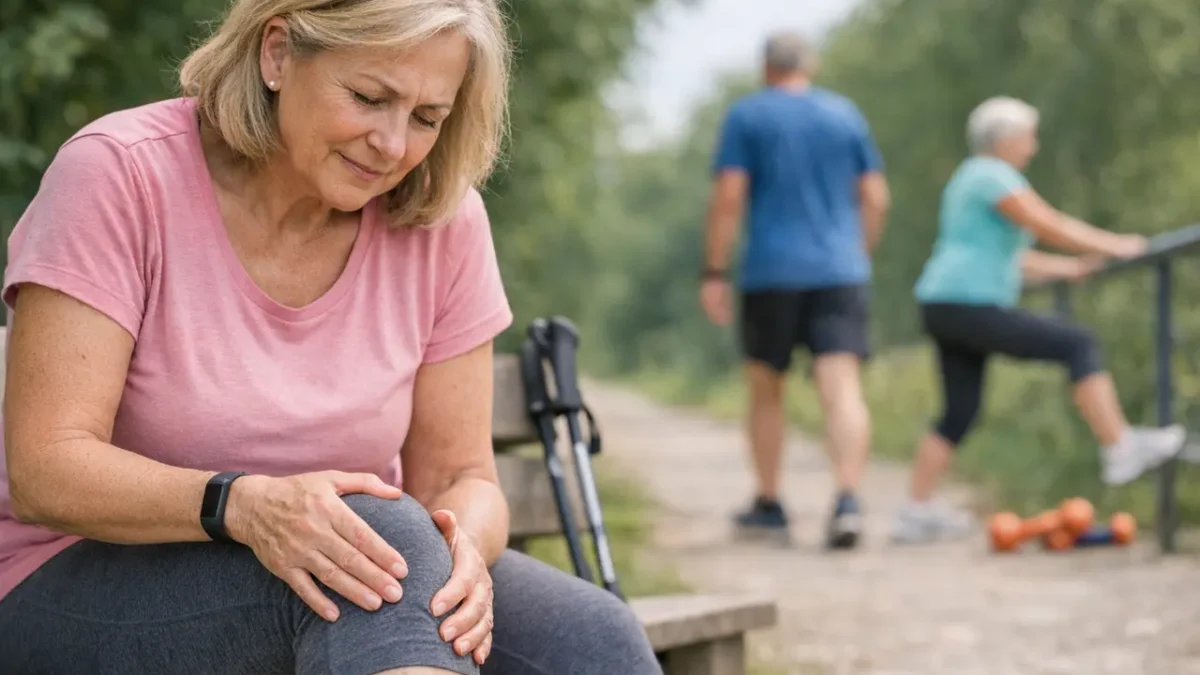
When the knee jerks with every step, the idea of preserving it by walking less seems logical. However, this is the trap that Dr Gérald Kierzek points out: faced with knee osteoarthritis, remaining immobile can also cause you to lose strength, mobility and confidence in the joint.
His advice is nuanced: walking is a good way to stay activebut it is not always enough on its own to live better with knee osteoarthritis. The challenge is not to force, nor to aim for an ideal step counter, but to combine regular activity, progressive strengthening and adaptation to pain.
Should you walk when you have knee osteoarthritis?
In most stabilized situations, walking can help maintain physical activity. Walking builds endurance, mobilizes the joint and limits the effects of too prolonged rest. It can also be easier to integrate into your daily life than a structured sports session.
But we should not draw a simplistic rule from this.
Walking does not cure osteoarthritis and does not have to become a test. If the pain increases significantly during or after activity, if you compensate a lot, or if you dread each outing, the program deserves to be adjusted. Complete rest is not a lasting solution, but the activity must remain bearable.
Why is walking alone not always enough?
The High Authority for Health recommends, for peripheral osteoarthritis, exercises adapted to the person. They can combine endurance, muscle strengthening, joint mobility and balance. In knee osteoarthritis, gradually strengthening the thigh muscles, especially around the knee, can help improve function and reduce pain.
Concretely, walking maintains momentum and endurance, but it does not always work enough on strength, stability or range of movement. However, an arthritic knee often needs a coherent whole: move, strengthen, maintain mobility, secure support. This is also what we find in the approaches to managing knee osteoarthritis and its symptoms.
There is no universal program. The exercises must take into account your pain, the stage of osteoarthritis, your physical condition, your weight, your other possible illnesses and your habits. This is the important reservation to keep in mind: these benchmarks are especially valid outside of an inflammatory or congestive attack, when the knee is not suddenly more painful, swollen or very stiff.
How to start without making the pain worse?
The most useful thing is often to start very modestly. Start with a duration and intensity that you can really tolerate: a few minutes of walking, a flat route, a pace that allows you to talk, then a slow progression.
The objective is not to reach a prescribed number of stepsbut find a regular activity that your knee tolerates.
With this walk, you can combine a few simple exercises: getting up from a chair in a controlled manner, working on knee extension, gradually strengthening the thighs or balance. But the choice depends on your situation. A physiotherapist can help you dose movements, correct compensations and know when to increase the load.
However, you must take your foot off the gas and seek advice if the joint becomes hot or swollenif the pain worsens significantly in a few days, or if unusual stiffness limits daily activities. In this case, continuing the same program without re-evaluation is not the right reflex.
The right benchmark is therefore not the number of kilometers traveled, but the knee’s tolerance over time: regular, progressive and varied activity is better than complete rest or a daily step counter challenge.