
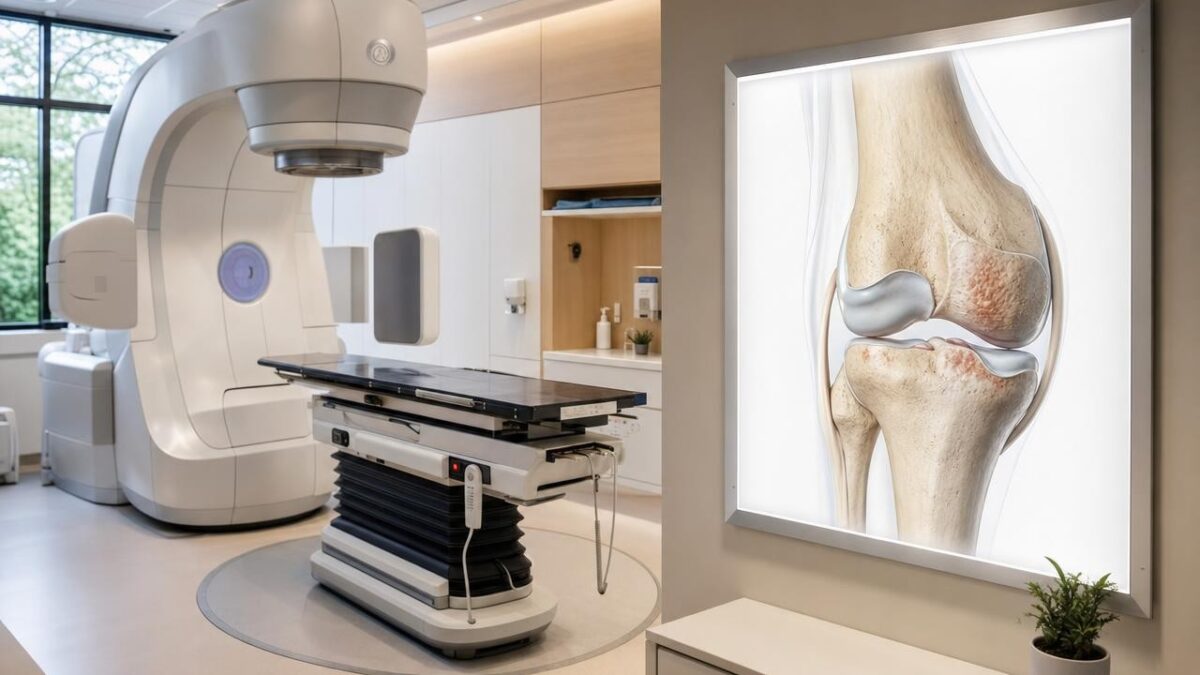
Presented on September 27, 2026 at the American Society for Radiation Oncology (ASTRO) meeting, these results are intriguing. But they still need to be confirmed before considering this approach as a real treatment for osteoarthritis.
What if we could act on osteoarthritis before it becomes irreversible?
Osteoarthritis of the knee progresses gradually: cartilage and other joint tissues deteriorate, while inflammation contributes to the progression of the disease. When the pain becomes severe and the knee loses its mobility, the prosthesis may ultimately become necessary.
Today, treatments primarily seek to preserve function and relieve symptoms. As Health Insurance reminds us: “No treatment can cure osteoarthritis of the knee, but it is possible to slow its progression through hygienic and dietary measures, medications, rehabilitation…”.
The radiotherapy studied here asks a different question:
can it act on the very evolution of the disease?
The trial included 292 adults, aged 38 on average, with Kellgren-Lawrence grade 0 to 2 osteoarthritis. All received glucosamine and chondroitin. Half also benefited from 4.5 Gy of radiotherapy divided into ten sessionswith low energy X-rays.
“At doses used for osteoarthritis, the goal is to reduce inflammation inside the joint.”explains Bobby (Nagendra) Koneru, radiation oncologist at Loyola University.
Indeed, at these doses, it is not a question of destroying cells as in the treatment of cancer, but of seeking to reduce the inflammation present in the joint.
Less pain, but above all less damage visible on MRI
The first result is encouraging, but it is not the most surprising. Both groups experienced less pain after treatment. However, only the group that received radiotherapy maintained lasting improvementwith better results on physical function and quality of life.
MRI imaging provides an additional element. For three years, she showed less structural deterioration of the knee in irradiated patients. At 12 months, the WORMS score (an MRI scoring system for assessing knee osteoarthritis) changed from -0.3 points in the radiotherapy group versus +0.9 points in the group receiving medication only. At 36 months, the scores reached respectively +0.5 and +2.3 points.
In other words, the treatment doesn’t just seem to change the way patients feel about their illness: a difference is also visible in the joint.
“The most compelling part of this study is how well the results fit together.”underlines Bobby Koneru. Patients had less pain, their function improved, MRIs showed less deterioration, and, years later, researchers observed less disability.
After a median follow-up of 11.9 yearsradiotherapy was associated with 67% reduction in risk of officially recognized disability linked to osteoarthritis. But one result particularly attracts attention.
Stage 2 could be the moment where everything is at stake
Of the 292 participants, 78 had grade 2 osteoarthritis. This is a stage where the disease is already established, but where the joint damage is not yet very advanced.
In this group, a disability was recorded among 31% irradiated patients against 61% in the control group. And above all, 14% received a total knee prosthesis versus 36% in the control group.
Both differences were statistically significant. “Stage 2 of the disease could represent a window where osteoarthritis is established but extensive joint damage has not yet occurred.believes Bobby Koneru.
This hypothesis is attractive: intervening when the joint is still sufficiently preserved could perhaps help slow down its development.
But this is still only a hypothesis to be confirmed.
A serious avenue, but not yet an alternative to the prosthesis
The researchers themselves highlight several limitations. The patients knew whether they were receiving radiotherapy and the control group did not receive simulated irradiation. The test was carried out in only one center in RussiaMRI data were incomplete and results regarding long-term disability and grade 2 were exploratory.
Furthermore, no acute radiation-related reactions or cancer in the treated area were observed during follow-up. But the study was not designed to assess extremely rare, very long-term effects or lifetime cancer risk.
For Gopal K. Bajaj, radiation oncologist at the Inova Schar Cancer Institute in Fairfax (Virginia), the interest lies mainly in the concordance between symptoms and imaging:
“What makes these results interesting is that the improvement reported by patients was accompanied by a measurable difference on MRI. This takes the issue beyond just pain relief.”.
The next step will therefore be a test multicenter, randomized, with simulated irradiationMRI criteria defined in advance and prolonged follow-up, particularly in patients with grade 2 osteoarthritis.
For people living with a painful knee, the prospect is important: one day being able to intervene
before the damage becomes irreversiblerather than waiting for the prosthesis to become the only solution. For now, however, this very low dose radiotherapy remains a promising avenue of research, and not a new standard of care.