
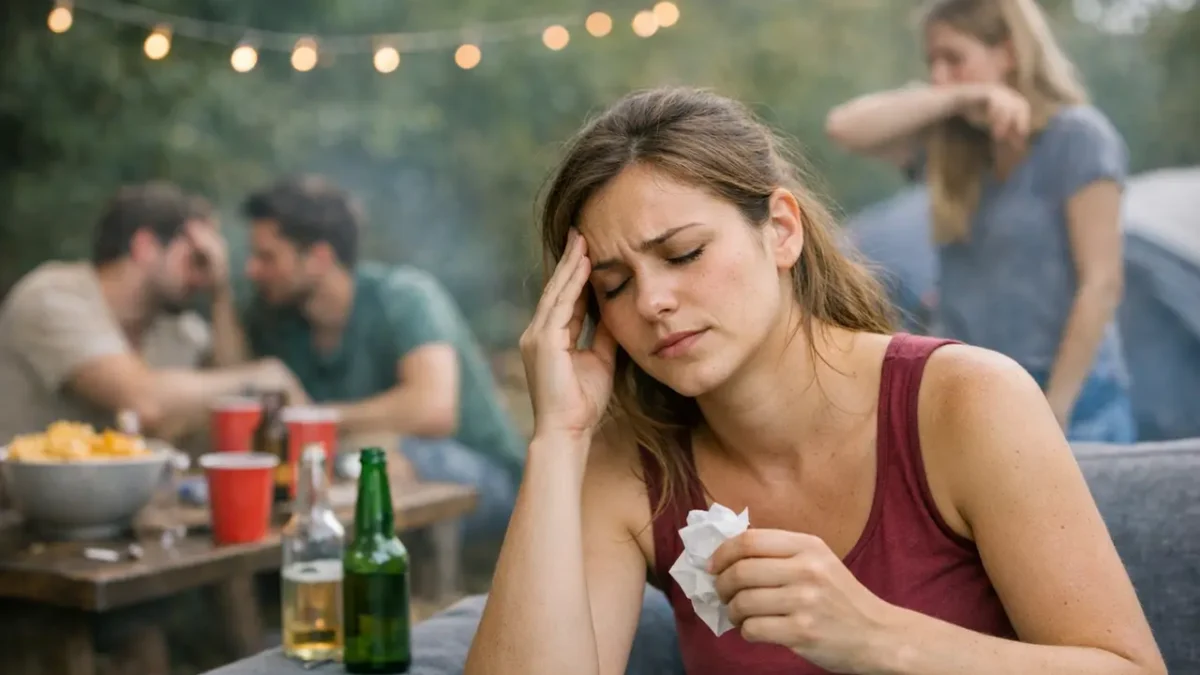
Waking up from an integration weekend, fatigue sometimes seems easy to put in the “day after the party” box. In Ardèche, the news nevertheless invites us to look broader: according to The Dauphiné Libéréaround a thousand students gathered at the Le Pommier campsite, in Villeneuve-de-Berg, on September 26 and 27, 2026, and several dozen participants had already tested positive for Covid.
The useful point is simple: fatigue and headaches can be among the symptoms of Covid, but are not enough on their own to diagnose the disease. The context, the evolution and the appearance of fever or respiratory signs must guide the rest.
Why can the day after a party blur the lines?
A single symptom rarely tells the whole story. According to Health Insurance, Covid can in particular associate a fever or feeling of fever, respiratory signs such as cough, shortness of breath or tightness, headaches, body aches, unusual fatigue, sore throat or nasopharyngitis, or even diarrhea.
The same source also recalls that the infection can sometimes go almost unnoticed. This is precisely what complicates things after a collective event: it is not because waking up is difficult that it is necessarily Covidbut that is also no reason to dismiss it too quickly.
In the episode reported in Ardèche, the public elements available confirm the gathering, the location, the dates and the positive tests of several dozen participants. They do not, however, allow us to publicly state that all the students concerned presented this or that specific symptom. Caution therefore concerns a simple idea: do not transform an individual feeling into a diagnosis.
The question to ask yourself is not just: do I have a headache? It is rather: was I in a context where many people were gathered? Have other participants tested positive? Do my symptoms change, persist, or are they accompanied by a fever, cough, sore throat, or difficulty breathing?
When should you seek advice rather than conclude too quickly?
A suspected hangover is not enough to rule out infection. If suggestive symptoms appear after a gathering, Health Insurance recommends contacting your doctor. A healthcare professional will be able to indicate whether a test is usefuldepending on the symptoms, the context and the surroundings.
This approach is all the more important when you have to come across vulnerable people. The goal is not to dramatize each fatigue, but to limit the risk of transmission when doubt is reasonable. Covid remains a disease whose signs can overlap with other everyday situations: only the complete context can guide the action to be taken.
While waiting for an opinion or a possible test, the recommendations remain concrete:
- Apply barrier gestures in case of suggestive symptoms;
- Avoid contact with vulnerable people;
- Inform those around you if the symptoms suggest an infection;
- Contact your doctor to find out what to do next.
A sign should not be trivialized: if you run out of breath at the slightest effort or when you speak, call 15or 114 for deaf or hard of hearing people. The day after a night out does not automatically explain respiratory discomfort.