
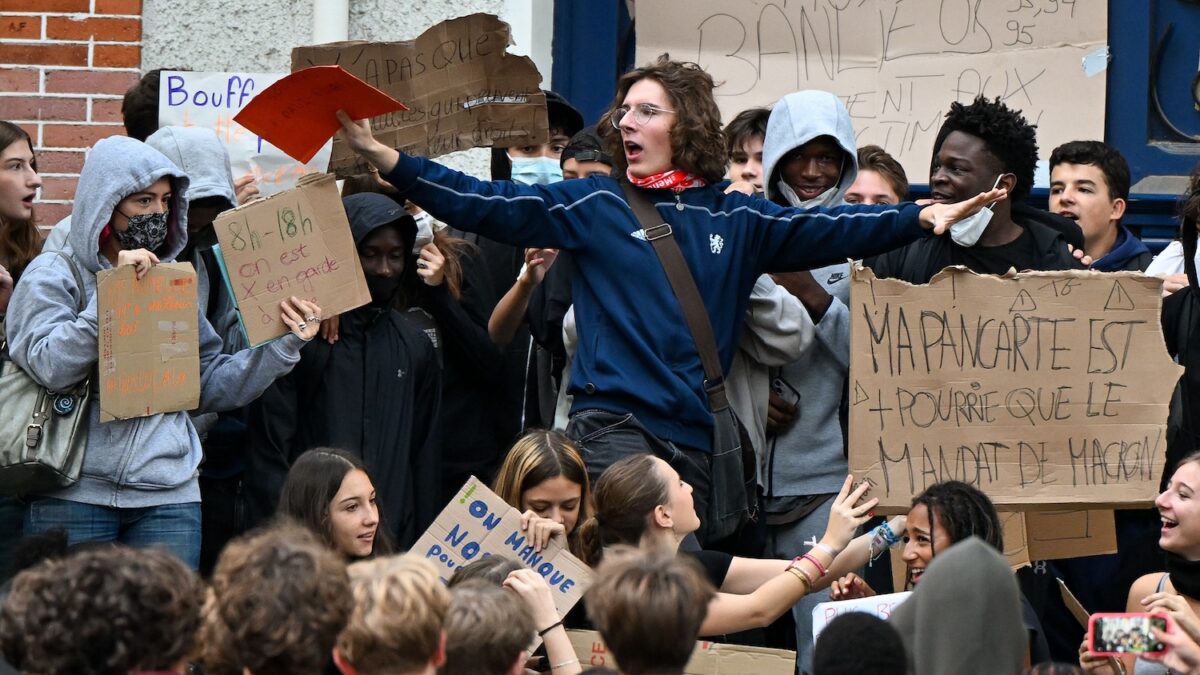
High school anger takes on a national scale. Part of several establishments in the Paris region, the protest is spreading throughout the territory. On the ground, the demands go beyond the simple political framework. The students are demanding renovated premises, the effective replacement of absent teachers, decent study conditions and denounce the permanent stress generated by Parcoursup.
As tensions intensify and the authorities worry about an increasingly degraded social climate, this crisis suddenly highlights the question of the pace and well-being of young people at school. If the physical fatigue and exasperation are palpable, the reality of the medical-school field reveals a deeper unease.
Saphia Guerischi, National Education nurse and general secretary of SNICS (National Union of Nurse Health Advisors), nuance for True Medical the causes of this exhaustion among adolescents.
French students work more than the OECD average
Students’ overloaded schedules are the first element pointed out.
“Although the impact of school pace and workload depends on each child, the teacher and the classroom dynamic, students are overall very resilient” explains Saphia Guerischi.
An inevitability that these young adolescents no longer seem to accept. Indeed, the overall load of courses and personal work places France among the densest systems for high school students. In the general and technological track, a high school student has on average between 28 hours and 35 hours of prescribed courses per week. And according to the latest report Perspectives on education of the OECD, France is characterized by longer and more concentrated days than most European countries.
Thus, on the overall scale of schooling, French students accumulate significantly more hours of compulsory education than the average for OECD countries.
“No more room for error”: how pressure from Parcoursup breaks the morale of young high school students
Class hours alone do not sum up the students’ distress. Beyond this heavy logistical organization, the mental health of young people is faced with an accumulation of social pressures and global uncertainties.
“The increase in stress and anxiety is undeniable among young people, which has a direct impact on their health. Political uncertainty, recent conflicts and even eco-anxiety generate a significant form of stress.
indicates Saphia Guerischi.“They are therefore more tired today due to a set of factors that weigh on them on a daily basis” confirms the school nurse.
With this overall anxiety comes increased academic pressure. The introduction of Parcoursup, continuous assessment for the baccalaureate and the constant anticipation of career choices weigh heavily on the shoulders of students from middle school onwards. The multiplication of supervised homework and evaluations maintains a continuous tension.
The school nurse highlights this continued fear of bad grades. “With Parcoursup, in recent years, students have had the feeling that they no longer have the right to make mistakes. As soon as they enter middle school, a fairly strong anxiety sets in regarding their choice of orientation and the impact of these on their future.”
Sleep debt and the impact of screens
The other explanatory factor in the chronic fatigue of high school students lies in the deterioration of the quality and time of sleep, which is greatly disrupted by the omnipresence of digital technology.
“We know that they are sleeping less and less, and this is a real issue for their health.”alerts Saphia Guerischi. “Students come to us because they are exhausted. By talking with them, we realize that they are under constant hyper-demand, both at school and outside, through screens and social networks. They have very little rest space.”
Faced with this hyperconnection and the difficulty of stopping after classes, the nurse recommends health education shared with families to relearn how to preserve the rest times essential to the physiological development of adolescents.
School infirmaries on the front line but under tension
In the end, adolescents often end up in the infirmary. “Students come in for reasons that may seem trivial, such as headaches, stomach aches, fatigue or the need to escape class.“, specifies Saphia Guerischi. “When we question them about the causes of this desire to leave the course and we identify underlying fatigue, we manage to untangle the situation with them in order to review their pace of life and act on their relationship with school.”
However, the school health service seriously lacks the means to ensure this fundamental monitoring. Nurses must fight to keep reception centers open, while school medicine faces a major shortage of staff.
“Of the 1,800 budgeted National Education doctor positions, only 700 are filled. This deficiency delays the early detection of many pathologies, I am thinking in particular of certain neurodevelopmental disorders in students”
the health professional is indignant.
Dilapidated premises and overcrowded classes: aggravating factors
Finally, the living environment within schools also contributes to the hardship felt by students. Numbers of 30 per class, continuous noise and poorly adapted buildings (particularly for the heat, in the face of heatwaves) create a trying environment.
“When students live in overcrowded classes of 30 people, cramped and noisy, without a place to listen or easy access to the infirmary to rest, we are only adding difficulty to an already complex situation.”notes the nurse. “And when it’s between 30 and 39 degrees in the classrooms, just sitting still becomes tiring. The students were literally exhausted from coming to class at the end of last year.”
Reestablishing the culture of connection and spaces for discussion
Faced with this worrying observation, how can we respond to the distress of young people? For Saphia Guereschi, the solution involves restoring social ties and communication within establishments. “The Health, Citizenship and Environmental Education Committees (CESCE) make it possible to initiate collective projects adapted to each middle school or high school.
The objective is to recreate spaces for speech and debate, to generate a collective dynamic which will take different forms depending on the establishments, teams and identified needs.“. A first step to respond to the overall uneasiness that many high school students experience today, but far from sufficient.
To preserve the physical and mental health of students, collective awareness is necessary: restore sufficient resources for school health, reinvest in buildings and relearn young people to preserve their sleep and break times essential to their construction.