
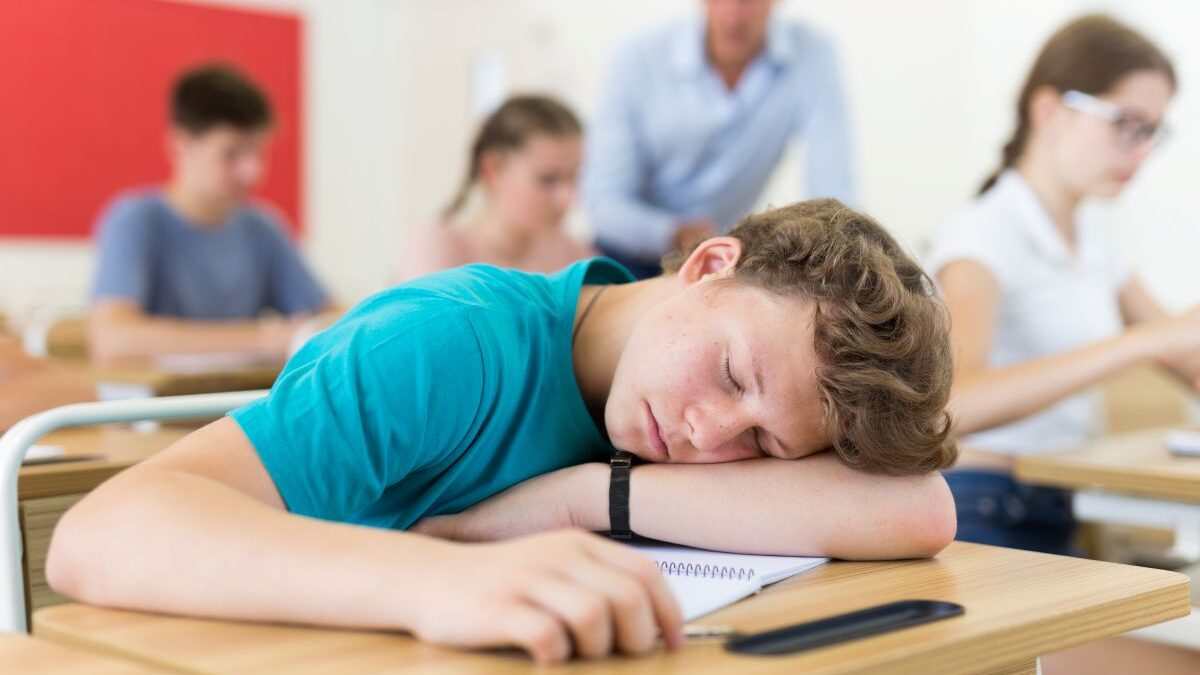
For many young people, maintaining a regular rhythm is a daily challenge. American researchers followed more than 1,100 students equipped with connected bracelets: initially, they slept an average of 6 hours 36 minutes per night and half went to bed after 1 a.m.
Getting paid to sleep: the incredible experience to improve young people’s sleep
By offering them about $5 per weeknight achieving at least 7 hours of rest, the scientists observed a 26% increase in long enough nights and an average gain of 19 minutes of sleep. “A slight improvement, which remains far from sufficient” first comments Dr Jérôme Liotier, sleep doctor.
Beyond this experience, what are the real keys to preserving the rest of our young people?
What is the ideal amount of sleep between 17 and 20 years old?
If the study set a threshold at 7 hours, the physiology of young adults often requires more. The transition from adolescence to adulthood is accompanied by specific needs that should not be underestimated.
“For an adult over 20 years old, you need between 7 and 8 hours of sleep. On the other hand, between 17 and 20 years old, we are just coming out of adolescence where the needs are generally between 8 and 9 hours. Young adults therefore need an additional hour of rest compared to the average adult.explains Dr. Liotier.
He also recalls the existence of different genetic profiles:
- Short sleepers: those who sleep less than 6 hours per night;
- Long sleepers: those who need more than 9 hours per night.
Why lack of rest seriously harms studies and morale
In France, one in three students indicate that their sleep difficulties disrupt their studies. Even more worrying, the National Observatory of Student Life reveals that 24.3% of students face psychological distress and 25.2% a depressive episode. However, sleep plays a direct protective role on cognitive abilities.
“Sleep consolidates memory. It is during deep slow-wave sleep that knowledge is imprinted in the brain. If you don’t get enough sleep, everything you learned during the day doesn’t stick.”underlines Dr Liotier.
Sacrificing your night to study before an exam is therefore a very bad calculation. “CIt’s a classic mistake among students to revise at the last minute and only sleep 3 or 4 hours, thinking they’ll learn more. Without these 8 hours of sleep, a large part of the revision goes by the wayside. It is rest that fixes the memory.”
Daily fatigue: watch out for sleep pathologies
Beyond the duration, the quality of rest is essential. A young person who sleeps 8 hours but wakes up exhausted must wonder. Underlying disorders can impair sleep in invisible ways.
“Students often have a profile of night owls and late risers. But if the sleep time seems sufficient and fatigue persists, it is necessary to check that a pathology does not alter its quality. warns the doctor. “From the age of 20, young men can begin to suffer from sleep apnea, while young girls are more prone to restless legs syndrome, two disorders that profoundly disrupt sleep.
These pathologies cause sleep disturbances. “Both sleep apnea and restless legs syndrome cause micro-awakenings. We sleep continuously seemingly without realizing it, and only a polysomnographic recording allows the diagnosis to be made.”
So what is the main warning signal? “The most telling sign is fatigue first thing in the morning when you wake up. If this feeling is regular and is accompanied by a need to nap in the afternoon despite sleeping full nights, it becomes necessary to consult a sleep doctor.” recommends our practitioner.
Evening hygiene: reflexes for falling asleep successfully
To fall asleep peacefully, it is not enough to go to bed at a fixed time, you must prepare your body. Dr Jérôme Liotier details common errors and how to avoid them:
- Stop exercising in time. “You must stop all physical activity at least three hours before going to bed. If you go to bed at 11 p.m., you should no longer do sport after 8 p.m.”;
- Maintain a low body temperature. “Hot baths should be avoided in the evening. To fall asleep well, the body needs a rather cool climate, with a room kept between 19 and 20°C. ;
- Cut screens. “You should turn everything off at least an hour before going to sleep. Instead, focus on reading a book or lessons on paper to help you fall asleep naturally”;
- Enter the door to sleep. “As soon as the first signs of drowsiness appear, it’s the right time to go to bed. If we miss this checkmark by making a phone call or launching another activity, we miss the sleep cycle and we will have to wait an hour and a half for the next wave to return. he concludes.
Adopting a rigorous lifestyle requires real self-discipline on the part of students. This ability to respect one’s physiological needs often makes the difference during the years of study: good regularity and preserved sleep remain the best allies for mental health and academic success.