
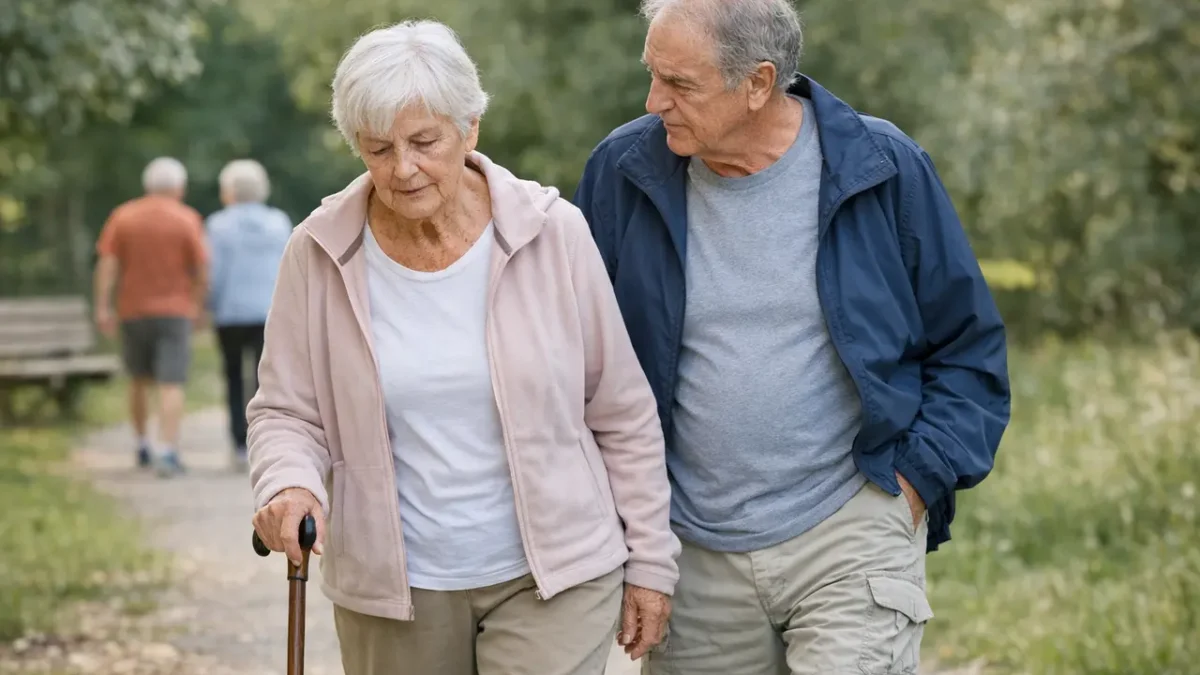
Initially, it looks like a very ordinary walking session: 45 minutes, three times a week, in a supervised setting. But for fragile seniors, one question changes everything: is it better to walk at your usual pace or try to speed up a little?
A study carried out by teams from Northwestern University and the University of Chicago suggests that more sustained, supervised and progressive walkingcan improve certain mobility benchmarks. Without proving that you have to accelerate alone overnight.
Can walking faster help frail seniors?
In older people, walking speed is not just an impression. It is often used as a simple indicator of functional health, because it reflects part of daily physical abilities. True Medical has already mentioned this in an article on walking speed and healthy life expectancy.
In this new trial, 165 frail or pre-frail adults were recruited. The mean age of participants included in the final analysis was 79.2 years. The program lasted sixteen weeks, with supervised 45-minute sessions, three times a week.
The study compared two approaches. In one group, the participants walked at a more intensive pace, with a higher but controlled effort. In the other, they walked at the speed that suited them, in a more leisurely manner. This trial was randomized by residence, which means that the groups were formed according to the participating places of life.
Among those evaluated at the end, 69.6% of participants in the intensive walking group improved their frailty category by at least one level, compared to 46.4% in the chosen pace group. The intensive group also improved more on usual walking speed and distance covered in the six-minute test.
What this changes in the walking advice
The result is interesting because it shifts the gaze a little. When we advise walking, we often talk about duration, regularity or number of steps. Here, the study suggests that
looks might also matterat least in certain fragile or pre-frail seniors, when the effort is adapted and monitored.
But the central point is indeed the supervision. The participants were not satisfied with a general recommendation. They followed an organized program, repeated over sixteen weeks, with supervised sessions. This is very different from advice given without evaluation: “Walk faster tomorrow”.
This nuance is important for everyday actions. Regaining a little speed or endurance can help you move more easily, for example during an outing, a short trip or a necessary daily walk. But the study does not make it possible to promise a recovery of autonomy, nor to generalize its results to all seniors.
Why should we not accelerate without caution?
The main limitation is missing participants. Out of 165 people recruited, only 105 appear in the final analytical cohort. And when researchers take this missing data into account in their analyses, the advantage observed in the frailty category is no longer statistically assured.
In other words, the study opens an encouraging avenue, but it does not demonstrate that increasing pace is enough to reverse fragility. Above all, it shows that a more intensive, supervised and regular walking program can be associated with better results in participants evaluated until the end.
For a senior who is already comfortable walking, the idea may be to gradually introduce short, slightly more dynamic passages, while remaining within a well-tolerated effort. On the other hand, in the event of instability, pain, unusual shortness of breath or a known illness that could limit effort, it is better
seek the advice of a doctor or physiotherapist before changing the intensity.
The step counter therefore does not tell everything. For certain fragile seniors, speed could become a goal of rehabilitation or adapted activity, provided it remains within the right framework: that of supervised progression, and not of improvised acceleration.