
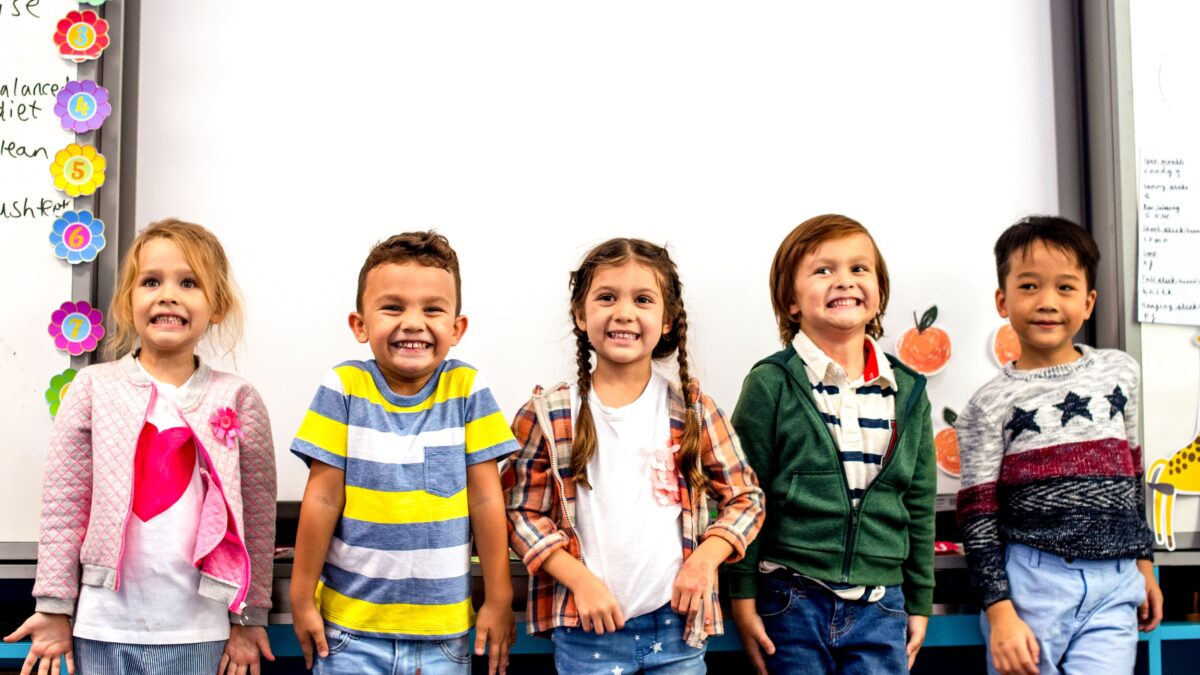
Fighting action in the bathroom! This morning, the children will have the right to their class photo. A traditional ritual announced shortly after the start of the school year, to immortalize their place (and their class). So the preparations are underway: choice of clothes, ironing, braided hairstyles or even gel in the hair… In many families, everything is done to leave a good impression, at least that day. Sometimes even putting real pressure on yourself. But why?
A photo that encourages comparison
The class photo is far from being a simple childhood memory. According to a study carried out by the FLASHS institute for Cheerz among 1,000 parents of children in nursery, primary or secondary school, 59% of parents admit to comparing their child to his or her classmates based on the cliché. And this view focuses first on appearance: clothing comes first (59%), followed by smile (53%) and general appearance (53%). In other words, this little annual snapshot also becomes, for many parents, a basis for comparison with other children.
The pressure does not stop with the child. 66% of parents surveyed believe that their child’s photo reflects an image of themselves and that they can be judged by other parents through this photo. A perception which can explain why 90% pay particular attention to their child’s outfit or appearance on photo day, including 54% very markedly. Even the financial aspect testifies to this importance given to image: 94% of parents say they devote a specific budget to their child’s appearance for the start of the school year, for an average expenditure of 178 euros per child.
“The class photo can quickly become an evaluation”
For Amélie Boukhobza, psychologist, this pressure is explained in particular by the very particular way in which the class photo works: it places the child among others, in an identical setting, at the same age and at the same time.
“The class photo can quickly become an evaluation. Of the child, of course, but above all, through him, of his parents. All that in a photo!”analyzes the psychologist.
And it is precisely this collective dimension that favors comparison. In a class photo, all the children are gathered in the same frame. The gaze can then move very easily from one face to another: who seems the most smiling? Best dressed? Most comfortable? The biggest? Or even the shyest?
“We look at the clothes, the size, the smile. Then we begin to interpret: he seems more shy, less at ease. More like this, less like that… We look for clues in the image about its place in the group”continues Amélie Boukhobza.
With a trap: wanting to make a photograph speak much more than it really can. A frozen smile, a look away or an unusual posture may simply be linked to the moment the photo was taken. However, the parent may see it as a sign of discomfort, exclusion or, on the contrary, integration.
“With the risk of making an expression captured in a second tell a lot”underlines the psychologist.
When the child’s photo also becomes that of the parent
If parents scrutinize the cliché so much, it is also because they may have the feeling that it is talking about them. A well-groomed, properly dressed and smiling child can thus be experienced as a form of implicit validation: everything is fine, I am doing my job as a parent correctly.
“There can also be something narcissistic at play, in the sense of the image and value we give ourselves. As if, as parents, our self-esteem depended on it!”explains Amélie Boukhobza.
The mechanism can work in both directions. The satisfaction of seeing one’s child to his or her advantage can enhance the parent’s value. Conversely, a detail deemed unsightly or an unfavorable comparison can weaken one’s self-esteem. Even if no one else is really paying attention.
“A smiling, well-groomed child who seems at ease can reassure us about our role. Conversely, a detail that we don’t like can take on disproportionate importance in what we imagine others think of us.summarizes the psychologist.
Clothing, hairstyle, brands: everything can become a sign
The class photo is also not completely socially neutral. An outfit, a pair of shoes, a hairstyle or a brand can be perceived as signs of belonging to an environment. Parents can then have the feeling that, behind a few clothes, others will guess their standard of living, their tastes or their way of educating their child.
“We give them information about the family’s means, its tastes, its education. With everything that our prejudices can add to the image”, observes Amélie Boukhobza.
However, this interpretation largely depends on how each person views the image. An outfit is not necessarily an intentional social message, any more than an expression in a photo tells us about a child’s personality or well-being.
What if our own history came into play?
The pressure felt around the class photo can finally find its source in the parent’s personal history. Certain childhood memories can resurface, especially when you yourself were made fun of for your clothes, your appearance or your place in a group.
“A parent who has suffered from teasing about their clothes or appearance may fear that their child will experience the same thing”explains the psychologist. In this case, carefully choosing the outfit, checking the hairstyle or anticipating the smallest detail can become a way of protecting your child.
But this desire for protection can also have an unexpected effect. By wanting to prevent our child from experiencing the wounds we ourselves have experienced, we can pass on to them the anguish that inhabits us.
“The risk is to transmit to him the worry that we would precisely like to protect him from”warns Amélie Boukhobza.
A memory above all
However, the class photo remains widely popular: 98% of families surveyed say they buy at least one photo. Proof that, behind the comparisons and the little worries, the desire to keep a trace of childhood remains very present.
The challenge then is perhaps to put this photo back in its rightful place. It does not say whether the child is “better” or “worse” than the others, does not make it possible to measure his or her integration in the class and certainly does not constitute an evaluation of the work of his or her parents. It is simply the image of a moment.
And in a few years, what we will probably look at with the most attention will be neither the brand of the sweater, nor the perfectly done hairstyle, nor the place occupied in the row. But that little child’s face, as it was at that time.