
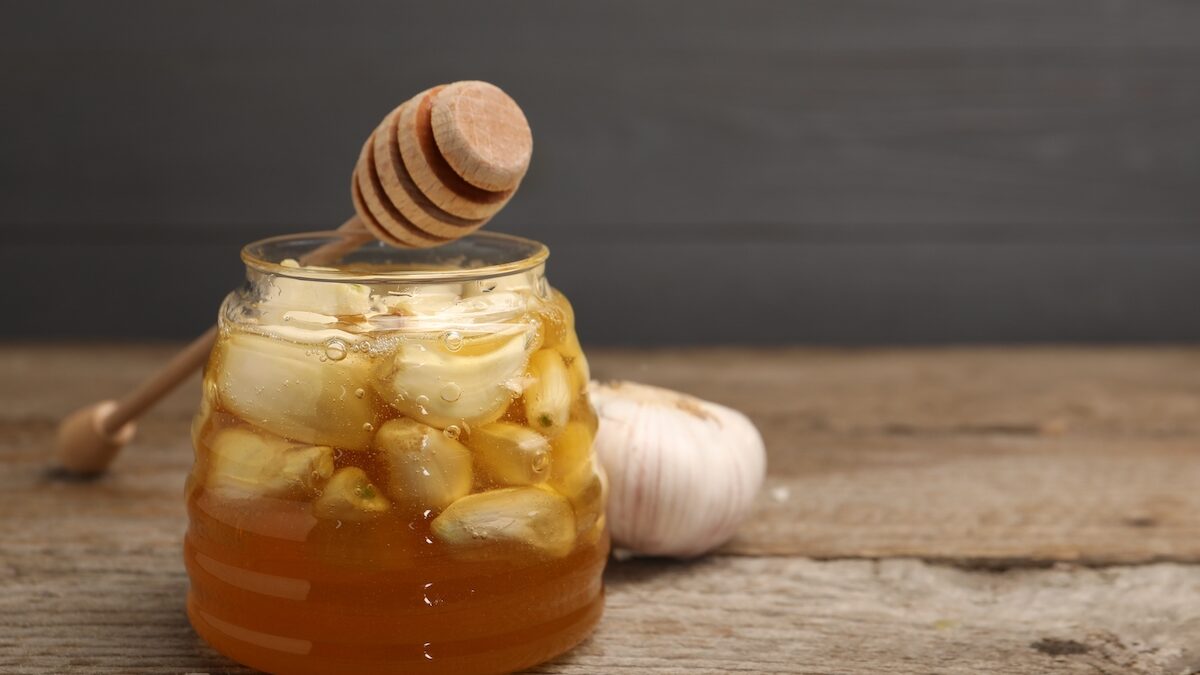
With fall, colds, viruses and fatigue return. But also the good tips to protect yourself, and of course please. It is in this context that a preparation regularly comes up on TikTok and social networks: raw garlic placed in honey, then left to ferment at room temperature.
An attractive home remedy due to its naturalness
On paper, the idea seems attractive. Garlic, to which antibacterial properties are attributed, and honey, known to be softening and healing: the duo would be the ideal winter remedy to “boost” the immune system.
Some fans say they eat a clove every morning to benefit from a “boost” and supposed protection against the little ailments of winter. “It is effective against coughs, colds and sore throats“, assure some Internet users. Others even attribute anti-aging virtues to it.
But behind this apparent natural potion lies a real security problem.
Garlic and honey: a combination that is not without risk
“This ‘grandma’s recipe’ of fermenting garlic in honey does indeed carry a clear risk of botulism and is not a safe method of preservation” alerts Dr. Gérald Kierzek.
Botulism is a rare but potentially very serious disease. It is caused by a neurotoxin produced in particular by bacteria Clostridium botulinum. Its spores are naturally present in the environment and can survive in certain foods. The danger appears when they find conditions favorable to their development and the production of toxins.
However, this is precisely what poses a problem with fermentation carried out at home, without control of pH, humidity or temperature.
Why can the mixture promote bacteria?
Pure honey is naturally unfavorable to the development of many micro-organisms, in particular because it contains little available water. But when a fresh clove of garlic is dipped in it, it releases water. “The conditions present around the food can then be different from those of honey alone” underlines the doctor.
The closed container adds another difficulty: Clostridium botulinum can grow in the absence of oxygen.
Finally, the acidity level plays an essential role. Below a pH of 4.6, the bacteria generally cannot multiply. But the pH of a garlic-honey preparation is not guaranteed at this level. Spontaneous fermentation therefore does not allow us to know whether the preparation is sufficiently acidic to prevent toxin production.
“Acidity is difficult to guarantee in a preparation made at home“, continues our expert.
In other words, leaving a few cloves of garlic in a jar of honey for several days is not a validated preservation method.
A toxin that can cause paralysis
The danger comes from the botulinum toxin produced when conditions are right. This acts on the nervous system by preventing the nerves from correctly controlling the muscles.
Early symptoms may include blurred or double vision, difficulty speaking or swallowing, muscle weakness, and progressive paralysis. In severe forms, the muscles necessary for breathing may be affected, which constitutes a medical emergency.
Another difficulty: we cannot necessarily detect the presence of the toxin by looking or smelling the food. A contaminated preparation may not show obvious spoilage.
This is why health authorities recommend great caution with preparations and preserves whose manufacturing and storage conditions are not controlled.

And honey for babies?
Honey is also the subject of a very clear recommendation for toddlers: it should never be given before the age of 1 year.
In infants, spores of Clostridium botulinum
can germinate in the intestine and cause infant botulism. ANSES recalls that honey is an identified source of this type of botulism.
This precaution obviously does not mean that honey is dangerous for adults. The risk particularly concerns infants, whose digestive system is still immature.
So, should we abandon this recipe?
Yes, especially when it involves letting garlic ferment in honey at room temperature without precise protocol.
“Garlic and honey can perfectly be consumed separately as part of a varied diet. On the other hand, transforming them into a fermented preparation presented as an “immunity cure” is not based on any guarantee of safety and is not a miracle shield against winter infections” supports Dr. Kierzek.
“In short, we forget this grandmother’s recipe!”
To get through the winter, it is therefore better to rely on preventive measures whose effectiveness and safety have been established, such as hand washing, or even a good diet, than on a preparation that has become viral on social networks.