
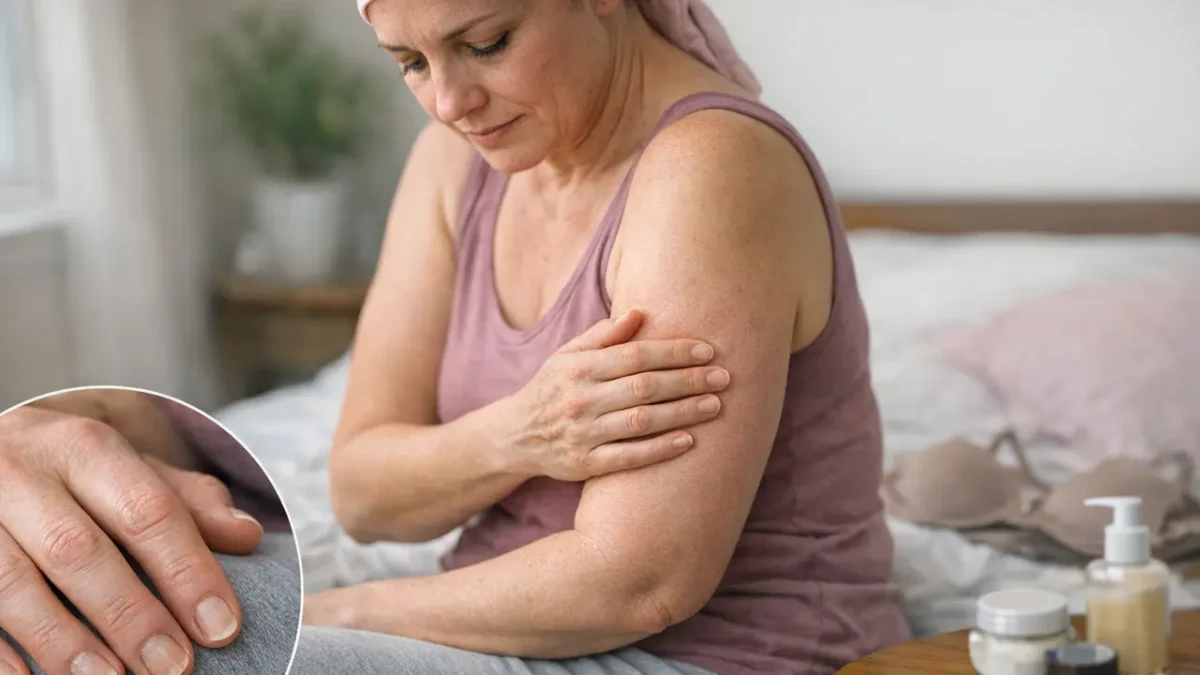
We often think of hair that falls out during certain chemotherapies. We also rightly talk about breast removal and reconstruction. But Dr Gérald Kierzek draws attention to other, more discreet ordeals that women — and, more rarely, certain men — treated for breast cancer can go through.
His advice is simple: do not consider these troubles as details to be borne in silence. Skin, nails, swollen arms, joint pain, hot flashes, intimate dryness…when these effects appear, they must be reported to the healthcare team. Treating cancer also means taking charge of what treatments put the body through.
What visible effects are less often mentioned?
Hair loss is known, but it is not the only visible change. According to the National Cancer Institute, certain chemotherapy treatments can cause dry skin, redness, plaques or even changes to the nails. These can become more fragile, brittle, streaked, wavy, and sometimes fall off.
Eyelashes and eyebrows can also temporarily fall out with certain chemotherapies. For many patients, this detail is not one: the look changes, the face seems different, and the self-image can be affected on a daily basis.
Breast radiotherapy can also cause skin reactions, often temporary when they occur early.
The treated area may become red, dry or irritatedwith variable sensitivity depending on the dose, the irradiated area, the technique used, the associated treatments and the sensitivity of each person.
An essential reservation: these effects are not systematic. They depend on the protocol, doses, associated treatments and each patient. This is also why advice must be personalized. To better understand the general effects of chemotherapy, you can read our article on the side effects of chemotherapy.
Why can an arm swell after breast cancer?
After certain lymph node treatments, and sometimes after radiotherapy, an arm may enlarge. This is what we call a
lymphedema. It is linked to damage to the lymphatic system, which normally drains part of the body’s fluids.
Concretely, the arm may seem heavy, tense, swollen. Some people experience discomfort moving their shoulder, elbow, or wrist. Lymphedema can also impact quality of life: dressing, working, carrying a bag or sleeping comfortably sometimes becomes more difficult.
However, we should not draw a general rule from this: not all people who undergo surgery or are irradiated develop lymphedema. But when swelling appears, it is better to report it quickly. Support existswith supportive care adapted to the medical assessment, without promise of a universal solution.
And what is less visible: pain, hot flashes, intimacy?
Some effects are not noticeable at first glance, but can take up a lot of space. Certain hormonal therapies, notably anti-aromatases, can cause joint pain, hot flashes, fatigue or vaginal dryness. These disorders can disrupt sleep, activities, but also intimate life.
Breast cancer and its treatments can also weaken self-esteem, relationships with the body, desire or relationships as a couple. After surgery, some women choose breast reconstruction, others do not: the important thing is to be able to be supported on their own journey. On this subject, also read our article: rebuilding yourself after illness does not necessarily involve breast reconstruction.
The take-home message is practical: talk to the healthcare team. Skin care, support for lymphedema, psychological support, consultation dedicated to sexuality, adaptation of supportive care: assistance can be offered. And if a treatment becomes difficult to bear, contact your oncologist before stopping it.