
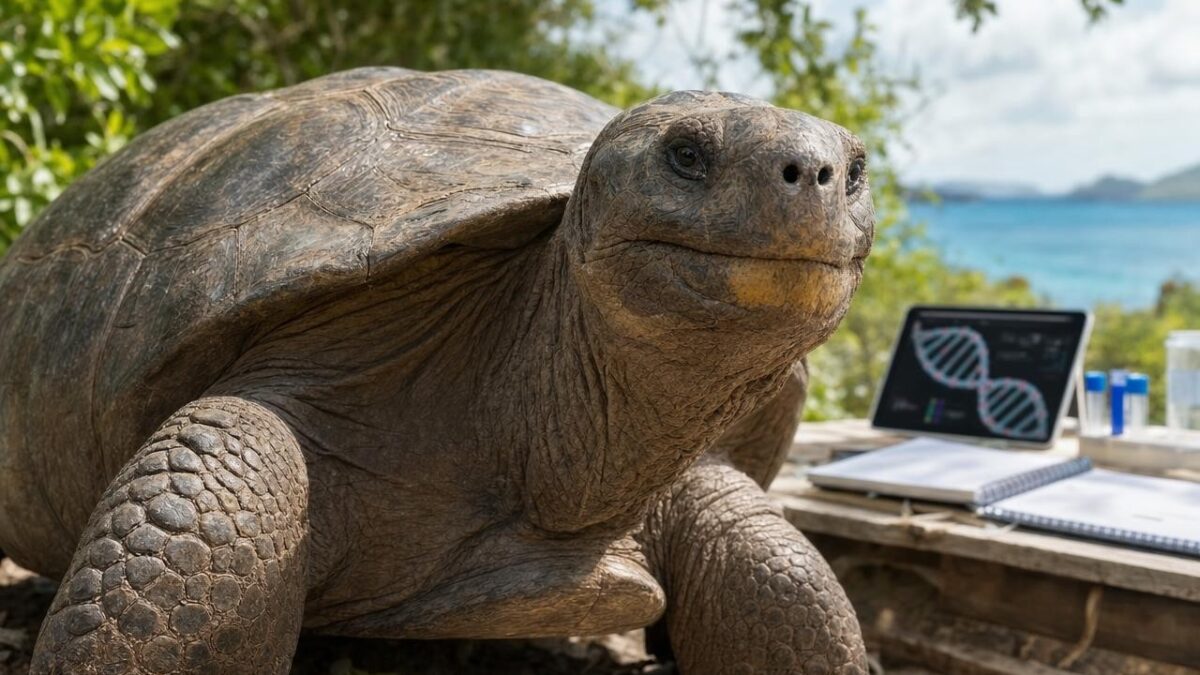
At almost two centuries old, the oldest known land animal is now focusing the attention of aging biologists. On the island of Saint Helena, a 194-year-old Aldabra giant tortoise serves as a living model to understand how certain cells delay the wear and tear of time. At the heart of this scientific investigation, we find both DNA and chemical marks placed on its surface.
This turtle is Jonathanborn around 1832 and studied in a vast analysis published on October 7, 2026 in the journal Science Advances. While the maximum life expectancy of an Aldabrachelys gigantea is estimated at around 94 years, Jonathan would have lived almost 100 years longer. Its genome and epigenome therefore provide valuable clues about the longevity extreme, which researchers are already comparing to certain human cases of super-centenarians.
Jonathan, star resident of Plantation House in Saint Helena
Jonathan has lived since 1882 in the grounds of Plantation House, the residence of the governor of Saint Helena, where he shares an enclosure with other giant tortoises. Blind due to cataracts, he nevertheless reacts to the voice of his veterinarian Joe Hollins. “I know that he knows me, that he knows my voice and the way I manipulate him, and I also know that it is not love on his part but the recognition of the arrival of a feast“, says Hollins, before adding: “And yet, of course, it doesn’t bother me. I have immense affection for him.”.
To protect this true living monument, the authorities refuse any blood tests. The international team led by the Kallel Foundation therefore collected cells from its mouth. Stephen Clark explains that the mouth swab was “rather delicate and dangerous”. A reference genome was assembled from a younger turtle, then adjusted to obtain a sequence “approximately 95% Jonathan”, which already requires interpreting the results with caution.
What Jonathan’s DNA and epigenome reveal about longevity
At the genetic level, Benjamin Vaisvil reports: “We found changes in Jonathan’s genome in pathways associated with longevity, such as DNA repair, cell function, mitochondriainsulin regulation and telomere function“. Researchers identified 287 genes with unique variants in it, including several related to tumor suppression and DNA repair, and also additional copies of a perforin gene that helps the immune system eliminate old and cancerous cells.
The real surprise comes from “methylation entropy”. Methyl groups are little chemical switches on DNA; with age, their pattern becomes chaotic. “If I had to define aging it would be increasing entropy.“, summarizes Stephen Clark. In Jonathan, most of the marks appear as old as he is, but in 272 key genes – especially related to mitochondria and RNA metabolism – the entropy remains as low as in a 5-year-old turtle. Dr. Justin Gerlach notes that “gene regulators involved in energy production and DNA repair have remained incredibly stable in Jonathan for almost two centuries“.
From Jonathan to Humans: Cautious Promises of Longevity Secrets
For Clark, “nature has already solved the aging puzzle in remarkable ways, and Jonathan’s genome provides a basic blueprint for cellular resilience“. The Kallel Foundation hopes to test in humans, via non-profit clinical trials, already known cheap molecules – such as rapamycin – in order to protect mitochondria and limit this epigenetic disorder, a pattern reminiscent of observations made in a 117-year-old woman also exhibiting exceptionally efficient mitochondrial function.
Scientists, however, insist on the limits. “We can’t say for sure that what we found is the reason for its longevity“, warns Benjamin Vaisvil. Clark agrees: “We can’t really plant a flag on something and say, ‘Oh, that’s why it lived so long.’ This work is only the first step“. As he summarizes elsewhere, “we are still trying to understand how aging happens and Jonathan gives us a real window into what happens over a very long period of time“. For now, his best secret remains this rare mix between extraordinary biology and quiet life in the tropics.