

The scale had dropped, then the pounds came back. After one or more diets, many end up wondering if they have damaged their metabolism, or if it is better to stop all attempts at weight loss. According to two experts, the possible consequences of loss-regain cycles depend in particular on the starting weight. In the case of obesity, the fear of yo-yoing should not prevent you from considering treatment. At normal weight, repeated and unnecessary diets raise another question, particularly around muscle mass and fat regain. Explanations.
I gained back all the kilos: did I “disrupt” my body?
After having “disadjusted” your body with a diet followed by regaining weight, has the yoyo effect condemned your weight curve to rise ever higher? The answer is not so obvious; Professors Norbert Stefan and Faidon Magkos, researchers at the German Diabetes Research Center and the University of Copenhagen, distinguish two situations.
In people with obesity, they indicate that there is currently insufficient evidence to assert that repeated attempts to lose weight would systematically worsen long-term weight change. In other words,
the fear of a yo-yo effect should not dissuade them from losing weight.
This nuance is important, because guilt sometimes pushes you to give up. The objective is not to multiply severe diets, but to re-evaluate what has not held up over time: rate of loss, diet, physical activity, sleep, treatments, psychological context, pain or daily constraints.
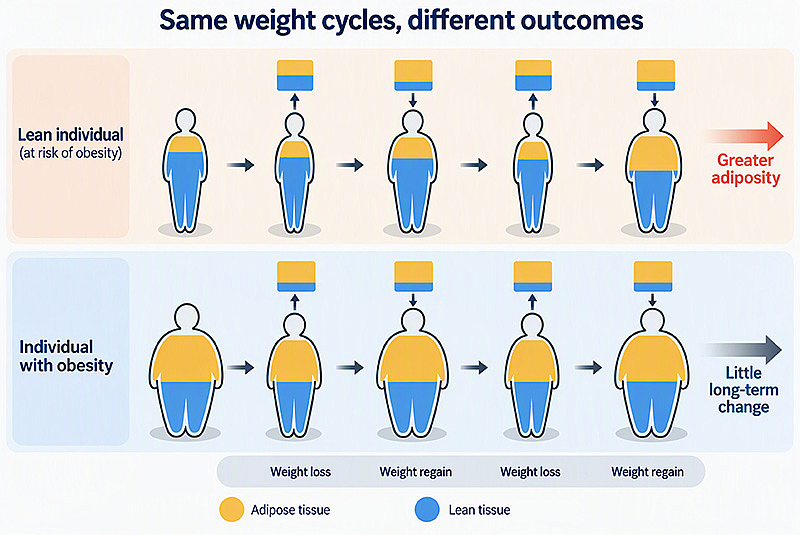 © Deutsches Center für Diabetesforschung
However, a reservation remains necessary: this is a scientific commentary, not a new randomized experiment which would demonstrate an identical effect in all people. It therefore does not allow us to say that all diets are without risk, nor that the yo-yo effect would always be commonplace.
Why doesn’t weight alone say everything?
At normal weight, the authors put forward a different hypothesis. During a restrictive diet, a person can lose some lean body mass, including muscle. If the pounds then return in the form of proportionally greater adipose tissue, the composition of the body could become less favorable over the cycles, especially in predisposed people.
According to the authors, “For people of normal weight, repeated dieting followed by weight gain can be harmful in the long term, especially if they already have a genetic predisposition to obesity or a predisposition due to other factors. It is therefore important to inform them of the potential risks associated with unnecessary weight loss attempts.“.
This is an avenue to explore further, not a certainty applicable to everyone. But it reminds us of an essential point: the scale does not distinguish between muscle, water, bone and fat. Two people at the same weight can have very different body composition and health status.
This is why going on a diet when your weight is already normal, simply to reach a lower figure, does not have the same meaning as treating obesity. In the first case, repeating significant restrictions can lead to muscle loss, frustration and difficult repetitions. In the second, structured support can have its place, even if the course includes retakes.
To better understand this debate, True Medical had already devoted an article to the question of the yo-yo effect and its real risks.
What to do after weight gain?
The right reflex is not to start a stricter diet alone. The useful starting point is a health assessment: weight, waist size, history, treatments, eating habits, physical activity, sleep, pain, morale, but also realistic goals.
The High Authority for Health recommends, in cases of overweight or obesity in adults, a personalized, graduated course, based on a multidimensional assessment and monitored over time. Depending on needs, this support may involve several professionals.
Physical activity also plays a key role. When gradual weight loss is considered, moving regularly helps limit the loss of muscle mass. It is not necessarily an intense sport: walking, gentle strengthening or exercises adapted to pain and abilities also count.
Gaining weight back should therefore be seen as a signal to adjust the support, not as a judgment on willpower. And above all, this is not a green light for repeated severe dietsespecially when the starting weight does not justify weight loss.