
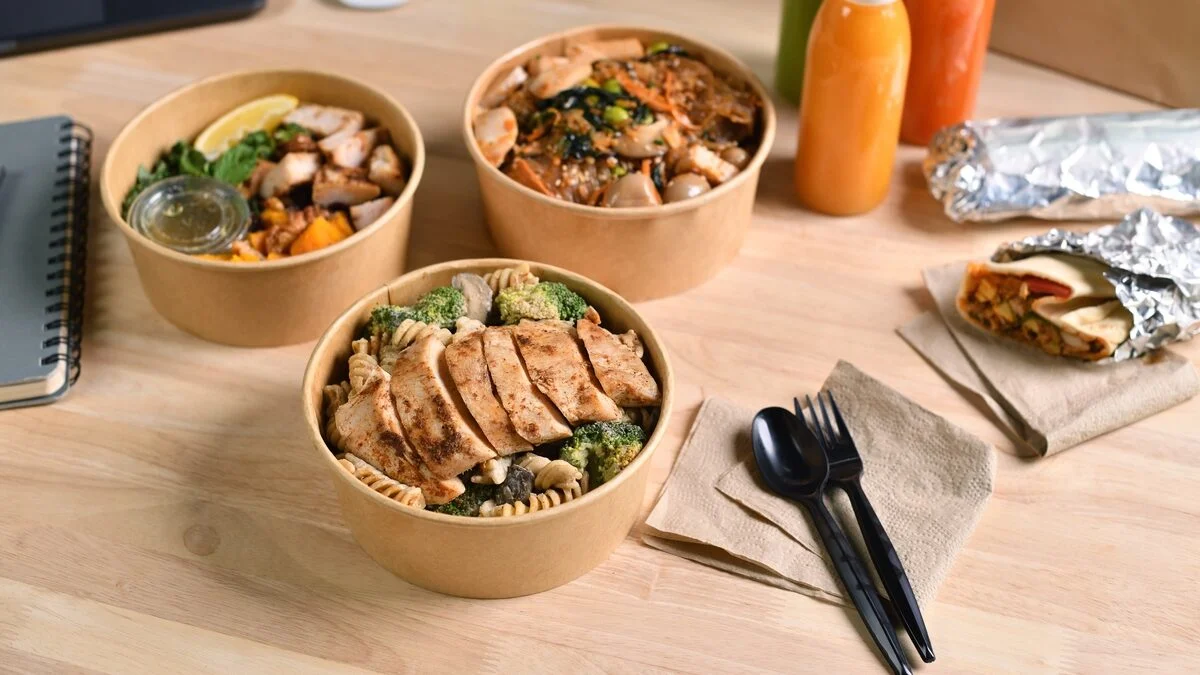
Between the veal blanquette from Marie and the Pad Thai with Picard shrimp, is your heart torn? Although we cannot advise you on the flavors to favor – as they are so personal – the composition of fresh and frozen prepared meals is very variable. Here’s what you need to know about them, according to Julie Boët, dietitian-nutritionist.
Fresh or frozen meals: which is better for your health?
First point to observe: the conservation of these famous trays. Dishes from the fresh section don’t last long in the refrigerator, while frozen foods can stay in the freezer for several months without necessarily losing their nutritional qualities.
“Contrary to what one might think, freezing does not automatically make a food less nutritionally interesting. Certain vitamins and minerals are even well preserved”explains Julie Boët.
The word “fresh” is therefore not necessarily synonymous with better quality. A dish stored in the refrigerator may even contain a lot of salt and additives. Conversely, a frozen meal consisting of vegetables, brown rice and chicken can make a very good lunch. The most important thing is to look at what this dish actually contains, rather than relying on its location in the store…
Prepared dish: what to look for on the label?
First good reflex: look at the list of ingredients. A simple, readable and short composition (preferably) allows you to better know what you are eating.
“I favor dishes that clearly combine vegetables, a source of protein and a starch, rather than those that mainly contain sauce, fat and refined ingredients”advises Julie Boët.
However, it is not necessary to ban all additives: their presence does not automatically mean that a product is bad for your health. “But if two dishes are comparable, you might as well choose the one whose composition is simpler, with fewer superfluous ingredients,” says the expert.
Pay attention to the protein content
Another point to check: protein intake, which allows you to be more satisfied, but also to better preserve muscle mass.
“For a lunch, look for around 10 g of protein per 100 g of product. Also pay attention to the size of the portion: a 300 g dish which provides 10 g of protein per 100 g provides 30 g in total, compared to 20 g for a 200 g portion,” warns the expert.
What if the dish contains too little? Then it will be possible to complete it with an egg, tuna, chickpeas or a dairy product for dessert.
Beware of fat
Next, also remember to look at carbohydrates and fats.
“Look at both their quantity and their nature. A preparation based on olive oil does not have the same profile as a sauce very rich in butter or saturated fats. Consumed in excess, the latter can contribute to increasing LDL cholesterol, often called “bad cholesterol”, underlines the dietician.
Finally, don’t forget fiber and salt. The former, which are found in vegetables, legumes and whole grains, contribute to the proper functioning of transit. Sodium, for its part, is often present in excess in dishes prepared with sauces, cheese or cold meats. “When comparing two similar products, choose the one that contains the least salt. Also remember to take into account what you eat during the rest of the day. specifies the nutritionist.
A light meal is not necessarily healthy
Finally, be wary of mentions like “rich in protein”, “light”, “natural” or “traditional recipe”. They are not enough to guarantee that a dish is balanced. “A low-calorie product may lack protein, vegetables or fiber and may not satisfy you sufficiently. Conversely, a slightly higher-calorie dish may be perfectly suited to your needs, particularly if you are active or need a substantial lunch,” underlines the dietitian.
What to finally choose?
The best choice is therefore not necessarily the dish with the lowest calories or the one which contains the fewest additives.
“It’s the one that gives you enough energy and nutrients, while remaining practical and filling”underlines Julie Boët.
A well-chosen frozen meal can be a great lunch option, as can something from the fresh section. The key is to look at what’s actually in it, rather than relying on its image.