
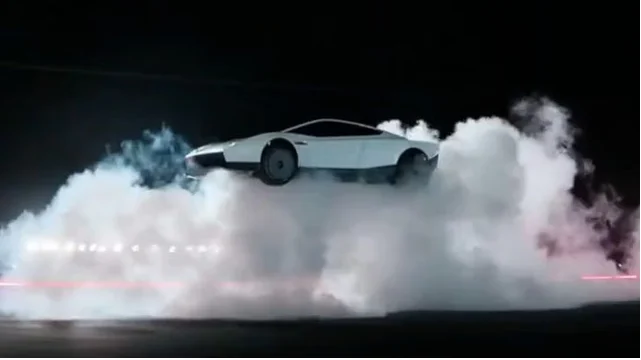
Imagine a team equipped with medical equipment capable of literally “flying” to your aid in a few minutes, thanks to a car that slices through the air. This vision is no longer so futuristic today. Last night, Elon Musk presented the world with a Tesla Roadster capable of taking off and propelling itself through the air… without any hitches. And much faster than any other vehicle.
“You’re going to see crazy things“
The billionaire had warned shortly before: “You’re going to see some crazy things tonight. What you’re going to see with your eyes, you’re not going to believe it.” In the video, he reveals his latest “toy”: a Tesla developed in partnership with SpaceX, Musk’s space branch.
The car, equipped with four thrusters, can reach 100 km/h in 0.81 seconds. But it is above all his demonstration which causes a sensation. The vehicle launches in an arc, seems to fall… before remaining smoothly in the air. Better yet, he would be able to roll upside down, glued to the ceiling, or perform a spinning jump on top of multiple vehicles. In short, he plays with gravity to move forward despite obstacles. A true masterstroke… at least, in terms of spectacle.
But beyond this technological prowess, a question arises: could such an innovation one day be used… emergency medicine?
A flying ambulance to save lives?
“An idea of a flying ambulance would be attractive”recognizes Dr. Gérald Kierzek, who was also impressed by the images. On paper, being able to avoid traffic jams and quickly reach a person in distress could actually be a game-changer in certain critical situations.
However, we must distinguish the vehicle presented by Elon Musk from what a real medical transport would require. “The vehicle presented by Elon Musk is not designed for health: it is a two-seater sports roadster”recalls the emergency doctor.
It is therefore impossible to accommodate a patient lying on a stretcher, complete resuscitation equipment and a SMUR team. Even more so if the vehicle suddenly turns around…
As it stands, this vehicle could not replace a medical ambulance. But this does not mean that the concept of a flying vehicle is devoid of interest for emergency services.
Could an emergency doctor arrive faster?
The most credible application would be to quickly transport a healthcare professional to the scene of an emergency, rather than taking a patient directly there. “An emergency doctor could theoretically reach a scene blocked by traffic jams more quickly”explains Dr. Gérald Kierzek.
We think in particular of a cardiac arrest, a serious trauma or a stroke, three situations in which every minute can count. A doctor or a trained worker could then begin to assess the victim, perform the first necessary actions and organize treatment before conventional help arrives.
In large cities, where traffic can significantly slow down interventions, a vehicle capable of moving through the air would present a potential advantage. It would still be necessary to be able to deploy it quickly, guarantee the safety of the flight and coordinate its intervention with the teams already on site.
Blood, antidotes or defibrillators delivered by air
Another avenue: the delivery of products and materials essential for emergency care. Blood intended for a transfusion, an antidote, a life-saving medication or even a defibrillator could theoretically be transported to a location that is difficult to access.
Again, the idea is not entirely new. Drones already represent an avenue for quickly transporting small equipment or medical products. They even have several advantages over a flying car: they are generally simpler, less expensive and easier to deploy for targeted deliveries.
For Dr Gérald Kierzek, the challenge is therefore less about making a sports car fly than about designing a means of transport truly adapted to the needs of emergency services.
Flying ambulances already exist in planning
What if the future of air rescue ultimately did not involve a Tesla, but rather devices designed specifically to transport people? This is notably the promise of eVTOLs, electric aircraft with vertical takeoff and landing.
These devices, which sometimes resemble small planes or large drones, are developed to ensure rapid travel without requiring a long runway. Some projects consider health uses, with vehicles capable of transporting patients, medical teams or specialized equipment.
Their potential benefit is particularly important in congested cities, but also in isolated areas where access to care can be complicated. It remains to be demonstrated that they will be able to meet the requirements of medical transport: safety, autonomy, carrying capacity, patient care conditions and coordination with emergency services.
A medical revolution for tomorrow?
Elon Musk’s flying Tesla is therefore a dream, but it does not constitute, at this stage, an operational ambulance. The announced performances and the spectacular demonstrations are not enough to prove that such a vehicle could be used in real conditions, even less in the context of a medical intervention.
However, the principle deserves to be explored. Reducing intervention times, transporting vital equipment or allowing a healthcare professional to bypass an obstacle are all avenues likely to improve emergency management. And in the not so distant future.
The real revolution will perhaps not consist of making a sports car fly, but of developing aerial vehicles that are reliable, accessible and adapted to the constraints of emergency services. A perspective that is still ambitious, but which could, in the long term, help save precious minutes when a patient’s life is at stake.