
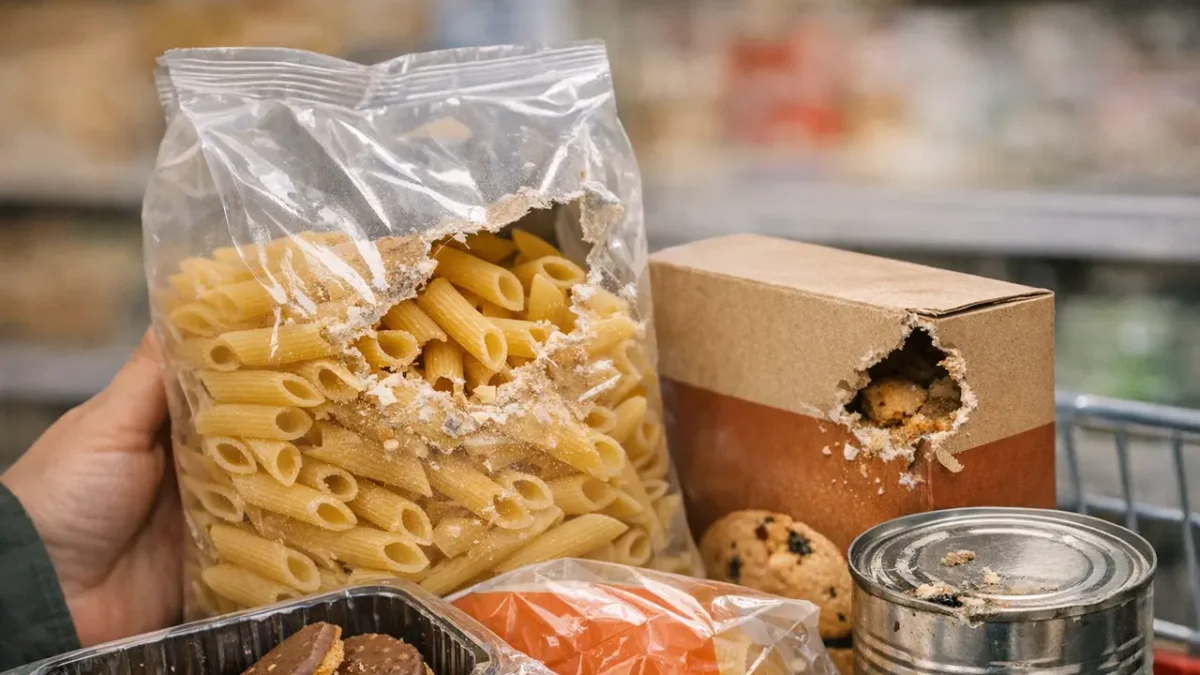
You put away your shopping and a detail stops the action in its tracks: the corner of a nibbled package, a damp cardboard box, small dark marks on a box. The doubt is immediate: should we throw away, clean, or simply remove the damaged packaging? The useful rule is in a few words: if the packaging which directly protects the food is gnawed, pierced or soiled, the contents must not be consumed.
The question returns after the broadcast by Further investigationimages showing rats on the shelves of a hypermarket. These images, shot in the summer of 2025, do not allow generalizations to be made to all stores, but they recall a very concrete hygiene reflex, valid in a family cupboard as well as when doing your shopping.
When the packaging in contact with food is affected, what should I do?
A bag of pasta with a hole in it, a packet of nibbled flour, a damaged plastic container film, a packet of cereal opened by a bite: in these situations, the primary packaging no longer provides protection. The food must be thrown awayeven if its smell, color or appearance seems normal.
Caution comes from the possible mode of contamination. Rodents can contaminate their environment with contaminated urine, droppings, saliva, hair or dust. Some traces are visible, others not. Simple sorting, transfer into a clean box or removal of the area close to the hole are therefore not enough to make the food safe.
Cooking is not all-risk insurance. It can reduce part of the microbial risk, but it does not guarantee the safety of food that may have been contaminated by a rodent. For the same reason, a discarded product must not be given to anyone else, to an association, nor served to an animal.
What if only the outer cardboard is damaged?
The situation changes when the affected carton is only excess packaging. This is the case, for example, of a batch of compotes, a box containing individual sachets or a cardboard box surrounding several jars. If only the overpack is reached and each indoor unit is perfectly closed, dry, clean and intactit can in principle be retained after inspection.
But this margin does not exist in the slightest doubt. Bite marks on a bag, droppings, humidity, unusual odor, sticky packaging, abnormal dust or dirt: it is better to throw it away. Flexible packaging, made of paper, cardboard or thin plastic, provides poor protection once it has been directly exposed to dirt.
For rigid containers, the American agency FDA distinguishes a special case. It specifies that only undamaged all-metal containers and hermetically sealed jars of commercial products can possibly be recovered, after removal of the label, washing and disinfection of the exterior. Containers that are dented, cracked, rusty, leaking, or have damaged lids or seals must be discarded.
“If the packaging is damaged, perforated, chewed or shows traces of dirt (urine, excrement), the product must be absolutely thrown away.” confirms Dr. Gérald Kierzek, emergency physician and medical director of True Medical. “Rats are vectors of many serious diseases for humans, transmitted by their droppings (urine, droppings), their saliva or the fleas they carry. Leptospirosis (the “rat disease”) being the major risk.”
What reflexes at home or in store?
At home, the most important thing is to avoid spreading the dirt. No need to shake the package or handle it for a long time on the work surface. A few simple actions limit the risk:
- Place the damaged product in a closed bag before throwing it away;
- Clean the affected storage area, shelf or cupboard;
- Wash your hands thoroughly after handling;
- Inspect neighboring products, especially soft or floury packaging.
At the supermarket, the reflex is even simpler:
do not buy a product whose packaging is chewed, holed, damp or soiled. Report this to staff so that the product can be removed and the area checked. It is better to avoid repeated manipulations or opening other packages to “check”.
If you have already consumed the food before discovering the damaged packaging, there is no need to systematically panic. Monitor the appearance of digestive disorders, fever or a change in general condition. If you experience symptoms, or if the person concerned is pregnant, immunocompromised, elderly, or if it is a young child, seek advice from a healthcare professional. In case of severe signs, call 15 or 112.
The most reliable benchmark therefore remains the integrity of the barrier which really protects the food. As soon as it is compromised, security comes before the economics of the package.