
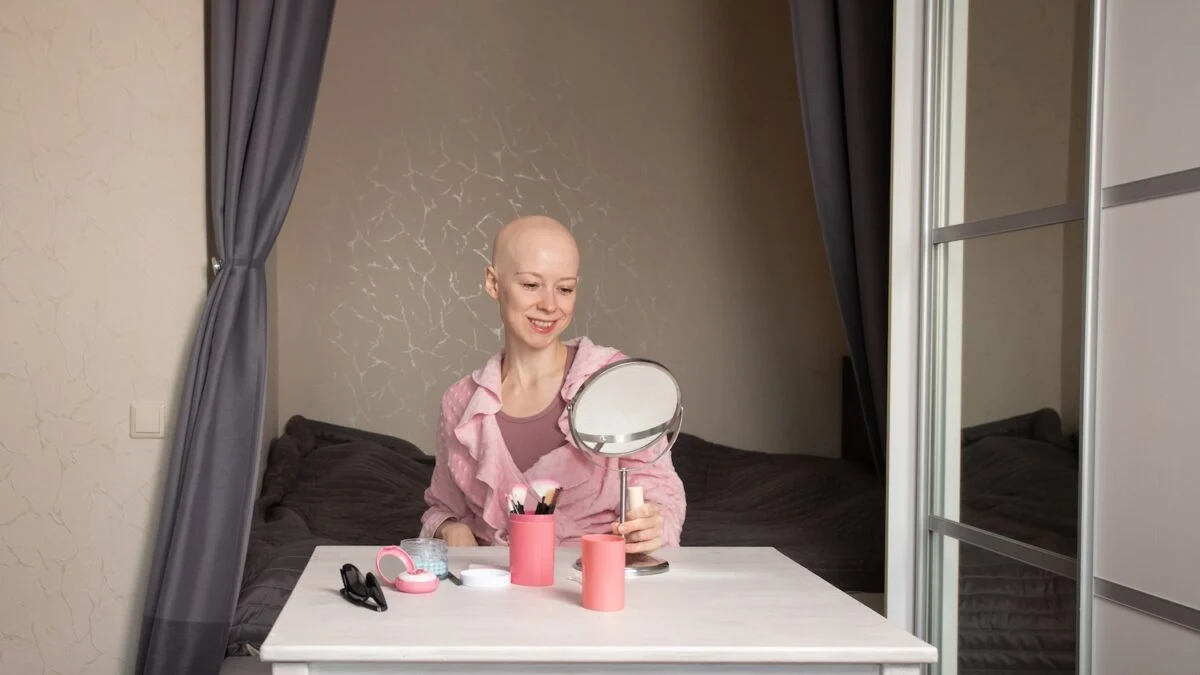
To mark its 25th anniversary, the Belle & Bien association launched a national week of free beauty care workshops at the beginning of October. An initiative which reminds us that preserving self-esteem and social connections are also part of the needs expressed during illness.
Cancer: 8 out of 10 women have been embarrassed by their appearance during or after treatments
Cancer is not just a disease that we fight with treatments. It sometimes transforms the body, the face and the most intimate landmarks. In front of the mirror, some women struggle to recognize their appearance. And this difficulty can weigh heavily on their daily lives.
According to an OpinionWay survey carried out for Belle & Bien among 314 women personally affected by cancer, 81% say they were embarrassed by their appearance during or after treatments. The consequences go beyond just looking at the mirror: among those who have felt this discomfort, 77% say they have avoided going out or seeing people.
However, the visible manifestations of the disease are not experienced in the same way by all women. If 76% of French women surveyed cite hair loss among the most difficult consequences to overcome, only 52% of women who have personally experienced cancer mention it. The latter also mention apparent fatigue (52%) and visible scars (34%).
These changes can weaken self-confidence at a time when support from loved ones and maintaining social relationships are particularly valuable.
For Dr Nasrine Callet, oncologist at the Institut Curie, the side effects can have a lasting impact on patients’ lives.
“The side effects of treatments are often transient, but during chemotherapy and sometimes several months afterwards, they can be very difficult to live with, with a real impact on the personal, social and professional lives of patients.she explains in the Belle & Bien press release.
Behind these figures, a reality deserves to be heard: feeling bad about your body during cancer is neither superficial nor anecdotal. It is a difficulty that can affect identity, confidence and the place that one feels capable of occupying among others.
A need for support that is still too little recognized
While the physical and psychological repercussions are significant, women believe that their experience remains insufficiently recognized. More than two thirds of the participants concerned believe that the impact of cancer on appearance and self-esteem is not sufficiently taken into account by society. For 40%, this recognition is also insufficient from the medical teams.
The lack of support constitutes another point of alert:
30% of the women concerned say they have not been offered help with appearance and self-image even though they would have liked to benefit from it.. Only 18% indicate that they have actually received this support.
These results highlight a gap between the needs expressed and the place given to these questions in the care pathway.
However, supportive care can help patients get through this period. They obviously do not replace cancer treatments, but complement them by taking into account the consequences of the disease on daily life.
“This is the whole role of supportive care: supporting the person in all dimensions of the illness, in addition to medical treatment.”recalls Dr Nasrine Callet.
The issue is not to impose on women to find a particular appearance, nor to ask them to remain positive at all costs. It is rather about giving them the means to reclaim their image, according to their desires and needs.
Free workshops to regain confidence and social connection
It is with this in mind that Belle & Bien organized the national operation “All beautiful, all good” at the beginning of October 2026. Free beauty treatment workshops are offered in six French cities, notably in Paris and Île-de-France, Lyon, Lille, Strasbourg, Rennes and Bordeaux, in partnership with various health establishments.
Led by volunteer beauty professionals, these sessions offer non-medical support, free of charge and without a commercial approach. The objective is not to hide the signs of the disease, but to help participants find caring gestures, feel better in their bodies and share a moment with other women facing similar experiences.
“Taking care of yourself again and sharing this moment with other women could help you reclaim your image and find a more active posture.”underlines Dr Nasrine Callet, referring to a study carried out the previous year with women who had benefited from aesthetic treatments.
Created in 2001, the association has supported nearly 60,000 women since its beginnings and organized 6,767 workshops, according to the figures provided. It now offers several support methods, face-to-face, by videoconference, at home, in hospital or independently.
For the years 2027 to 2031, Belle & Bien aims to support 35,000 additional women, whatever their cancer.
“For a long time, appearance could be considered secondary to illness. This survey shows that it touches on something much deeper: self-confidence, relationships with others and social life.”estimates Guillaume Adam, general delegate of the association.
On the occasion of Pink October, the message goes beyond the sole question of screening. During and after treatments, supporting women also means hearing their difficulties in recognizing themselves, respecting their relationship with the body and allowing them to not go through these transformations alone. Because taking care of yourself during cancer is not superficial: it can also help preserve your self-esteem and maintain connections with others.