
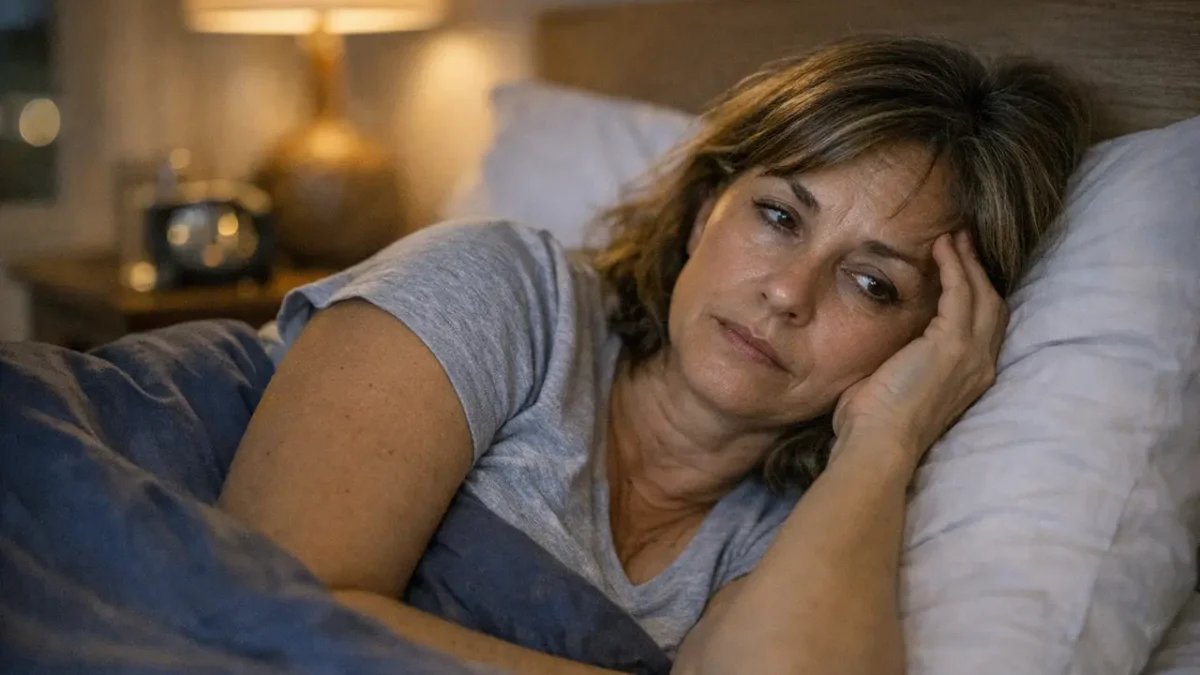
Do you still have your period, but your nights are no longer the same? Repeated awakenings, shorter sleep, fatigue upon waking… These signs can appear during perimenopause, this transition phase around the end of menstrual cycles. This is one of the points highlighted by preliminary results of the French Climatère survey, carried out by the Foch hospital.
The idea is not to make perimenopause the automatic explanation for all bad nights. But it deserves to be considered when sleep deteriorates for a long time, even if the periods are still present.
More fragmented nights, not just shorter
Perimenopause refers to the transition period surrounding the end of menstrual cycles; menopause is confirmed retrospectively after 12 months without periods. This transition can be accompanied by irregular cycles, hot flashes, night sweats, mood changes… and, in some women, sleep problems.
According to preliminary results, 27.3% of women have frequent sleep disorders. In perimenopause, the risk of developing such disorders is approximately twice as high as in premenopausal women.
This figure must be clearly understood: it does not mean that all sleep difficulties are linked to perimenopause. It concerns a high level of reported symptoms
through questionnaires. In other words, it highlights the most troubled women, not all the troubled nights.
The disorder described is not necessarily a simple reduction in time spent in bed. Often, it is the continuity of sleep that deteriorates: we fall asleep, then we wake up, we go back to sleep, then a new awakening occurs. Sleep becomes fragmentedless recuperative, with fatigue which can weigh on the day.
Hot flashes, night sweats… and other possibilities
Hot flashes and night sweats are some of the well-known symptoms of the menopausal period. They can wake you up suddenly, force you to change position, drink, air the room or even change your clothes. In this case, the link with sleep seems obvious.
But things are often more complex. Sleep problems during menopause can be caused by hot flashes, anxiety, pain, certain treatments, lifestyle habits or other health problems. Night sweats therefore do not explain all insomnia.
After taking these symptoms into account, perimenopause remains associated with a 52% increase in the risk of experiencing frequent sleep disorders. Other factors of sleep disorders are therefore involved: professional or family stress, anxiety, depression, sleep apnea, restless legs syndrome, alcohol or caffeine consumption, chronic pain, odd schedules, medications, etc. Hence the importance of not trivializing the fatigue that is setting in. The first results from Climatère are based on questionnaires: they make it possible to observe associations, but not to attribute each bad night to hormonal changes alone.
When should you talk to your doctor?
It is not necessary to wait for the periods to stop completely to consult. If the nights have been getting worse for several weeks, if the awakenings are frequent, if fatigue disrupts work, concentration, mood or daily life, it is better to speak to a health professional.
To prepare for the consultation, it may be useful to note a few simple elements: bedtime, wake-up time, number of nighttime awakenings, presence of sweats or hot flashes, fatigue during the day, drowsiness, morale, consumption of alcohol or coffee, current treatments. This information helps distinguish a climacteric disorder from another cause that needs to be explored.
The right reflex: describe precisely what happens at nighteven if the rules are still present. Perimenopause can be one of the hypotheses, without being the only avenue.
Treatment then depends on the context: sleep hygiene measures, adaptation of certain treatments, management of anxiety or pain, detection of sleep apnea, discussion of climacteric symptoms. Hormonal treatment for menopause is discussed on a case-by-case basis.after medical evaluation, symptoms, history and contraindications; it is not an automatic response to sleep disorders.
Nights that become fragmented in your forties or early fifties should therefore not be brushed aside. Perimenopause can contribute, particularly in the case of night sweats or hot flashes, but long-term disrupted sleep deserves a real assessment to avoid missing another treatable cause.