
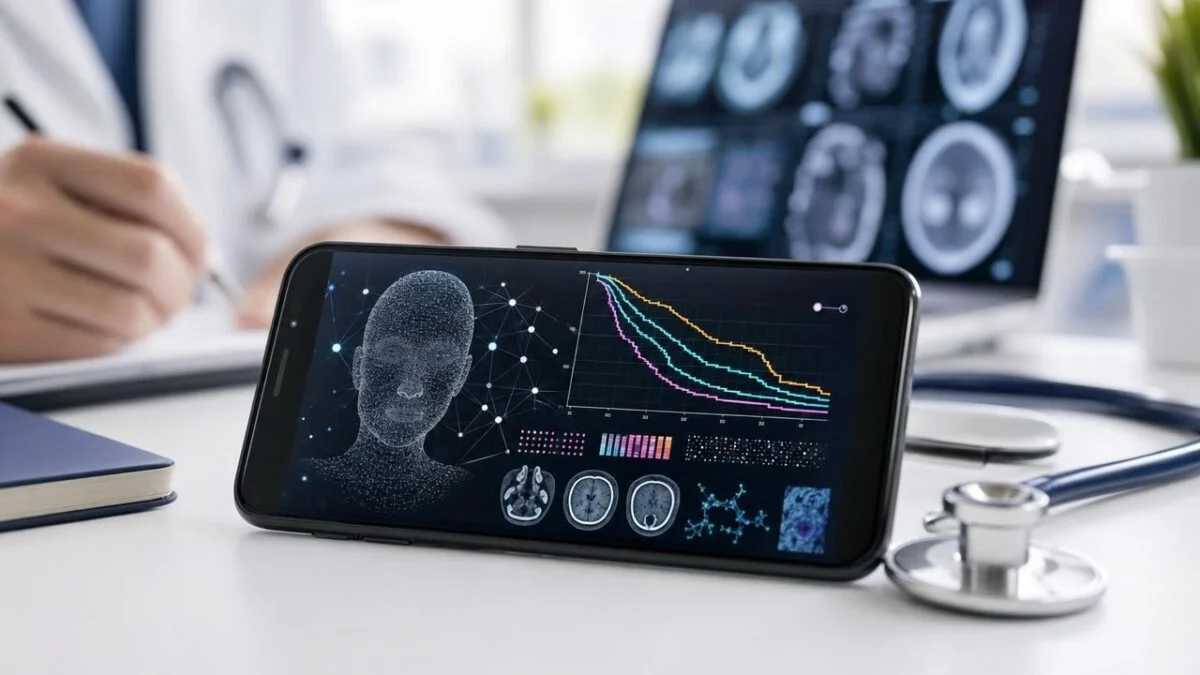
Behind a face, doctors are already looking for signs of fatigue, fragility or illness. But could this assessment, often intuitive, become more objective thanks to artificial intelligence? This is the avenue explored by researchers from Mass General Brigham, in Boston, in a study published on October 19, 2026 in The Lancet Digital Health.
Their tool, FAHR-Face, has been trained on more than 40 million photographs. It made it possible to develop two models: one estimates the apparent biological age, the other evaluates the risk of death in patients with cancer. The objective is not to predict a person’s date of death, but to help doctors better assess their fragility before major treatments.
A selfie to spot signs of fragility
Before radiotherapy, surgery or intensive drug treatment, oncologists must assess the patient’s ability to tolerate care. Two people of the same age do not necessarily have the same physical reserves.
FAHR-Face first learned to recognize general facial characteristics, before being adapted for specific medical purposes. The researchers notably trained it on more than 30,000 photographs of patients treated with radiotherapy.
Two complementary tools emerged from this. FAHR-FaceAge estimates apparent biological age, while FAHR-FaceSurvival directly assesses the risk of death. The first analyzes in particular the nasolabial folds, the forehead and the temples. The second is more interested in the area under the eyes and the bridge of the nose.
“Our goal is to make health assessment based on facial photography more quantitative, consistent and accessible on a large scale, so that it can support personalized treatment decisions rather than replacing doctors’ judgment.”explains Raymond Mak, radiation oncologist at the Mass General Brigham Cancer Institute, quoted in the establishment’s press release.
A face that looks five years older, an increased risk of death
To evaluate their technology, the researchers studied a cohort of 38,183 patients treated with radiotherapy. The results show an association between AI-estimated age and survival.
 © Mass General Brigham/Lancet Digital Health
The image on the left illustrates the features most important to cancer survival predictions from the FAHR-FaceSurvival model, while the one on the right shows the features most important to the biological age estimates from the FAHR-FaceAge model. The areas highlighted in yellow had the greatest influence on each model’s predictions.
When FAHR-FaceAge estimated that a patient appeared biologically at least five years older than his actual age, his risk of death was higher by 21%. Conversely, when the model assigned an age at least five years lower, this risk was reduced by 17%. These figures do not mean that an older face causes an increase in mortality. They describe statistical associations observed between the patients studied.
The second model, FAHR-FaceSurvivalalso revealed a strong signal: in the quarter of patients with the highest risk scores, mortality was more than three times higher (multiplied by 3.23) than in the quarter with the lowest scores. Another striking result: among the 122 patients who obtained the maximum risk score, 64 died within 90 days of the photograph.
However, these data do not make it possible to individually predict the evolution of a cancer. The algorithm identifies statistical regularities, without establishing with certainty the biological mechanisms that explain them.
The researchers also observed that current smokers appeared biologically older than former smokers, who were themselves estimated to be older than people who had never smoked. Heavy alcohol consumption and drug use were also associated with more marked facial aging.
“A decision-making tool”, not a prediction of survival
For Dr. Gérald Kierzek, emergency physician and medical director of True Medical, we must avoid any confusion about the scope of this discovery.
“It is not really a survival prediction tool, but rather a therapeutic decision support tool aimed at providing oncologists with an objective and non-invasive indicator of a patient’s fragility and physical reserve before initiating heavy treatments (radiotherapy, surgery, systemic therapies).”he explains.
“The idea is to quantify what we already assess visually: a patient who “looks older than his age” in a photo could have a lower tolerance to intensive treatments..
Ultimately, this indicator could help personalize care or adapt the frequency of monitoring. But it cannot replace the clinical examination, other assessments of frailty or the dialogue between the patient and his medical team.
The limits remain important. The main study involves American cancer patients treated with radiotherapy. The reliability of the tool in other populations, for other cancers or with other treatments remains to be demonstrated. Biases related to skin color, body type or other demographic characteristics are also possible.
The model was relatively stable in the face of variations in light, pose, expression and makeup. However, certain facial changes, particularly after rhinoplasty, can influence the estimates. The consequences of other cosmetic procedures or dermatological diseases remain to be clarified.
The risk of transforming a face into a medical verdict
Beyond technical performance, a question remains: how would a patient experience the announcement of a risk of death estimated from their face? Such information could be particularly anxiety-provoking, even though the result remains probabilistic and imperfect.
“If the algorithm gets it wrong, we might somehow not provide care to someone who actually needs it.”warns bioethicist Matthew Liao, cited in
ScientificAmerican. A poorly interpreted score could thus lead to underestimating a patient’s needs or limiting access to beneficial treatment.
Dr. Kierzek also warns against use by health or life insurance companies to assess risks, set rates or exclude certain policyholders. A face must not become an instrument of financial discrimination.
For now, FAHR-Face remains a research tool. Before any clinical use, it will have to confirm its reliability in more diverse populations and demonstrate that it really improves medical decisions.
Because behind each photograph, there is a person, their story and their possibilities for responding to treatments. Artificial intelligence could help oncologists better assess the fragility of their patients. It must never turn a probability into a verdict, nor decide for those it is supposed to help.