
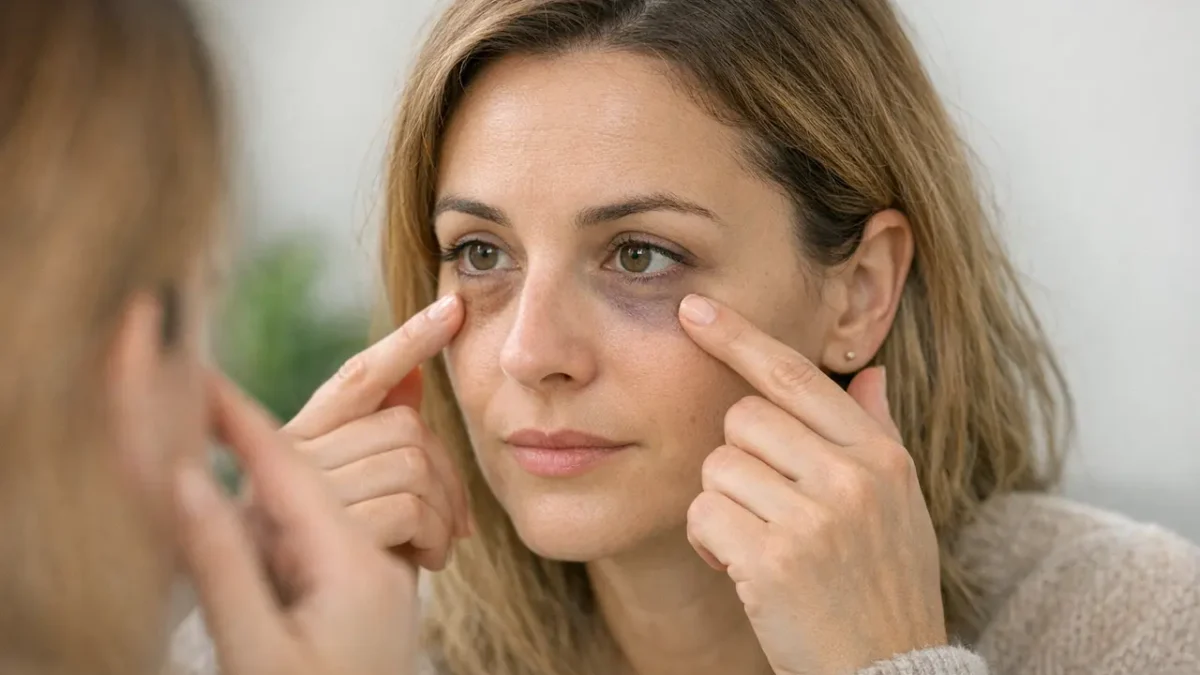
On Instagram, Dr Marie Jourdan reiterates the essentials:
dark circles do not have a single origin. Their color, their relief and their evolution during the day guide the possible solutions. The goal is not necessarily to make them disappear, but to avoid poorly chosen care and unrealistic promises.
Color, hollowness or volume: the right clues to observe
The most common trap is to attribute all dark circles to lack of sleep. In the video, the dermatologist emphasizes on the contrary the diversity of the mechanisms: brown, bluish or purplish circles, hollows which create a shadow, bags, or mixture of several elements.
“There is no one cream that will work for everyone.”
This idea is consistent with the available data: dark circles can be pigmented, vascular, structural or mixed. To begin, you must therefore look color, relief and when appearance variesrather than stacking products.
- Brown circles often evoke a pigmentary component. They may be more marked in certain people for constitutional reasons or linked to phototype;
- Blue or purplish dark circles may correspond to a vascular component, or to very thin skin revealing the underlying tissues through transparency;
- Hollow dark circles sometimes give a brown impression when it is mainly a shadow, linked to the relief of the face or the gradual melting of volumes;
- The pockets correspond to a volume under the eye. They can be fluctuating, particularly more visible in the morning, or linked to a protrusion of fat.
If you are unsure between several situations, it can be useful to compare with illustrated benchmarks to identify the different types of dark circles.
What can really help, depending on the type of dark circles
For brown circles, so-called depigmenting treatments can be offered to reduce the appearance of pigmentation. The expert also highlights a practical point: the eye area is a sensitive area, which justifies using products formulated for this area. On the other hand, constitutional dark circles are often difficult to completely correct : improvement, when it exists, remains variable.
For bluish or purplish dark circles, certain treatments containing caffeine can be used for cosmetic purposes, with a possible decongestant or vasoconstrictor effect. But you should not expect a guaranteed correction: caffeine does not transform the structure of the skin and corrects neither a hollow nor a real fat pocket.
When the main problem is a hollow, the dark effect comes mainly from the cast shadow. In this case, creams have clear limits. Aesthetic medicine procedures can sometimes be discussed, but only after a specialist assessment: they are not personalized advice, and they are not decided based on a quick observation in the mirror.
Pockets also require distinguishing between two situations. Mobile pockets, more significant after a short night or in the morning, can give rise to drainage procedures or decongestant treatments, with variable results. On the other hand,
a pocket linked to a fatty protrusion does not disappear with a cream. In this case, a surgical correction such as lower blepharoplasty can be discussed with a specialist, in particular to remove or reposition the fat. To explore this point further, True Medical also details ways to treat bags under the eyes.
The right reflex, before buying a new eye contour, is therefore simple: ask yourself if you want to act on pigmentation, bluish coloring, shadow or volume. Treatment can improve appearancebut it does not replace a medical evaluation when a laser, injection or surgery option is considered.