
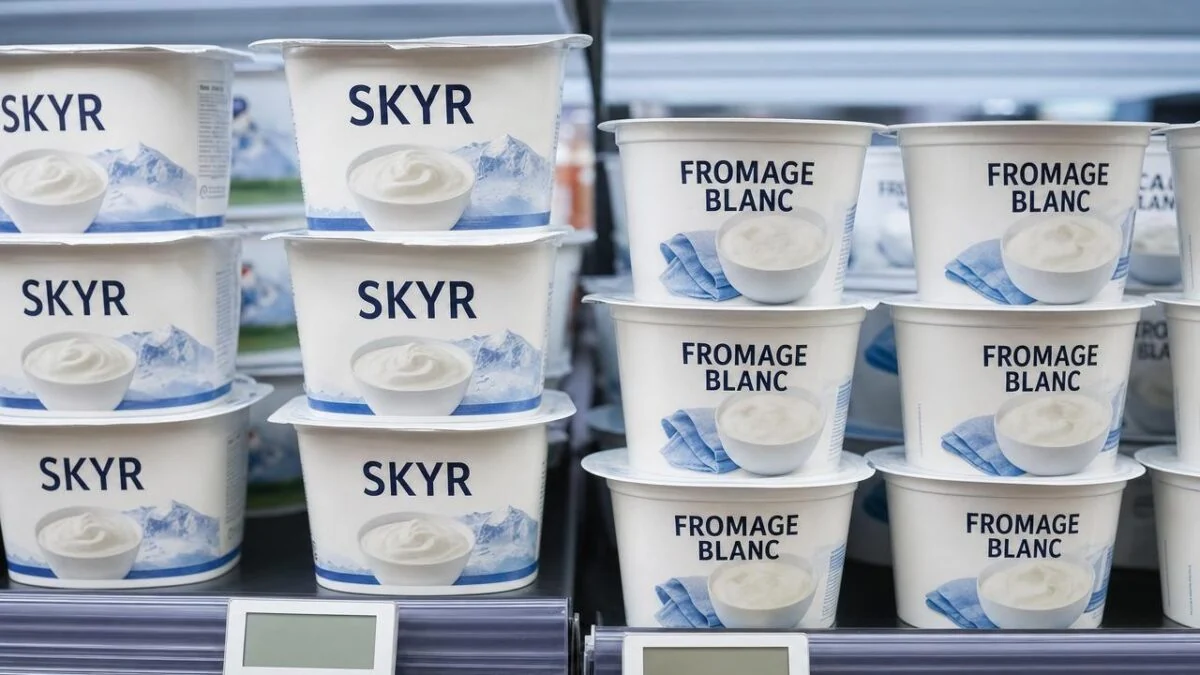
In the fresh section, two neighboring jars promise protein-rich dairy products, but one costs almost twice as much as the other. When you watch your budget, this kind of difference makes you hesitate: does the higher price really guarantee more protein on the plate? The duel is launched between two stars of fermented dairy products, present on social networks.
Facing the traditional
white cheeseTHE skyr Icelandic is seen as a protein champion. A natural skyr provides on average 10 to 12 g of protein per 100 g, compared to 6 to 8 g for a 0% white cheese. For a comparable portion, the difference is around only 2 g of protein, while the price of the jar can almost double.
Skyr and cottage cheese: a limited protein gap
Skyr owes its image as a high-protein product to its manufacturing method. Danone describes a long-drained skimmed milk, which removes whey and concentrates nutrients. Plain skyr contains between 10 and 12 g of protein per 100 g, compared to 6 to 8 g for 0% white cheese. On the scale of a 150 g pot, that’s only a few grams more.
In terms of fat and calories, both remain light: around 0.2 to 0.5 g of lipids per 100 g and 45 to 65 kcal depending on the dairy. The two dairy products therefore do not pose a problem in terms of fat, apart from the gourmet versions enriched with cream. Skyr and cottage cheese provide 100 to 120 mg of calcium per 100 g, useful for bone strength.
How much does a gram of protein really cost?
The real question becomes the relationship
price/protein. A Carrefour Classic’ 3% white cheese is sold for €1.95 per kilo, compared to €4.64 for a natural Danone skyr. Compared to proteins, these prices give around €0.026 per gram for cottage cheese, compared to €0.052 for skyr, or almost double.
Rather than relying on the word “skyr” or a jar covered with “high protein” slogans, it is better to read the label: proteins per 100 g, price per kilo, then a little mental calculation. The experts cited by UFC-Que Choisir point out that apart from a few cases, there is no point in always looking for more proteins. Beyond the marketing aspect and taste differences, skyr remains a well-drained fresh cheese…
In what cases is skyr worth the extra cost?
Skyr may still be of interest if you like very dense textures or if you digest lactose poorly, because draining it eliminates some of it. But the real trap often lies elsewhere, in added sugar. Whether you opt for skyr or fromage blanc, it is better to choose a natural product and sweeten it yourself, as some commercial versions are particularly sweet.