
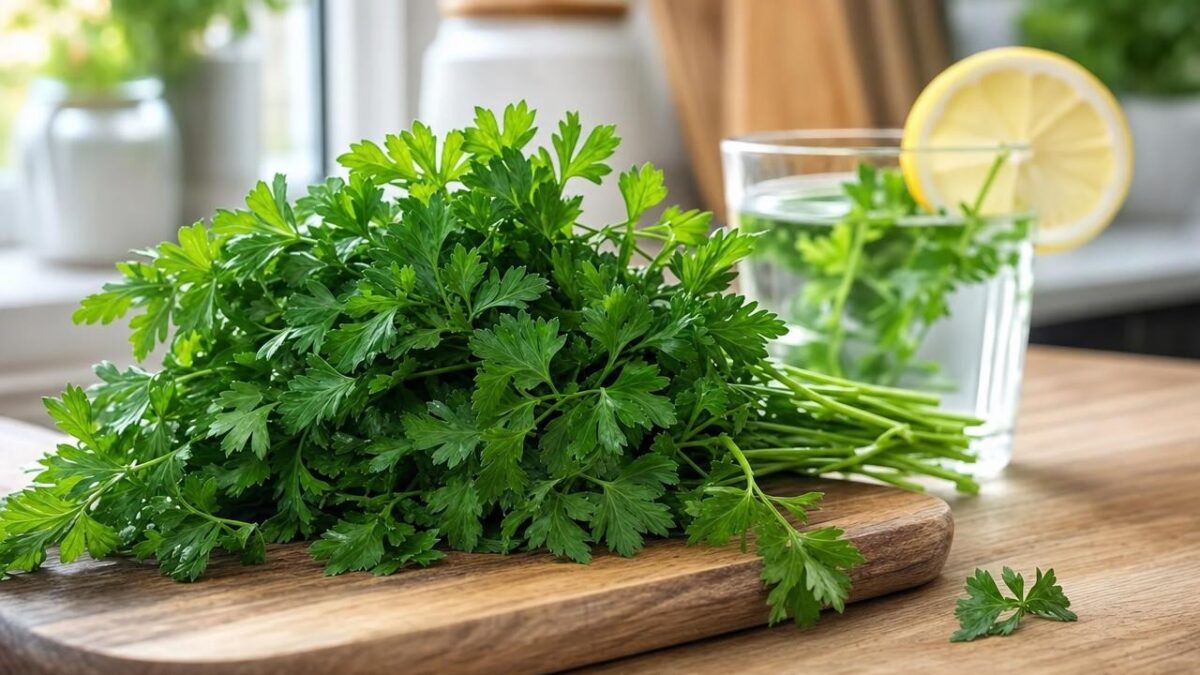
A herb that often ends up forgotten on the edge of the plate, it could nevertheless be of service to all those who complain of heavy legs, a swollen stomach after a meal or tight rings at the end of the day. In the hunt for natural remedies against water retention and bloating, one candidate regularly comes up in the recommendations of nutritionists.
How Parsley Works on Bloating and Water Retention
This herb is parsley (Petroselinum crispum). Long confined to the role of garnish, this ancient Mediterranean plant is described as a natural diuretic, that is to say a plant which promotes the elimination of water and salt through urine.
The word “swelling” actually covers two realities. Bloating, first of all, is linked to intestinal gas: tense stomach after a heavy meal, flatulence, temporary discomfort. Water retention, then, is seen more on swollen ankles, shoes or rings suddenly too tight, often linked to salt, hormones or certain illnesses.
For dietitian Amanda Capriglione, interviewed by the media The Healthyeating parsley mainly affects the first part. She explains that “this can aid digestion and help reduce bloating” and specifies that “it contains compounds that allow the expulsion of gases from the body“.
A handful of fresh parsley added to a tabbouleh, soup or green smoothie can be enough to make digestion a little more comfortable.
What Mayo Clinic and studies show
LParsley has been cultivated for thousands of years and is classified as a natural diuretic, alongside dandelion and caffeine. There Mayo Clinic cites parsley as an example of a plant that can help, marginally, with water retention, while recalling that the evidence remains limited in humans and that a health professional should be consulted in the event of persistent edema.
A study published in 2002 in the
Journal of Ethnopharmacology observed in rats an increase in urinary volume over 24 hours with an aqueous extract of parsley seeds, a result which does not constitute direct proof of effectiveness in humans.
Parsley is also very rich in vitamin K. According to National Institutes of Healthadult women need 90 micrograms per day and men 120 micrograms. Amanda Capriglione also recalls that “ten sprigs of parsley are enough to reach your daily dose of vitamin K“. Good news for bones, but a point of vigilance if you take anticoagulants like warfarin, because vitamin K can interfere with their action.
Here’s how to properly consume parsley
Dietitian Julia Zumpano, of the Cleveland Clinic, recommends a very simple approach: “Incorporate herbs into your diet via a meal, not in pill or concentrated liquid form.“
On the plate, this means chopped raw parsley on salads, vegetables, fish, or mixed in a yogurt sauce. Coupled with good hydration and a reduction in salt, this regular gesture gently supports urinary elimination. For those who like herbal teas, you can infuse around 15g of fresh parsley in 250ml of boiling water for 5 to 10 minutes, up to three cups per day maximum.
This type of drink should not be combined with medicinal diuretics, nor used in cases of kidney failure without medical advice. Medical sources also remind us to be careful during pregnancy, some old research having mentioned a risk of miscarriage with large doses, and in people on anticoagulants.
If water retention is accompanied by pain, shortness of breath or urinary problems, rather than self-treat with parsley.