
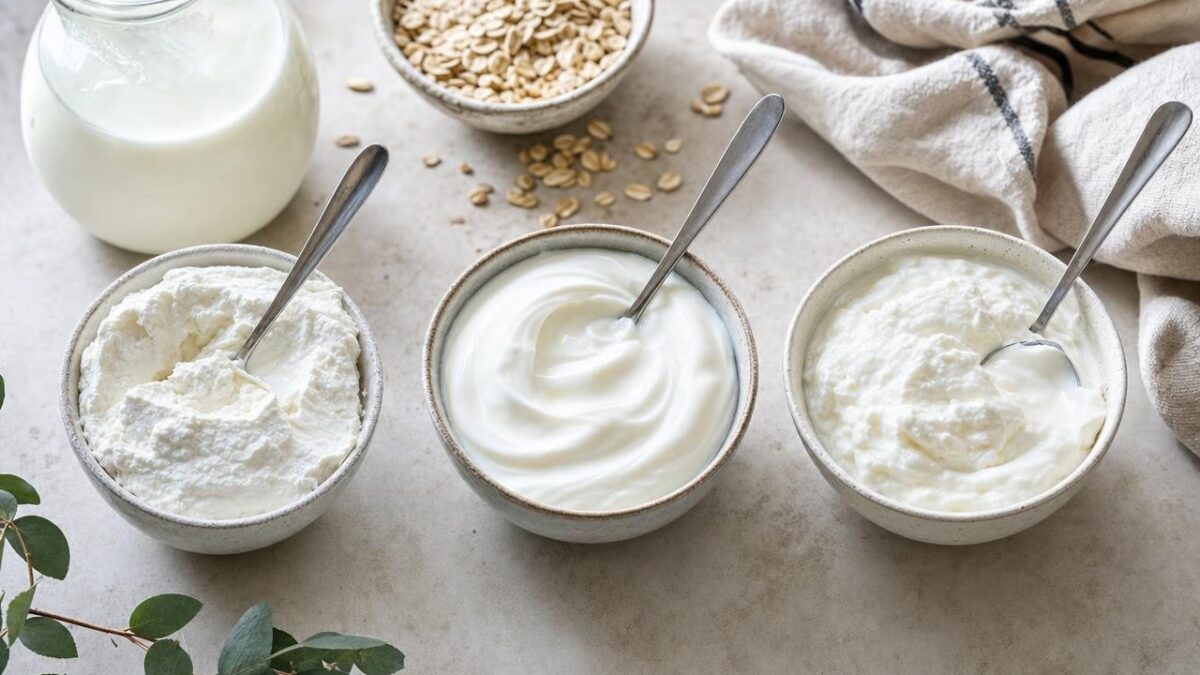
In the fresh section, jars of fermented milk compete for the place of best health ally. The French are buying more and more products advertised as high protein, looking for the one with the most calories for the fewest calories. Between yogurts, cottage cheeses and very thick dairy products from the North, it’s difficult to know which pot really deserves to stay in the fridge every day.
Skyr, yogurt and cottage cheese: what changes in manufacturing
To begin with, yogurt is milk inoculated with lactic ferments like Lactobacillus bulgaricus and Streptococcus thermophilus. These bacteria transform lactose and thicken the milk, without significant draining: there remains a lot of whey, therefore a fairly fluid product and a moderate protein intake, around 4 g per 100 g according to the CIQUAL Table.
The fromage blanc also receives ferments, then rennet which causes the milk to curdle before careful draining. We remove more whey and we reach around 7 to 8 g of protein per 100 g in the 0% version, according to the CIQUAL Table. The Skyr follows this pattern with even more extensive drainage, hence its very dense texture.
Nutritional comparison: proteins, calories, fats and calcium
On the protein side, the CIQUAL Table indicates around 8 g for 100 g of 0% white cheese compared to 4 g for natural yogurt. Skyr amounts to 9 to 11 g of protein and approximately 55 to 65 kcal per 100 g, with less than 0.5 g of lipids.
For fats, the figures place Skyr between 0.2 and 0.5% lipids, very close to magerquark at 0.2 to 0.4%, when a classic yogurt is around 3.5% and a cream yogurt 10%. For calcium, Skyr is 150 mg per 100 g, cottage cheese is 90 mg and yogurt is 130 mg. Which means that these three dairy products all provide around 100 to 150 mg of calcium per 100 g.
What is the best choice according to your objective?
For weight and protein, Skyr plain or 0% white cheese dominate.
Natural yogurt remains useful for digestion and pleasure, if chosen without added sugars.