
Beyond screening, this discovery sheds light on a feared phenomenon: the ability of certain cancer cells to resist treatments and cause a relapse. A promising avenue, which however still needs to be validated.
A blood test to detect invisible traces of cancer
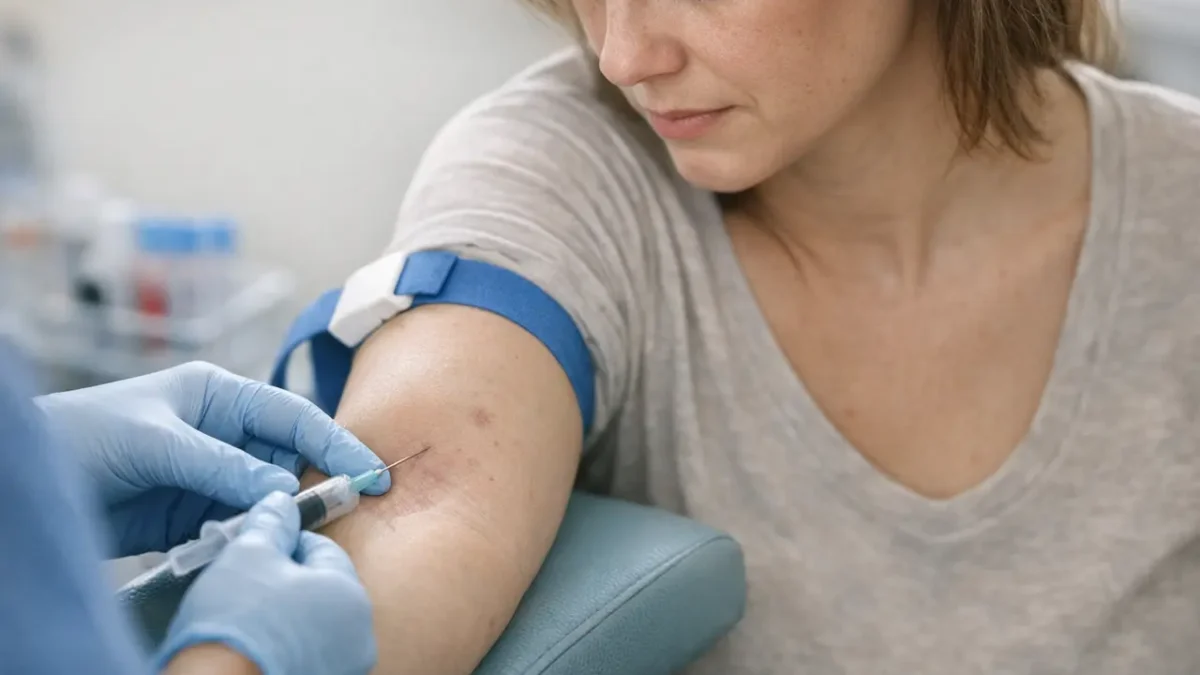
For women facing breast cancer screening, waiting for a mammogram can be a source of worry. Especially since dense breasts sometimes make certain anomalies more difficult to identify. It is on this difficulty that researchers from the Weizmann Institute of Science, in collaboration with the Hebrew University of Jerusalem, are working. Their objective: to detect molecular traces left by cancer cells in the blood.
Their method, published in Nature on November 11, 2026, is based on a technique called liquid biopsy. Its particularity is to search for epigenetic signatures, that is to say marks which regulate the activity of genes.
To understand, DNA can be compared to a recipe book present in every cell. Epigenetic marks indicate which recipes should be used and how often. In cancer cells, these instructions can be profoundly altered.
The researchers first analyzed tumors taken from 12 women who had undergone breast cancer surgery. A delicate step, because these marks deteriorate quickly after the tumor is removed.
“Once a tumor is removed, there is only a short window of time before its epigenetic marks begin to deteriorate.”explains Noa Furth, researcher involved in the work. She says she transported the samples from the hospital to the laboratory on ice so she could analyze them the same day.
95% accuracy for certain early cancers
To find these signatures in the blood, scientists exploit a natural phenomenon: when cells die, they release nucleosomes, small fragments made up of DNA associated with proteins. Using single-molecule microscopy, fluorescent markers and artificial intelligence, the team developed a method capable of identifying the characteristic epigenetic marks of tumor cells.
The test was evaluated on blood samples from 77 women with breast cancerfollowed for at least five years, and 30 healthy women. Result: the models reached 95% accuracy in distinguishing certain early cancers from control sampleswhen the tumor was limited to the breast and measured two centimeters or less.
The researchers also report good performance after expanding their analyzes to 188 samples.
Another interesting observation: breast density seemed to have little influence on the results. An important point, since dense breasts can complicate the interpretation of mammograms.
“Our blood test showed strong diagnostic performance regardless of breast density.”underlines Professor Efrat Shema of the Weizmann Institute.
Please note, however: these results do not demonstrate that the test can already be used to detect cancer in the general population.
Aggressive cells could herald a recurrence
The other discovery of the study concerns women already treated. Even when a tumor has been removed and treatments appear to have worked, some cancer cells may persist and cause a relapse.
Researchers have identified, within certain tumors that are considered not very aggressive, a small population of particularly invasive cells, recognizable by their epigenetic signature.
Even more surprising, these differences appear to be primarily linked to epigenetics, rather than specific genetic mutations.
“When we grew models of breast cancer in the laboratory starting from non-aggressive cells, an aggressive population eventually emerged every time.”explains Efrat Shema.
The team then looked for these signatures in the patients’ blood. She found that their presence was associated with an increased risk of recurrence. By combining these markers, the researchers managed to distinguish, with 81% accuracypatients whose cancer had returned during follow-up to those who had not relapsed.
The test would even have made it possible to identify a risk in certain women considered unlikely to reoffend according to the usual criteria. For Guy Ron, researcher associated with the study, the more this signature is present in the blood, the greater the risk of relapse seems greater.
Can we soon replace mammography?
These results open up perspectives, but do not mean that mammograms could be replaced by a blood test.
In France, organized screening is still based on a mammogram every two years for women aged 50 to 74 at average risk. After breast cancer, follow-up is based on regular consultations and examinations adapted to each situation.
The new test must still be validated on much larger populations and in conditions close to medical practice. In particular, it will be necessary to verify its ability to detect cancers in women without symptoms and assess the risk of false positives, which could lead to unnecessary tests and anxiety.
Researchers now want to understand how to prevent these cancer cells from becoming more aggressive and resisting treatment.
The challenge would therefore no longer be just to detect breast cancer, but also to better anticipate its evolution. A perspective that is still experimental, but particularly important for women who fear, after overcoming the disease, that they will one day see it return.