
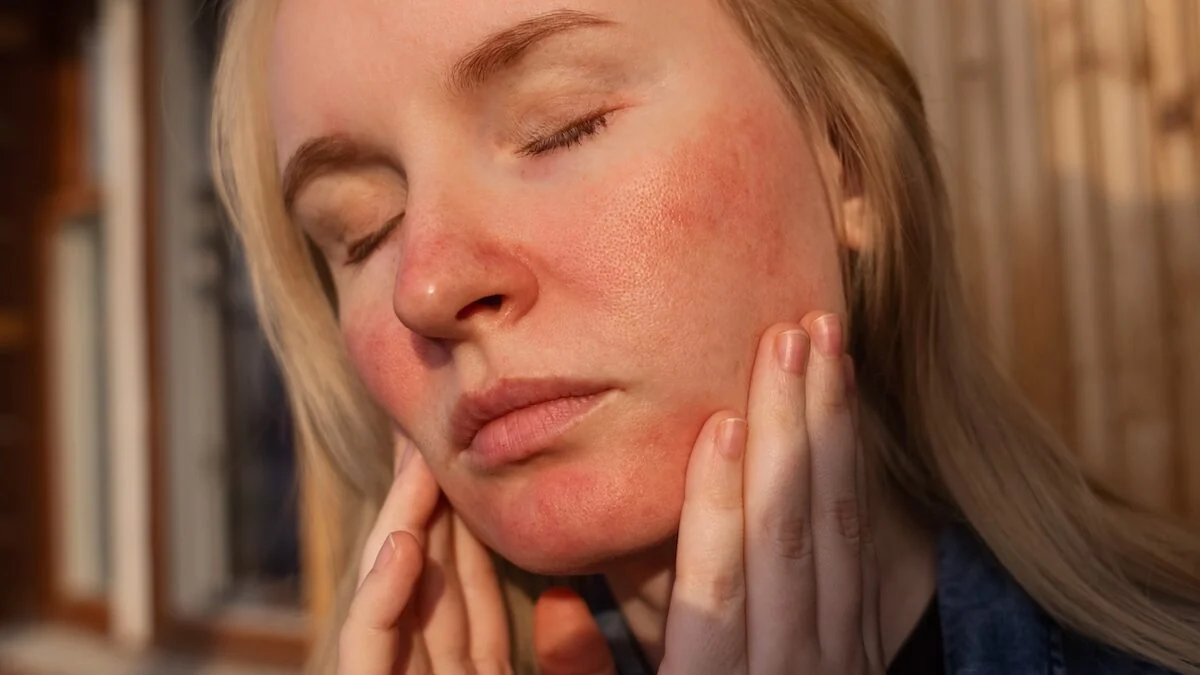
On Instagram, Dr Marie Jourdan (@dr_marie_jourdan) reminds us of a simple idea:
rubbing your face does not necessarily trigger rosaceabut can aggravate skin that is already reactive or prone to breakouts.
Friction is not the cause, but it can irritate more
The nuance is important. Rosacea is a chronic disease of the facial skin, which can manifest itself by redness, rosacea, flushing and, depending on the form, small inflammatory pimples in outbreaks. To learn more about the symptoms and treatments of rosacea, you should remember that it is not just a temporary redness.
The dermatologist emphasizes precisely this point: through abuse of language, we sometimes use “rosacea” to talk about diffuse redness or small visible vessels, while certain inflammatory outbreaks can also take the form of pimples, sometimes confused with acne.
“Rubbing is not going to cause a rosacea flare-up in everyone.”
This is the message to keep in mind: friction is not a proven cause of de novo rosacea. On the other hand, it can play the role of an irritating factor. On skin that is already fragile, red, uncomfortable or that “can’t take much,” rubbing insistently can increase redness, burning sensations or tightness. In other words, we must not confuse cause and aggravating factor.
This caution is in line with Health Insurance recommendations: when the skin is prone to rosacea, it is better
clean without rubbing and avoid abrasive gestures. The same reasoning applies to sensitive skin in general: the skin barrier reacts more quickly to mechanical attacks, even if they seem harmless. Too vigorous makeup removal, a grainy scrub or a rough towel can be enough to maintain the irritation.
Actions to take when the skin reacts quickly
The expert gives very concrete examples: scrubs, strong massages, removing makeup or applying a self-tanner are moments when you can easily scrub too hard. The right reflex is not to stop touching your face, but to reduce anything that mechanically attacks the skin.
In practice, on sensitive skin or skin prone to redness, it is better to adopt a short, gentle and regular routine. The most useful actions are often the simplest:
- Avoid mechanical scrubsrough brushes and strong facial massages;
- Clean with a gentle product, without trying to “strip” the skin;
- Dry the face by gently dabbing it, rather than rubbing with a towel;
- Remove makeup slowly, with light movements, especially on the cheeks and around the nose;
- Limit irritating products if the skin heats, stings or reddens easily.
These tips do not replace medical advice, but they help to understand why gentleness is central to good actions for sensitive skin. The goal is not to have a perfect routine, nor to feel guilty if a flare-up occurs: rosacea is a chronic conditionwith calmer periods and others more inflammatory.
If the redness persists, is accompanied by inflammatory spots, significant burning sensations or lasting discomfort, it is best to speak to a healthcare professional. Treatments for rosacea depend on its form: certain creams or vascular laser may be indicated in specific situations, but they should not be started alone after irritation.
Finally, not all facial redness necessarily corresponds to the same situation. Erythrosis, rosacea, inflammatory rosacea or other skin causes may look similar. To understand facial redness, observation over time and the advice of a caregiver remain useful, especially if symptoms change or become established.