
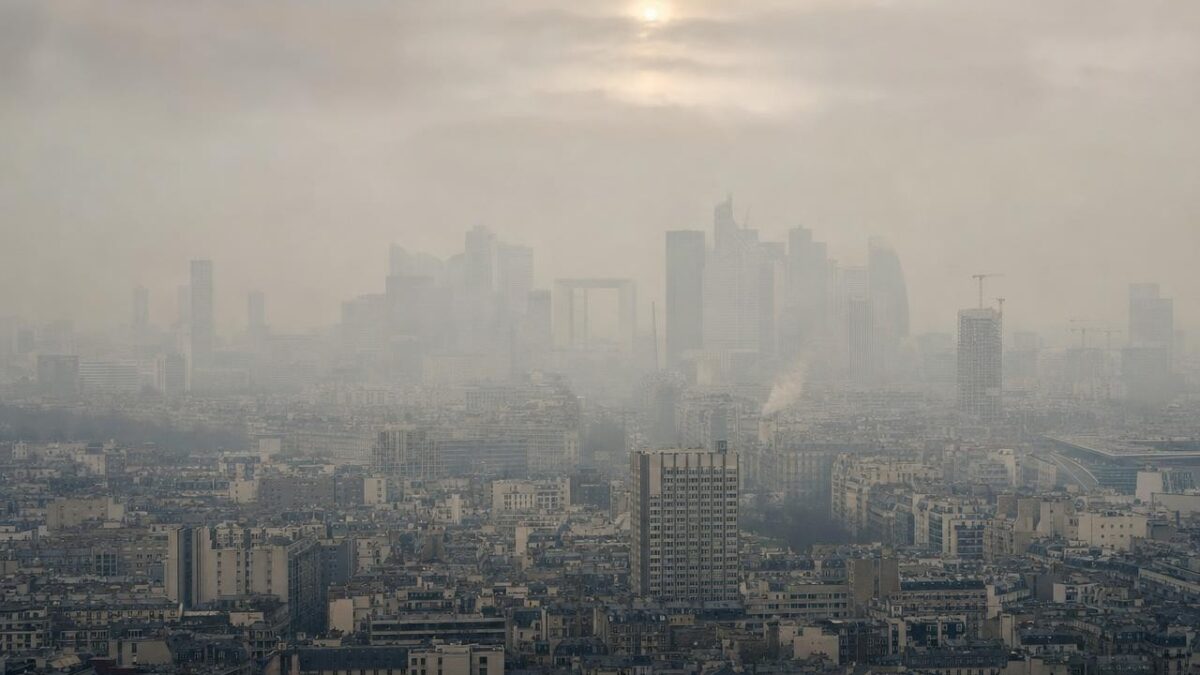
A bike ride behind a bus, a stroller on the side of a boulevard, a throat that stings on busy traffic days: air pollution is often experienced in small signs. On November 17, 2026, franceinfo relayed a Clean Cities ranking dedicated to 40 European cities. Its useful message is immediate: Lyon, Greater Paris and Marseille arrive in the second half of the tablewith a D grade.
This list does not say that a resident will get sick because of their street. Rather, he reminds us that chronic exposure to fine particles and nitrogen dioxide remains a public health issuewell beyond just pollution peaks.
Why are Lyon, Greater Paris and Marseille singled out?
According to the rankings carried out by Clean Cities, a coalition of NGOs focused on urban mobility, Lyon comes in 23rd place, Greater Paris in 24th and Marseille in 25th. The three obtain a D grade, while Copenhagen, Stockholm and Helsinki top the ranking with a “very good” rating.
The comparison concerns air quality, but also the ability of cities to come closer to future European requirements. It must therefore be read as a political and health signalnot as an individual medical measure. The NGO particularly emphasizes the levers linked to traffic: fewer thermal cars in the city, more efficient public transport, safe cycle routes separated from traffic.
On franceinfo, Clément Drognat Landré, French coordinator of Clean Cities, affirms that we still breathe “toxic air” in French cities mainly due to automobile traffic, even if he recognizes efforts for some: “In Paris, for example, nitrogen dioxide, which is really the tracer pollutant in traffic, has fallen by more than 40% over the last ten years”, explains Clément Drognat Landré. According to him, “we must continue to reduce the role of the car and in particular of the individual thermal car”. Conversely, Marseille is described more harshly, particularly for road pollution and that linked to cruise ships.
Does this ranking change anything for health?
The most misleading risk is the one you don’t see. Air pollution can irritate the respiratory tract in the short term, but its most severe effects are linked to prolonged exposure. Public Health France estimates, for mainland France, nearly 40,000 annual deaths attributable to exposure to fine PM2.5 particles and nearly 7,000 to nitrogen dioxide for the period 2016-2019. These numbers do not automatically add up, as exposures may overlap.
The local estimates cited for this classification must be formulated with caution: they are population-based, depend on the pollutant selected and the scenario used to compare a situation with or without pollution. We can therefore speak of attributable or avoidable deaths according to hypotheses, not of direct causality for a given person. To understand this mechanism, our file on the health impact of chronic exposure to air pollution details the documented respiratory and cardiovascular damage.
People with asthma, children, pregnant women, the elderly or those suffering from respiratory or cardiovascular diseases are among the most vulnerable groups. For them, poor air is not only a nuisance: it can aggravate symptoms, facilitate consultations or make certain efforts more difficult.
What will the 2030 European deadline change?
The classification is part of a precise regulatory timetable. European directive 2024/2881 provides, from January 1, 2030, for new annual limit values: 20 µg/m3 for nitrogen dioxide, 10 µg/m3 for PM2.5 and 20 µg/m3 for PM10. This amounts in particular to halving the old annual limits for nitrogen dioxide and fine PM2.5 particles.
According to Clean Cities, 37 of the 40 cities studied are not yet ready for these thresholds. Legally, European procedures primarily target Member States, even if communities are on the front line to act on mobility, town planning and transport. For a resident, this means that air quality does not only depend on individual actions: it also depends on the frequency of buses, the space left to cars, the safety of bicycle journeys and the proximity of major roads.
During the most degraded episodes, reflexes remain useful: consult local alerts, adapt intense physical activities and follow the recommendations if you are vulnerable. But the main issue remains less visible: breathe less polluted air all year roundnot just pass the peak days. This is where this ranking puts French cities under pressure.