
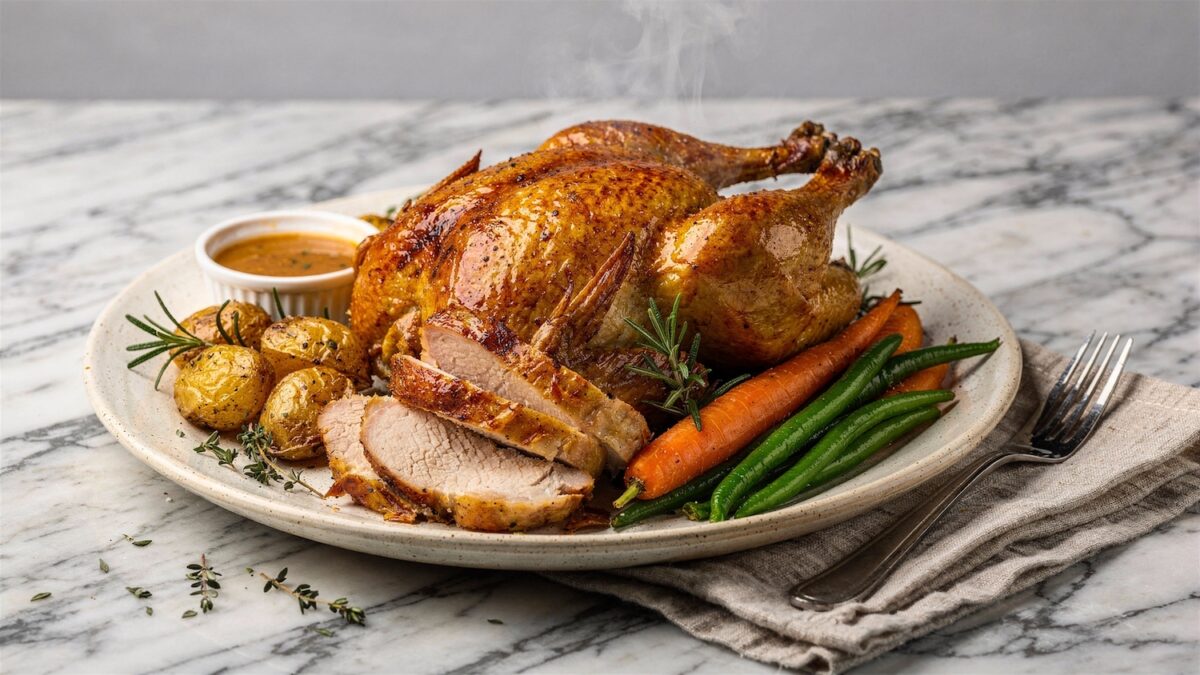
In front of the poultry section, two trays can look the same while telling very different things. One highlights “French origin”, the other displays “farmer”, “raised in the open air” or “Label Rouge”. But which one really lets you know how long the chicken has been raised?
The useful answer is a reflex: look for the supervised approach to which the product is linkedthen its specifications. The aging time is not always clearly printed on the packaging, and not all information answers the same question.
“Origin France”: what does the tray really tell you?
The mention “French origin” provides information on the origin of the product. It can be important for choosing a sector or a source, but it does not, by itself, give the age of the chicken at the time of slaughter. A chicken can therefore be French without its breeding period being readable directly on the tray.
Another source of confusion: formulas around the outdoors. For poultry, valuable mentions and references to the age of slaughter are regulated when they fall under recognized procedures, in particular the Red Label, an appellation of origin, organic farming or product certification. In other words, “free-range” should not be read in isolation as sufficient proof : you have to look in which context this mention appears.
This is where reading the packaging comes in handy. The full title of the product, any logo, the approval number or the certified characteristics can direct you to the reference document. To avoid shortcuts, it is better to know how to read the information on a food label rather than only comparing the slogans visible on the shelves.
When there is a Label Rouge, where can I find the specifications?
The Label Rouge is an official sign of quality. According to the DGCCRF, its characteristics are set out in specifications, approved by interministerial decree on a proposal from the INAO, then controlled by certifying bodies. The Ministry of Agriculture also specifies that the logo must be accompanied by the approval number and certified communicating characteristics.
Concretely, if your chicken carries a Red Label, look for
the full name of the product and the approval number. These elements make it possible to go back to the official file in the INAO database. For the example of Label Rouge LA/07/85, the INAO page is accessible here: “Free-range yellow chicken raised in the open air”.
The determining document is then the specifications. In the case of the specifications for Label Rouge LA/07/85 “Free-range yellow chicken raised outdoors”, the certified characteristics mention a breeding period of at least 81 days or at least 100 days depending on the case. This is verifiable information, because it appears in an official document.
But this data has an essential limit: it corresponds to a minimum provided for by these precise specifications. It does not give the exact age of the chicken in your tray, and it cannot be applied to all the poultry on the shelf, or even to all the products that display another approach.
Does this figure change anything for health?
A longer aging period can help to understand how a product is produced. However, it is not enough to conclude that a chicken would automatically be better for your health. The Red Label regulates production characteristics and superior quality in the regulatory sense; this is not a general nutritional claim.
The same reasoning applies to labels and purchasing choices. They can provide information on the breeding method, the origin or certain guarantees, but they do not replace the overall balance of the diet. To extend this distinction, it can be useful to understand what the labels on meat guarantee.
Nutritionally, chicken remains a white meat whose benefit also depends on the quantities consumed, the cooking method and the accompaniments. A grilled escalope, a breaded preparation or a very salty dish do not tell the same story on the plate. This is why white meat is not automatically healthier in all situations.
In front of the shelf, the right action consists of following three steps: identify the visible mentions, identify the applicable supervised procedure, then find the specifications if you want to check a duration. If no precise title or number allows this link to be made, the packaging simply does not allow a reassuring formula to be transformed into a controllable aging period.