
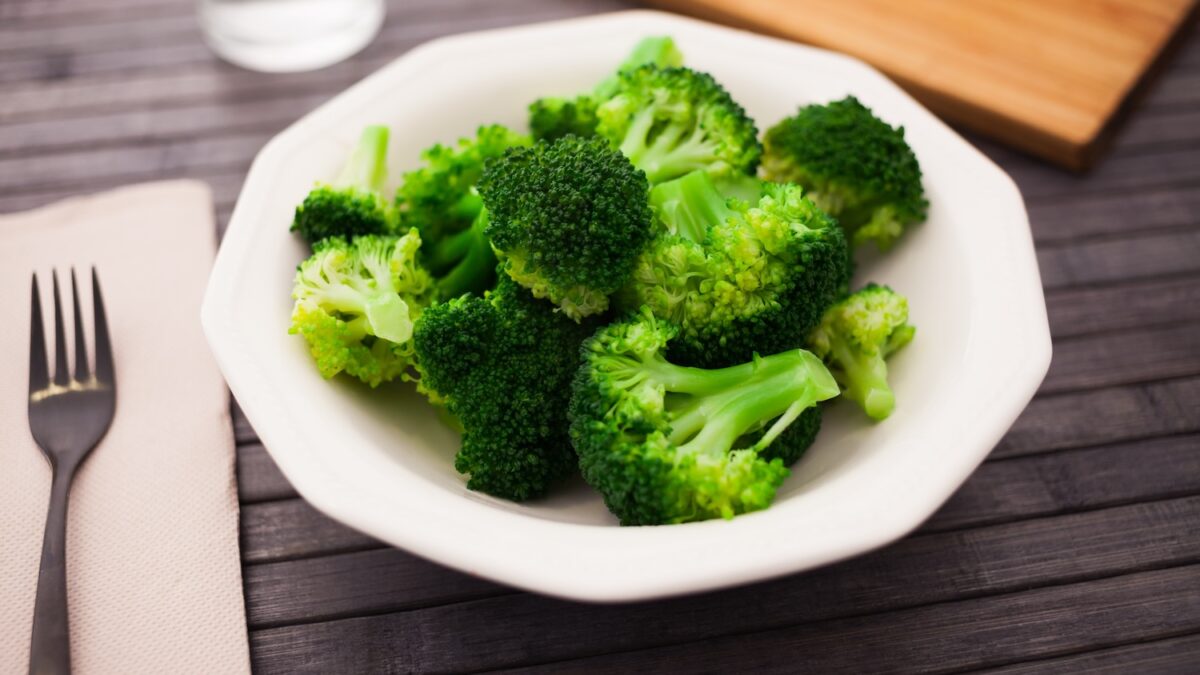
On the work surface, the choice seems trivial: will the broccoli florets plunge into boiling water or stay above, in a steam basket? When it comes to taste, everyone has their own habits. For vitamin C, the available data lean clearly towards steam, under the conditions studied.
This is not a spectacular health promise, nor a reason to change all your recipes. It is above all a very concrete cooking story: vitamin C is fragile, sensitive to heat, and it dissolves in water. This is why submerged and then drained broccoli doesn’t end up quite like steamed broccoli.
Why is cooking water a game changer?
When broccoli is boiled, its florets are in direct contact with hot water. Two phenomena can then be combined. On the one hand, heat can degrade some of the vitamin C. On the other hand, because vitamin C is heat sensitive and water soluble, a fraction can pass into the cooking liquid.
The following action also counts: if you drain the broccoli and the water goes into the sink, part of the vitamin C which has migrated into this water disappears with it. Nothing is really visible on the plate, but the final content of the vegetable may be modified.
With steam, the principle is different. Broccoli heats up, of course, but it doesn’t bathe in water. Contact with the liquid remains limited, which reduces the transfer of water-soluble vitamins to the cooking water. This is one of the reasons why steam often emerges as an interesting option when we seek to preserve certain fragile nutrients.
What does the experiment conducted on broccoli show?
A study published in the Journal of Zhejiang University Science B compared several methods of cooking broccoli at home, including boiling and steaming. The protocol was very structured: 200 g of broccoli, 5 minutes of cooking ; for boiling, the pieces were cooked in 400 ml of water then drained; for steam, they were placed above 200 ml of water in a closed steamer.
In this study, boiling was associated with a loss of approximately 33% of vitamin C. Steaming did not result in a significant loss compared to raw broccoli. The result is therefore in line with the culinary explanation: the less the vegetable is immersed, the less risk of vitamin C leaving in the water that is thrown away.
But this number should not be copied and pasted on every pan. The size of the florets, the amount of water, the lid, the cooking time, the freshness of the vegetable or letting it become very tender can change the result. The study gives a trend, not a universal percentage valid in all kitchens.
More generally, vitamin C is described as sensitive to oxidation, heat and light; it can also escape into the cooking water. To preserve vitamins, it is advisable to keep fresh vegetables in the refrigerator, consume them quickly, and if possible steam or stew them in a little boiling water.
So, what to do in your kitchen?
If you’re serving broccoli as a side and want to steam the vegetables to preserve the nutrients, the steamer basket is an easy option. The right benchmark is not only the cooking method, but also the time: stop as soon as the broccoli is tender to your likingwithout prolonging it unnecessarily.
A few actions can limit losses: avoid cutting the bouquets into tiny pieces, do not let them cook for too long, serve quickly after cooking. These details seem modest, but they sometimes weigh as much as the choice between saucepan and steam basket.
Should we therefore ban boiled broccoli? No. If you prepare a soup, a soup or a broth that you consume, the logic changes: part of the vitamin C can pass into the water, but this water is not thrown away. Heat can always destroy part of ityou simply do not lose the cooking liquid.
The message is therefore not to promise a measurable clinical benefit by changing the pan. To further preserve the vitamin C in broccoli, short steam cooking is often a good compromise. And to benefit from the nutritional benefits of broccoli, the best cooking method is also the one that makes you want to eat it regularly.