
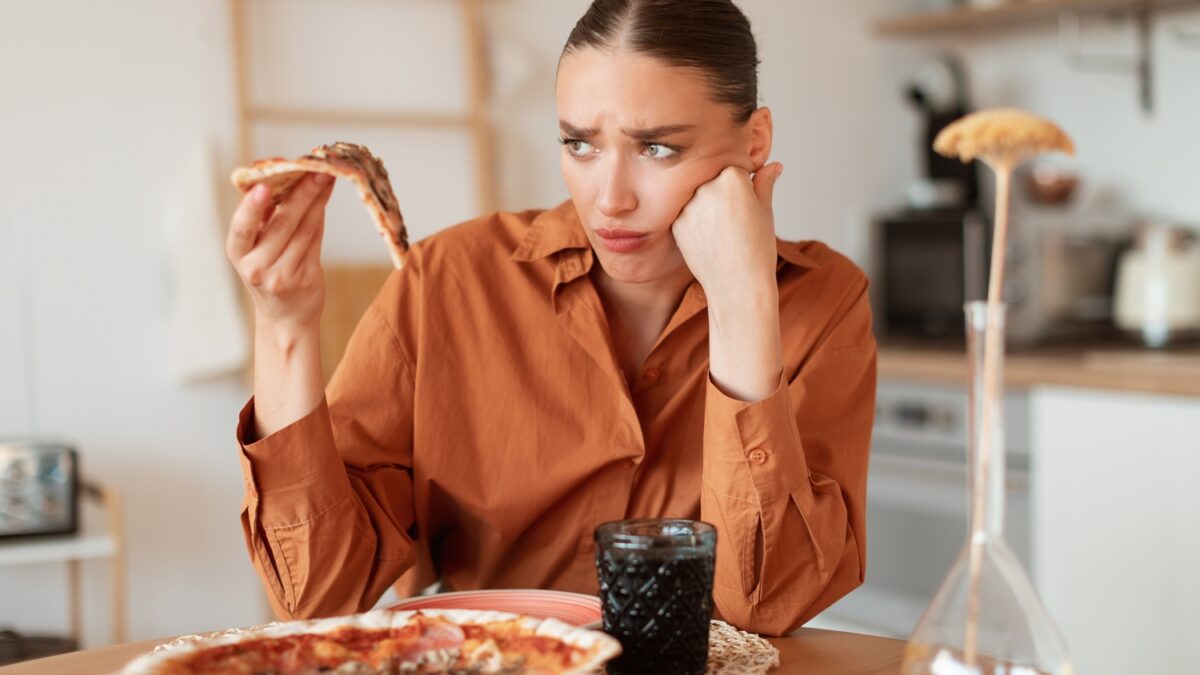
Because you were too ambitious (or greedy) in your order, it often happens that leftover pizza remains in its box, waiting patiently to be consumed. But be careful, leaving them in the open air for several hours is anything but a good idea. Dr Gérald Kierzek, medical director of True Medical, reminds us of the essential precautions to avoid food poisoning.
Disgusting video reveals bacterial growth on leftover pizza
A microbiologist has highlighted the surprising amount of bacteria that can grow on leftover takeaway pizza, which could make you hesitate before eating it. In a recent video that has racked up nearly 14,000 views, Nicholas Aicher, a senior quality control analyst in Chicago, assessed bacterial growth on a pizza right after purchase and the next day.
The video, shared on his TikTok account @howdirtyis, which has more than 450,000 followers, begins by showing him a large takeout pizza, half cheese, half pepperoni, and using a swab to take samples from each side. The next morning, he took samples from the remaining slices from the day before, which he then placed in labeled Petri dishes and incubated. After some time, not specified by Mr. Aicher, he noticed that the fresh slice of cheese was “impeccable”. In contrast, the sample from the fresh pepperoni slice showed significant bacterial growth. While examining the older slices, he noticed that the cheese slice had visible bacterial growth.
Surprisingly, the older slice of pepperoni contained fewer bacteria than the fresh slice, a phenomenon he couldn’t explain. Regarding this experience, Mr. Aicher said: “I thought it would be fun for people to discover all these nasty little things that we don’t think about every day.“.
Between 4°C and 60°C, bacteria multiply rapidly
“Leftover pizza left at room temperature can become dangerous very quickly. In general, after hours outside the fridge in the “danger zone” (between 4°C and 60°C), harmful bacteria such as E. coli or Staphylococcus aureus can proliferate and make the pizza unfit for consumption, with real risks of food poisoning. alerts Dr Gérald Kierzek, medical director of True Medical.
And if the ambient temperature is high (above 32°C), this delay can be reduced to one hour. In practice, in a cooked dish, “a bacterial cell can double every 20 minutes, making contamination exponential.”
he specifies.
If you have fallen asleep on the sofa with a leftover pizza in your hand, there is only one reflex: head to the trash can to throw away these potentially contaminated leftover meals.
Pizzas: a few rules help prevent the appearance of bacteria
So you will have understood: pizzas can become real breeding grounds for bacteria if they are not stored correctly. Luckily, there are a few simple steps you can take to prevent your dinner from becoming a playground for harmful germs.
“To prevent bacteria from proliferating on leftover pizza, cool it quickly and store it in the refrigerator within two hours of cooking. It is recommended to place it in an airtight container or wrap it tightly in plastic wrap or aluminum foil to limit exposure to air and humidity, factors that promote bacterial growth,” recalls Dr. Gérald Kierzek.
Leftover pizza should therefore be stored in a refrigerator at around 4°C. Under these conditions, they can be kept for three to four days maximum.
“Beyond that, the bacteriological risk increases even if no visible sign such as an odor or mold is present. It is better not to eat a pizza that has a suspicious odor or an abnormal texture,” relates the doctor.
Enough to now spend great pizza evenings with friends… in complete safety!