
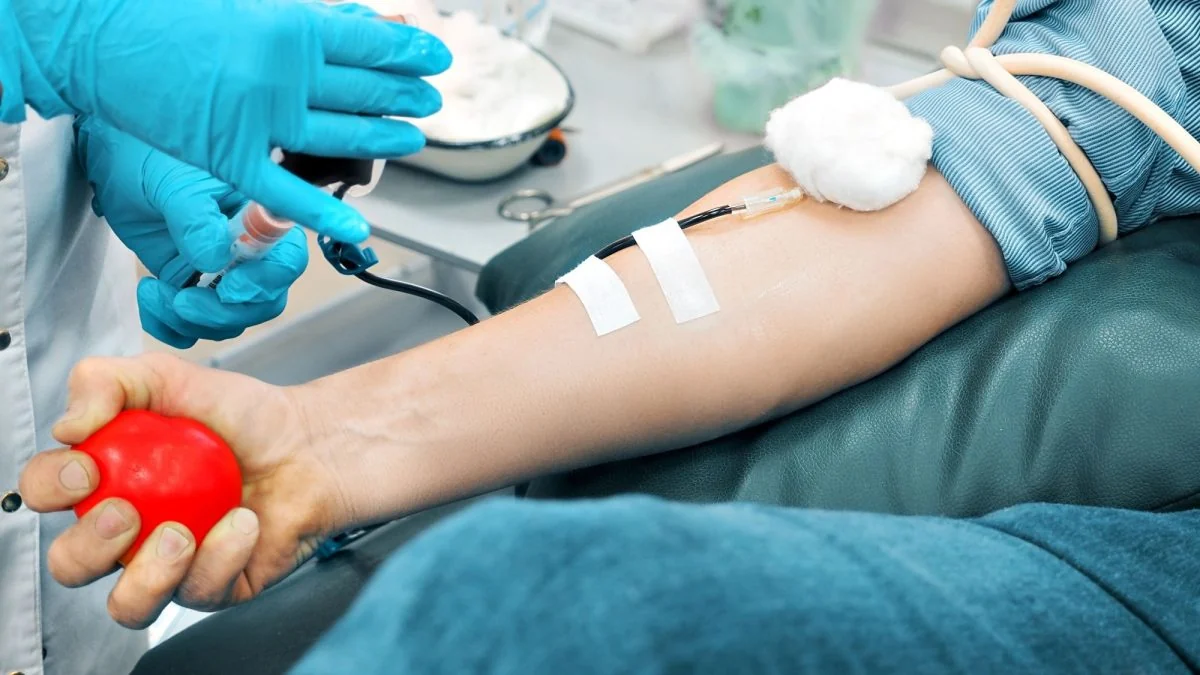
On the donation chair, the gesture seems almost complete as soon as the bag is filled. In reality, for blood drawn, the journey is just beginning. A bag does not go directly to a patient: it enters a chain of controlsfrom the preliminary interview to the checks carried out before the transfusion.
The broadcast of the documentary The tragedy of contaminated blood brings this issue to the forefront. In the 1980s, in France, people contracted HIV after a transfusion or treatment with blood products. In particular, in 1993, the Council of State held the State responsible for contamination caused by transfusions of unheated blood products carried out between November 22, 1984 and October 20, 1985. Since then, transfusion safety has been based on a central idea: no isolated filter is enough.
Before donating, what are we really trying to know?
The first step occurs before sampling. The donor completes a questionnaire, then speaks with a doctor or authorized nurse. The objective is not to “sort” people randomly, but to assess whether donation is possible that day, to protect both the donor and the recipient.
State of health, treatments, recent care, exposure to blood, situations that could expose you to infection, travel: several pieces of information may lead to postponing the donation or planning additional examinations. Public Health France indicates, for example, that certain risk factors, such as recent travel or birth in an endemic area, can lead to testing for antibodies against malaria or Chagas disease.
This is why sincere responses remain an essential link. The selection rules have evolved with scientific knowledge and regulations, but their goal remains the same: to identify situations where a donation could be risky. To better understand the concrete process, our article details how a blood donation takes place.
After the sample, what happens to the bag?
When donating, we do not only take the bag intended to become a blood product. Sample tubes are also collected. According to the French Blood Establishment, they are used for the biological qualification of the donation, before the products from the bag can be sent for distribution.
These analyzes relate in particular to the virology, serology, immunology and blood counts. If an anomaly is detected, the bag is discarded and the donor is notified. In other words, the journey does not go from the sampling chair to the patient’s bed without an intermediate step.
Compliant blood products are then prepared and distributed as needed. At the hospital, other checks are also carried out, including the final check of compatibility before transfusion, described by the EFS in the course of a blood bag.
HIV, hepatitis, syphilis: why does zero risk not exist?
Public Health France reminds that each donation is subject to regulatory screening for major infectious agents: HIV, hepatitis B and C, syphilis, as well as pathologies associated with human T-lymphotropic viruses (HTLV) only in new donors in mainland France and in all donors in the French departments of America.
For HIV and hepatitis, laboratories look for different biological markers, including antibodies, antigens and viral genomic screening tests, depending on the virus. This genomic screening reduces the so-called period of “silent window”these first days following contamination when the infection can still be difficult to detect.
Public Health France gives meaningful orders of magnitude: 9 days on average for HIV-1 with these techniques, compared to 22 days with traditional serological tests; 7 days for the hepatitis C virus versus 66 days; 22 days for hepatitis B versus 38 days. These averages show the progress of screening, but they do not guarantee that a very recent infection will always be detected.
Zero risk therefore does not exist in transfusion medicine. This is precisely why the interview, analyzes and vigilance after the donation complement each other. If a donor realizes after the fact that he has forgotten important information, or if he learns of an exposure that could call into question the safety of his donation, this information must be able to be reported and taken into account.
Certain situations, such as temporary contraindications to blood donation, illustrate the importance of this dialogue before and after the blood sample. The criteria for access to donation are not limited to a category of population: they are today based on the evaluation of risk situations and specific contraindications. Our analysis of the current donor selection criteria looks back at this development.
For the donor, the consequence is very concrete: donating blood remains an essential gesture, but it does not stop with the bandage placed on the arm. Information given before, during or after sampling can further contribute to securing the entire chain.