
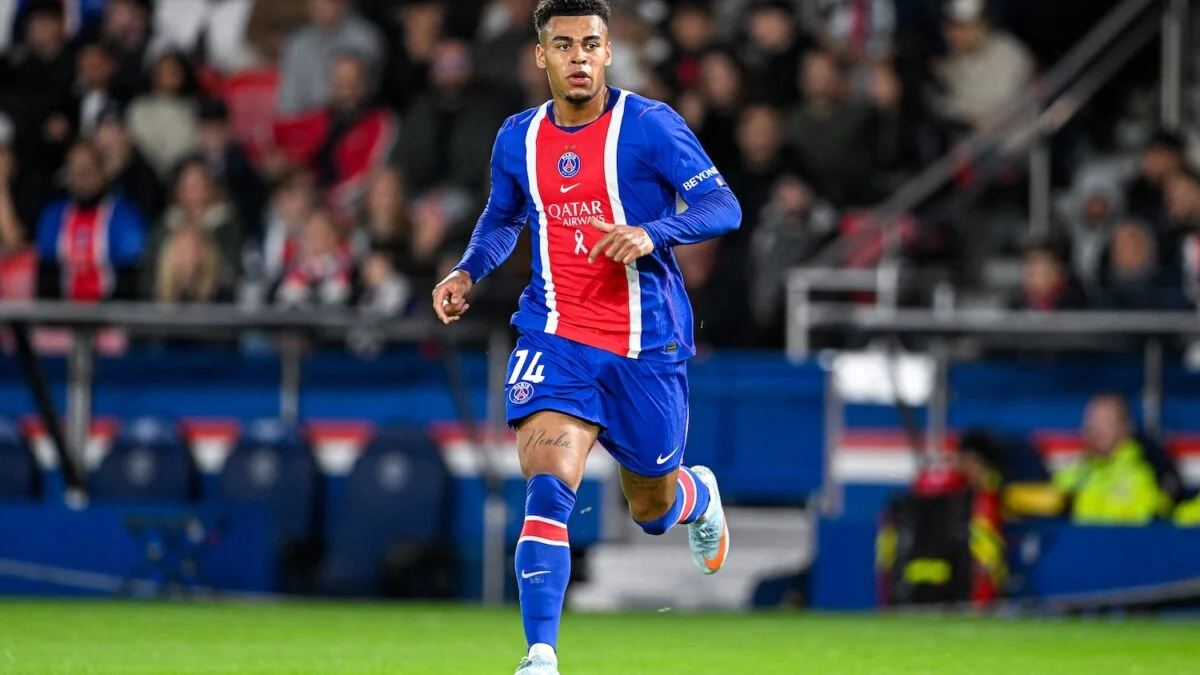
The scenario that Paris Saint-Germain feared was confirmed. After Khvicha Kvaratskhelia, injured in similar circumstances in October, it is the turn of Désiré Doué to suffer a rupture of the anterior cruciate ligament (ACL) in his right knee. An injury particularly feared among athletes, as it can disrupt a season and require several months of rehabilitation.
On November 22, the Parisian club made the diagnosis official in a medical press release: “Victim of a ruptured anterior cruciate ligament in his right knee during this Saturday’s Ligue 1 match against OGC Nice, Désiré Doué will undergo surgery by the end of the month..
At the age of 21, the player trained at Stade Rennes begins a demanding treatment course. Because although the operation allows the ligament to be reconstructed, it is not enough to regain all the capabilities of the knee. Recovery also takes place in the weeks that follow, with progressive and carefully supervised rehabilitation.
Understanding what the cruciate ligament really stabilizes
The anterior cruciate ligament is located in the center of the knee. It connects the femur to the tibia and contributes to the stability of the joint, particularly during rotations and changes of direction. This is precisely what makes it particularly in demand in football, handball, skiing, basketball or sports requiring sudden support.
A breakage can occur following a pivot, a twist, a sudden change of direction, a poorly controlled landing or an impact. It can be accompanied by significant pain, rapid swelling and a feeling of instability.
“A crunch, sudden pain, a knee that gives way and rapid swelling should raise suspicion of a rupture of the cruciate ligament.specifies Dr. Gérald Kierzek, emergency physician and medical director of True Medical. And added: “The Lachman test confirms the instability, while the x-ray is carried out urgently to rule out a fracture but it is the MRI which has the last word in visualizing the lesions..
In the case of Désiré Doué, examinations confirmed a rupture of the anterior cruciate ligament of the right knee. This damage requires specialized treatment, particularly in a professional footballer whose sport places significant demands on the joint.
The operation is not enough: recovery is built after
There are two main approaches to treating a ruptured anterior cruciate ligament: surgical reconstruction, which involves replacing the injured ligament with a tissue graft, and, in certain specific situations, ligament repair, which aims to reattach the torn fibers.
In a professional athlete practicing a pivotal sport such as football, surgical reconstruction is often considered when the rupture compromises the stability necessary for playing high-level sport.
But the intervention does not necessarily have to be carried out urgently. The condition of the knee, its swelling, its mobility and any associated injuries must be assessed before determining the best time to operate.
“You should never operate on a rupture of the cruciate ligament urgently, but re-examine the knee 3-4 weeks after the trauma in most cases.explained Dr Éric Plotkine, orthopedic surgeon and traumatologist at the Parisian Maussins Nollet clinic.
Once the intervention has been carried out, the recovery work truly begins. The goal is to gradually regain mobility, reduce inflammation, recover muscle strength and relearn how to properly use the joint.
The first weeks: an essential step to regain a functional knee
After cruciate ligament reconstruction, rehabilitation is essential. The first weeks are not aimed at immediately regaining sporting performance, but at putting the knee in the best possible conditions for the future.
In particular, it is necessary to work on several objectives: controlling pain and swelling, gradually recovering extension and flexion of the knee, reactivating the muscles and regaining more and more natural walking.
The patient must also gradually become an actor in his recovery again. Here are the benchmarks for resuming activity communicated by Dr Éric Plotkine, to be adapted according to the intervention carried out and the progress of each patient:
- Walk : directly after the operation, without a splint, with two crutches for 10 to 15 days;
- Driving: after 2 to 3 weeks;
- Return to office work: after 2 to 4 weeks;
- Return to a physical or manual professional activity: after 4 to 6 weeks;
- Gym : squats, exercise bike and elliptical bike, as well as swimming (crawl, but not breaststroke), from the sixth week;
- Jogging : after 3 months;
- Pivot sports: football, skiing, tennis, etc., after 6 to 8 months.
These deadlines constitute benchmarks and not a timetable to follow blindly. Progression depends on individual recovery, the results of functional assessments and the recommendations of the medical team.
Resumption of football does not mean immediately regaining your level
For a professional footballer like Désiré Doué, the prospect of returning to the field is necessarily at the heart of concerns. But an essential distinction must be made: regaining the ability to walk, resuming running and playing football at a high level again are three very different stages.
The time limit of six to nine months is often mentioned after an ACL tear. Yet for sports involving pivoting, acceleration, contact and changes of direction, the full return can exceed nine months.
Current recommendations favor a recovery based on objective criteria: absence of pain and swelling, satisfactory mobility, recovery of muscular strength, functional tests and psychological preparation.
Because finding a sufficiently strong knee does not always mean immediately regaining confidence in it. The fear of a new injury can modify support, slow down certain movements and complicate the return to competition. This psychological dimension is an integral part of rehabilitation.
For Désiré Doué, the path will therefore be gradual. The challenge will not only be to get back on the pitch as quickly as possible, but to be able to return with a knee that is sufficiently stable and prepared to support the demands of professional football. A long-distance race in which patience counts as much as physical work.