
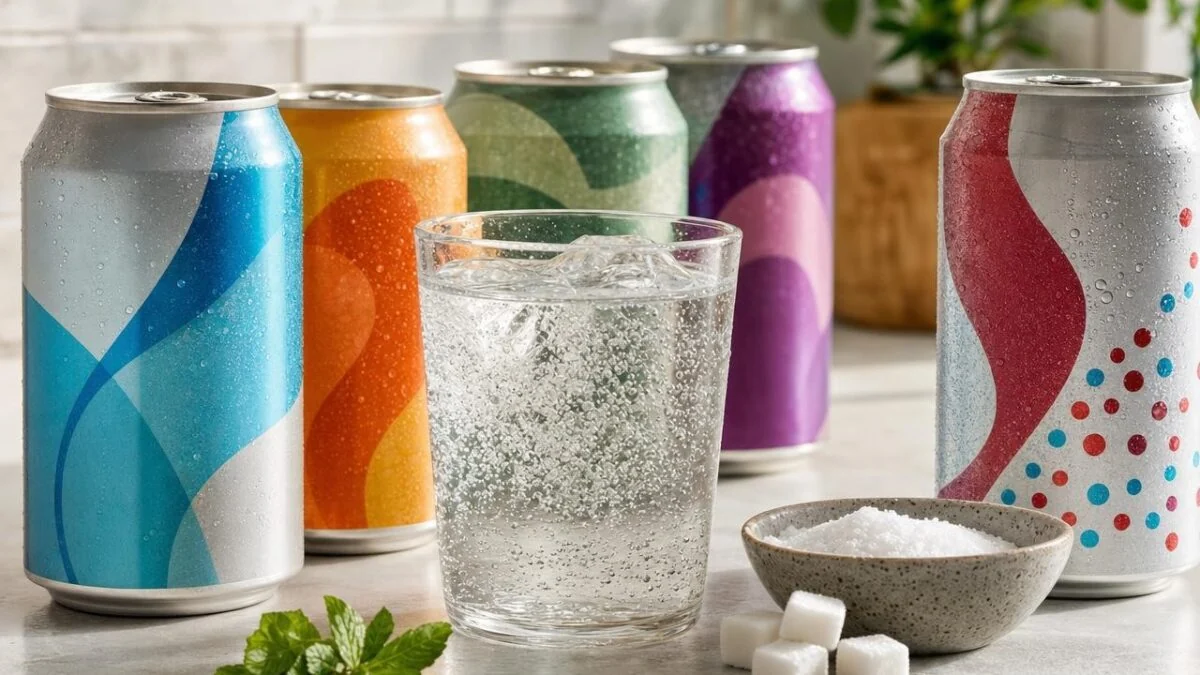
In the drinks section, the promise is intriguing: bubbles, a soda taste, but also fiber, sometimes presented as “prebiotics”. Sold as more modern and healthier than traditional sodas, these cans appeal to young consumers. But is this really the case?
Why do we need to convert the fibers “per 100 ml”?
However, the right reflex is not to stop at the word written in large size on the can. The really useful information is in the nutritional table: how many grams of fiber will you drink, in total, in this serving? And what else does the drink contain: sugars, sweeteners, flavorings, actual volume?
The DGCCRF reminds that the nutritional declaration is expressed per 100 g or 100 ml, in order to allow comparison between products. For a drink, this presentation is practical, but it requires a little calculation. If the label indicates, for example, 2 g of fiber per 100 ml, a 330 ml can provides approximately 6.6 g of fiber. For 350 ml, multiply by 3.5.
The useful reflex therefore consists of locating the “fibers” line, then relating it to the exact volume of the can. It is this total quantity that counts in your day, not just the standardized value displayed for 100 ml.
Another important nuance: the terms “source of fiber” and “rich in fiber” are not free. European Regulation 1924/2006 governs these formulas: “source of fiber” corresponds to at least 3 g of fiber per 100 g or 1.5 g per 100 kcal; “rich in fiber” at least 6 g per 100 g or 3 g per 100 kcal.
For a drink, it is therefore necessary to distinguish this regulatory threshold from the label value often read for 100 ml. And an authorized claim does not automatically transform a soda into a health food.
Added fiber and prebiotics: what can we expect?
Fibers have real physiological effects. ANSES describes in particular a documented laxative effect, variable depending on the nature of the fibers, and recalls that certain fibers fermented in the colon can produce gas. In other words, the type of fiber matters as much as the number of grams.
To better understand these differences, it is helpful to distinguish between soluble and insoluble fiber. In fortified drinks, we often find added fibers such as inulin or fibers from corn. They can contribute to the total fiber intake, but they do not alone reproduce the diversity of a diet rich in plants.
This is particularly true when the drink highlights the microbiota. The term “prebiotic” suggests that certain fibers may serve as a substrate for gut bacteria. But
the microbiota promise should not be read as a guarantee of effect for everyone. Tolerance depends on the dose, overall diet, regularity of consumption and individual digestive sensitivity.
This sensitivity is not a detail. Beyond 5 to 7 g of inulin per day, some people may experience bloating or pain. This is not a universal medical limit, but a point of caution: if your intestine reacts easily, it is better to avoid sudden increases in added fiber.
What to look at before putting the can in the basket?
A fiber-enriched drink may be better formulated than a regular soda, but it is still a processed drink to be evaluated as a whole. Fiber should not overshadow sugars, possible sweeteners, flavorings, portion size and frequency of consumption. Good arbitration is done on the entire label, not on a single promise.
The basis remains the daily diet. To increase your fiber intake, the most interesting sources are varied: vegetables, fruits, legumes, whole grains, nuts and seeds. They also provide other nutrients, which a can cannot replace.
Finally, don’t mix marketing messages. A “sugar-free”, “light”, “prebiotic” or “rich in fiber” drink does not necessarily meet the same objective. The real instinct remains to look at what is actually in the can.
Before making it a habit, look up the grams of fiber per 100 ml, multiply by the volume drunk, then see if the product really fits into your day. If that can becomes your main source of fiber, it’s probably because the marketing has taken up a little too much space in your glass.