

A mole changes, a black spot appears, eczema prevents you from sleeping… and no dermatologist takes on a new patient. In this case, don’t wait passively
is the right reflex: you must prioritize the worrying signs, document the evolution and go to a doctor to obtain, if necessary, more rapid guidance.
When a stain or mole shouldn’t wait
In The ParisianLydie, 70, says she spotted a “not clear” black spot on her arm before looking for a date for more than a year. A dermatologist will eventually diagnose a melanoma, then a second on the back. This testimony does not prove, in itself, that a delay always results in aggravation. But he points out a solid rule: for melanoma, the earlier the diagnosis, the better the prognosis.
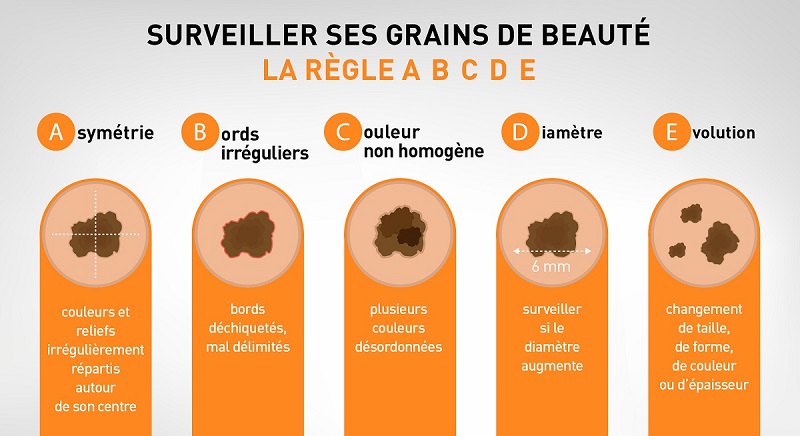
The goal is not to self-diagnose, nor to panic at each pimple. According to Health Insurance, one or more signs of the ABCDE rule justify medical advice without delay. The benchmarks to know are simple:
- Spot asymmetry or irregular edges;
- Watch for color that turns black, multiple or uneven;
- Note an increase in size, particularly beyond 6 mm;
- React to a recent development: shape, relief, color, itching or bleeding;
- Compare with other moles: a very different lesion, the “ugly duckling”, deserves an opinion.
 © Gustave Roussy
Photographing the lesion with the date can help show the progress, especially if you have been hesitant for several weeks. To explore the visual criteria in more detail, you can also consult our guidelines for recognizing the signs of a suspicious mole.
If no dermatologist responds, go through a medical circuit
The difficulty of access is real. The National Council of the Order of Physicians lists 2,859 doctors regularly active in dermatology-venereology as of January 1, 2026, a figure down compared to 2016 according to professional data. Be careful, however: a national number does not say how many appointments are available near you.
In the event of a suspicious lesion, the most effective route often remains the treating physician. The High Authority for Health recommends that a suspicious lesion be referred to a dermatologist without delay. Concretely, prepare for the consultation to avoid wasting time:
- Bring dated photos, taken in the same conditions if possible;
- Clearly report what has changed: size, color, relief, bleeding, pain or itching;
- Mention your known risk factors: personal or family history of skin cancer, immunosuppression, numerous moles, significant sun exposure;
- Ask if a priority mail, teleexpertise or hospital consultation is indicated;
- Contact the doctor again if the lesion progresses before the scheduled appointment.
A random photo sent by email or personal messaging is not a safe solution. If your doctor offers to send images, use the secure channel he or she indicates. Teleconsultation, teleexpertise or image assistance tools can facilitate sorting in certain routes, but these tools do not replace a dermatological examination when a lesion is progressive or frankly suspicious.
Faced with a shortage, several professionals can identify that a situation needs to be addressed, without making a dermatological diagnosis. This point is detailed in our article on the role of local professionals when faced with a suspicious lesion.
Severe eczema: do not trivialize daily suffering
Skin cancers are not the only situations to prioritize. LeParisien also reports the journey of Laëtitia, 36 years old, marked by red patches, oozing near the eye, itching and scratching until she bled for several years, before hospital treatment. His story shows thatchronic dermatosis may warrant re-evaluation when it becomes unlivable.
In eczema, treatments depend on the diagnosis, location, extent and severity. The fact that local treatment was not enough for one person does not mean that it is ineffective in general. On the other hand, itching that prevents you from sleeping, lesions that ooze, pain, damage to the face, an impact on work, clothing, self-image or morale should lead to resuming contact with your doctor.
The doctor will be able to verify the diagnosis, look for an infection or another cause, adapt the care and, if necessary, refer you to a specialist consultation. Certain moderate to severe forms require targeted treatments prescribed and monitored medically, but no medication cited in a testimony should be presented as a universal answer. To help situate these possibilities, our brief on options for moderate to severe eczema can help prepare the questions to ask. While waiting for an appointment,
do not stop or change a prescribed treatment without medical advice.