

The weight of the ten most assigned first names increased from around 40 to 45% of births at the start of the 20th century to just over 10% in the 2010s (reading the graph). The repertoire of first names has expanded by a third since the relaxation of the legislation in 1993, and there were 20 times fewer first names assigned in 1900 than today.
1900: Marie and Jean as headliners
Our great-grandparents had far fewer choices. In 1900, Marie was given to one in 5 girls and Jean to one in 12 boys. It was not uncommon for three children to have the same first name in the same class.
Today, the situation is no longer comparable. Gabriel and Louise should be given respectively to one boy in 70 and one girl in 110 in 2026. Compared to the annual number of births, these first names represent barely 1% of the attributions.
What the weight curve of the ten most given first names shows
The graph, which follows the evolution of the weight of the ten most assigned first names from 1900 to 2020, shows a clear decline, with different rhythms depending on gender:
- Among boysthe share of the ten most given first names increased until the 1940s (around 48% according to the graph), before declining markedly;
- For girlsit decreased earlier, from the beginning of the century, then reached a plateau between the 1920s and 1960s;
- From the 2000sthe two curves meet. They are then around 15%, then a little above 10% in 2020 (values read on the graph, therefore approximate).
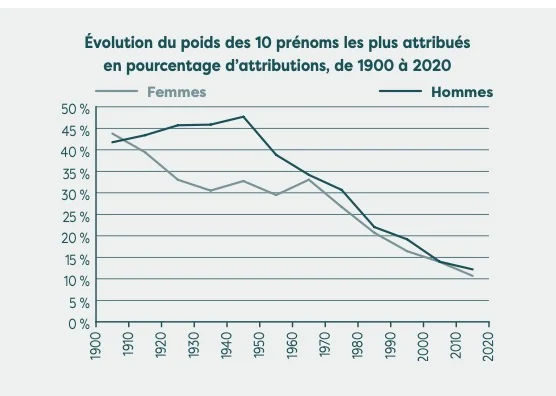 © All rights reserved L’Officiel des Prénoms (First Editions)
Evolution of the weight of the 10 most assigned first names
Legislation that is being relaxed in stages
The clear decline in the curves from 1966 corresponds to a relaxation of the law of 11 Germinal Year XI, known as the Bonaparte law. This law required parents to choose from a list of first names taken from different calendars and characters from ancient history.
The ministerial instruction of 1966 expanded the admissible choices to first names taken from mythology, regional first names, diminutives and variations. In 1993, the Bonaparte law was abolished: the State then gave parents almost unlimited freedom of choice.
The stock of first names is expanding in both genders, which explains the merger of the curves at the turn of the 2000s.
Increasingly rare first names
The expansion comes both from the massive arrival of new first names and the multiplication of variants. Regional or from elsewhere, old or invented, these original first names contribute to parents’ desire to give their child a unique identity.
INSEE figures illustrate this movement:
- Marie is only attributed in 0.3% of births;
- Of the 35,000 first names recorded in the INSEE file, less than 1,800 were given to 50 or more children this year;
- Only Marie and Jean are still worn by more than 800,000 people.
The very common first names of yesterday, like Marie and Jean, should not leave heirs carried so massively. The current diversity of first names reflects the freedom offered to parents, far from the imposed lists at the beginning of the century.