
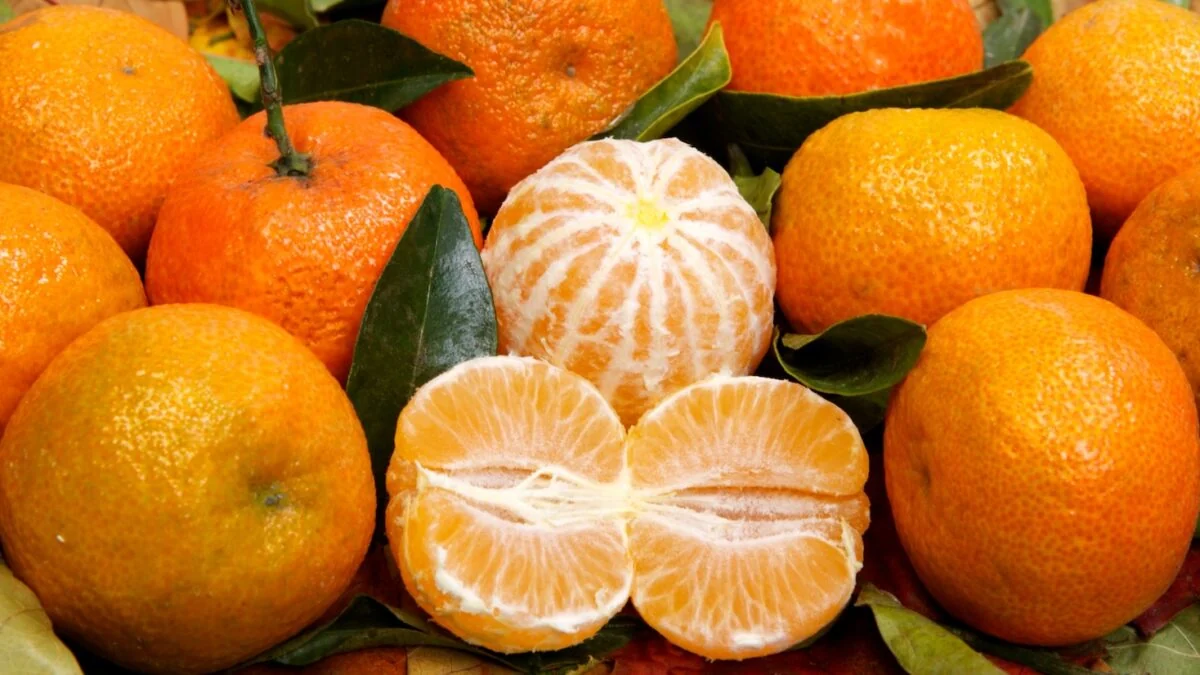
You hesitate between two clementines: one very orange, the other marked with a small green spot near the peduncle. By reflex, many put the second one down, convinced that it is not ripe. However, when it comes to a Clementine from Corsica IGPthis reflex can cause you to miss a fruit ready to be enjoyed.
The nuance is important: it applies to this clementine sold under protected geographical indication, not to all clementines on the market. In peak season, when the 2026 harvest is marked by heat and drought in Corsica, the skin doesn’t always tell the whole story.
Is a green spot really a sign of immaturity?
For Corsican Clementine IGP, the essential point is this: the fruit is picked when ripe. The Ministry of Agriculture reminds that this clementine is harvested by hand, when it has reached maturity, and that it can have an orange skin stained with green without this meaning that it is immature.
Why this color? The orange coloring of citrus fruits is favored by cooler temperatures. At the start of the season, or when weather conditions disrupt this process, the fruit may be ripe inside while its skin has not yet taken on a uniform color. In 2026, a Corsican producer cited by Corse Net Infos reported a slower and more random coloring under the effect of high heat, while the taste criteria, such as sugar and acidity, could be there.
The IGP specifications are even very precise: the exterior coloring may not be uniform and may contain
up to 1/5 of green surface. Maturity is therefore not judged solely by the color of the skin, but by internal criteria, notably the balance between sugar and acidity of the juice.
Be careful, however, not to draw the opposite conclusion: a green spot does not prove that a clementine comes from Corsica. Nor does it alone prove its quality. It is only a sign compatible with the characteristics of Clementine de Corse PGI.
On the shelf, what marker should you look at before the color?
If you are looking for an authentic Corsican clementine, the right reflex is not to only examine the skin, but to look at the labeling. The protected name “Clémentine de Corse” accompanied by the IGP logo is the mark to look for on the packaging, the tray or the shelf label.
The PGI, or protected geographical indication, designates a product whose quality, reputation or characteristic is linked to a geographical origin. In the case of Corsican clementine, the INAO points out that it is a product recognized as PGI since 2007, cultivated and harvested according to precise specifications.
Another particularity highlighted by official sources: Corsican Clementine IGP achieves its natural coloring and maturity on the tree, without coloring activator, and does not undergo chemical treatment after harvest. Here again, this information applies to fruits sold under this protected name, not to all clementines available in stores.
If you want to eat it the same day, do not automatically rest a PGI Corsican Clementine because it keeps a small green zone. Instead, look for intact, undamaged fruit and rely on the label for its origin.
Vitamin C, fiber: why keep the quarters?
In terms of nutrition, clementine also has good arguments. Like other citrus fruits, it is one of the food sources of vitamin C. ANSES points out that this vitamin contributes in particular to facilitating the absorption of non-heme iron, that is to say the iron present in plant foods such as legumes.
Concretely, if you eat lentils, finishing the meal with a clementine can help your body better use part of the vegetable iron in the meal. It’s a simple, seasonal combination that ties in with the benefits of combining lentils with a source of vitamin C.
To preserve the fiber, it is better to eat the fruit in quarters rather than limiting yourself to its juice. You benefit from the vitamin C and fiber naturally present in the fruit. To go further, you can find the nutritional benefits of clementine and, more broadly, those of citrus fruits and their richness in vitamin C.
When choosing, green skin is therefore neither an automatic defect nor proof of origin. The real sorting is done on the IGP label, then on the condition of the fruit: a useful nuance when the reflex of “more orange” takes over in front of the stall.