
In some brain operations, the shortest path does not go through the top of the skull. On November 4, the Meyer Pediatric Hospital in Florence reported the case of an almost 5-year-old child operated on for a craniopharyngioma using a transnasal endoscopic route: a camera and instruments introduced through the nose to reach a tumor located at the base of the skull.
This case draws attention, but it doesn’t change the rules for all patients. This access route depends above all on the precise location of the tumorits relationships with the pituitary gland, the hypothalamus, the optical pathways and neighboring vessels.
Can a benign tumor still be a cause for concern?
The child had been followed since the age of 2 and a half, according to the hospital, after examinations carried out related to the functioning of his thyroid. These explorations revealed a craniopharyngioma, a rare tumor in children, generally located near the pituitary gland and hypothalamus.
The American National Cancer Institute describes craniopharyngioma as a benign, non-cancerous tumor. But, in this area, the word “benign” does not mean “risk-free”:
the tumor does not spread like cancer, but it can grow and compress essential structures.
The pituitary gland is particularly involved in growth, puberty and the regulation of certain hormones, including those linked to the thyroid. To locate this small gland, our file on the role of the pituitary gland in growth and the thyroid allows us to better understand why a neighboring lesion can cause very different symptoms.
In children, headaches, visual disturbances, nausea or vomiting, slowed growth, weight gain, unusual thirst, more frequent urge to urinate or early or late puberty may be among the signs described. They are not specific: they can have many other causes and warrant appropriate medical advice.
Why didn’t the team remove everything straight away?
Craniopharyngiomas often have a solid part and a cystic part, that is to say a pocket filled with fluid. In the case described in Florence, doctors first placed a catheter in the cystic part, in order to reduce the pressure while seeking to preserve the hypothalamic-pituitary region.
One year later, however, checks showed growth of the solid component around the catheter and the appearance of a new cystic part. A second minimally invasive procedure, trans-cerebral, was then carried out to perforate the wall of the cyst. At the following checks, the cystic component having further increased, the team re-evaluated the strategy and decided on excision.
Cyst drainage is therefore not necessarily a definitive treatment.. It can be part of a staged approach, with monitoring and reassessment. Our page on the symptoms and treatments of brain tumors also reminds us how location weighs on therapeutic decisions.
Going through the nose, what does that really change?
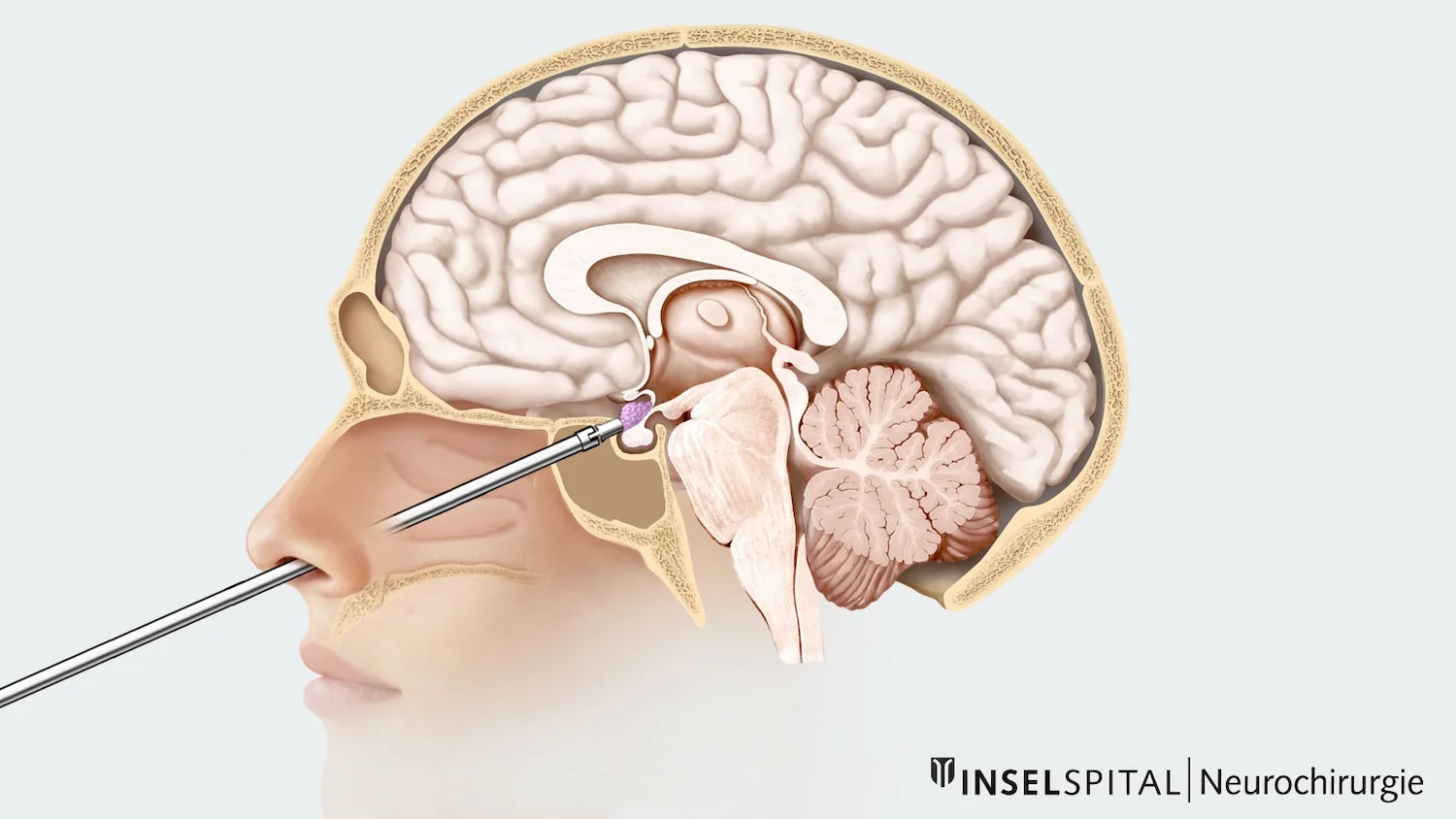
To visualize the procedure, you must imagine a profile section: the nose is at the front, the base of the skull just behind. In an endonasal endoscopic approach, surgeons insert a small camera and instruments through the nasal cavity, then reach the pituitary region through the sphenoid bone at the base of the skull. An image from the University Clinic for Neurosurgery, Inselspital Bern, explains the technique.
 © Universitätsklinik für Neurosurgery, Inselspital Bern
The interest, in certain well selected cases, is to reach tumors located in the center of the base of the skull without opening the skull from above. The Meyer neurosurgery department indicates that it performs endoscopic surgery of the basic skull with 2D and 3D transnasal access for certain skull base tumors.
This technique is not a universal solution. A systematic review published in the Journal of Neurosurgery: Pediatrics indicates that the endonasal approach has developed in children, but that comparisons with transcranial routes remain difficult, because the patients, tumors and available data are very heterogeneous.
The stakes remain high: if the pituitary gland, hypothalamus, optical pathways or certain vessels are affected by the disease or treatments, hormonal, visual, metabolic or neurological complications may occur. These files are therefore the responsibility of specialized teams, with prolonged follow-up. To complete this, our article on benign tumors of the pituitary gland also details the examinations and certain possible approaches.
According to Meyer Hospital, the child returned home a few days after the procedure and resumed his usual activities. This is encouraging news for his family. But this isolated case does not allow us to conclude that this path is suitable for all childrennor to prejudge long-term follow-up: it above all illustrates to what extent, near the pituitary gland, a few millimeters can guide an entire surgical strategy.